
AI for air traffic control won’t be like concerning advanced models, Transportation head says
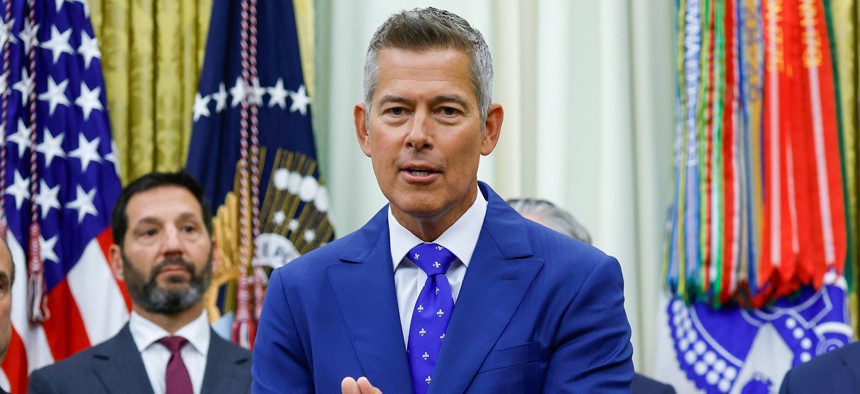
U.S. Transportation Secretary Sean Duffy speaks during a meeting with U.S. travel executives in the Oval Office of the White House on September 02, 2026 in Washington, DC. Kevin Dietsch/Getty Images





Transportation Secretary Sean Duffy drew a distinction between the advanced AI models that have raised alarms from some tech executives and the new capabilities being deployed to overhaul management of the nation’s airspace.
Artificial intelligence tools have a major role to play in ongoing efforts to modernize the nation’s outdated air traffic control systems, but those technologies will operate differently — and with vastly more human oversight — than the powerful models that have raised new safety concerns in recent weeks, the Transportation Department’s top official said on Tuesday evening.
Speaking at a dinner hosted by the National Artificial Intelligence Association, Transportation Secretary Sean Duffy discussed the role that AI is set to play in the Federal Aviation Administration’s ongoing push to overhaul management of the nation’s airspace.
Duffy first announced the Trump administration’s modernization initiative in May 2025 following several high-profile plane accidents, including a deadly crash between an Army Black Hawk helicopter and a commercial airliner near Ronald Reagan Washington National Airport that January.
While the project includes some brick-and-mortar improvements at U.S. airports, most of the initiative is focused on updating air traffic monitoring and communications systems — with AI set to play a key role in those efforts.
“We are building all new equipment — whether it's radar, radios [or] voice switches,” Duffy said, but he added that adoption of AI will be “a slow roll into the airspace.”
One specific airspace control area that Duffy said could be enhanced by AI use is weather management, since “we can figure out pathways to fly over weather and through weather, do it really safely, but have better information to make better decisions to bring more efficiency into the airspace, which means you're not delayed as much and we can deploy more aircraft into the airspace.”
But Duffy stressed that AI will only be used to augment the work of human air traffic controllers, and that their jobs will not be replaced by the emerging capabilities.
“It's all going to be driven, not by the most complicated AI, but AI that will provide information to them, and will, I think, have a huge impact on the flying public,” he said.
Duffy’s comments came in the wake of a series of warnings that high-profile tech leaders issued about the potential harms of advanced AI models. Those alarm bells reached a fever pitch earlier this month after Anthropic researcher and former OpenAI employee Jacob Coxon shared a viral post on X following his resignation that warned that leading AI firms were “racing straight to self-improving superintelligence and gambling with our lives.”
His post was soon followed by a 3,800-word essay from Anthropic CEO Dario Amodei that called for a global slowdown in advanced AI development, which also received similar support from leading tech executives like Elon Musk and OpenAI CEO Sam Altman.
Duffy alluded to those concerns, saying that "the conversation that's happening over the course of the last few days is different than the conversation [we’re having], because the tools are different that we use at DOT than the broader tools that are in the news over the weekend.”
Advances in technology, he added, are often fraught with inherent risks, but he said it’s important to consider the question: “How do we think through what's an acceptable risk?”
Striking the right balance — particularly when it comes to AI guardrails — is important, Duffy said, since “I need to make sure that I have regulations in place that keep people safe, but I also don't overregulate and I kill the small innovative companies, or the ones that are big enough they [leave] America and go somewhere else and take the technology, take the jobs with them.”
In response to tech leaders’ calls for a slowdown in AI development, President Donald Trump said in a Truth Social post on Monday that the country needs “strong and smart” guardrails. But he added that “the only reason the AI/Data Center outburst is happening is because the United States is leading, by a lot, every other country,” and said “Don’t kill the Golden Goose” when it comes to restrictions on development.
When asked about any further regulations or frameworks governing AI development, Duffy deferred to Congress and Trump’s leadership, but he noted that “rarely do we have people ask for regulation of us — that’s a new one for us, kind of.”