
Republican lawmakers ask GAO to review current AI regulatory landscape
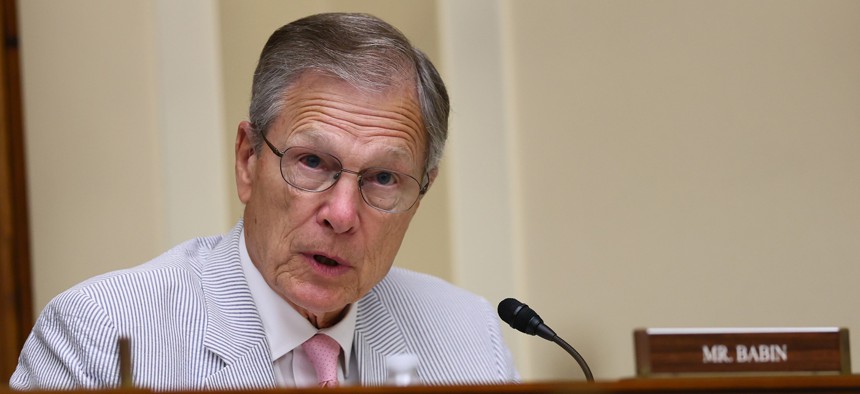
Chairman Rep. Brian Babin (R-TX) speaks during a House Science, Space, and Technology Committee hearing in the Rayburn House Office Building on July 16, 2025 in Washington, DC. Michael M. Santiago/Getty Images



Leaders in the House Science, Space, and Technology Committee have asked the Government Accountability Office to examine the regulatory landscape at both the state and federal level.
Lawmakers on the House Science, Space, and Technology Committee are asking the Government Accountability Office to conduct a “comprehensive review” of current federal and state laws regulating artificial intelligence to inform future legislative efforts.
Committee Chairman Brian Babin, R-Texas, and Research and Technology Subcommittee Chairman Jay Obernolte, R-Calif., sent the letter to Comptroller General Gene Dodaro on Wednesday.
The lawmakers cited policy actions like President Donald Trump’s executive order on AI signed during his first term in 2019 and an Office of Management and Budget memorandum from 2020 on agency rulemaking — along with recommendations from congressional AI working groups — as examples of the myriad AI requirements created within the federal bureaucracy.
“In recent years, a variety of federal and state legislation, executive orders, and other forms of guidance have established requirements for the development, deployment, and use of AI,” the letter said. “To address these critical questions and aid in the legislative process, we request that GAO examine the current laws and regulations governing AI at both the federal and state levels.”
Babin and Obernolte underscored the challenges associated with states creating new AI laws and regulations ahead of a unifying national framework. Absent the latter, the chairmen say the review will help Congress evaluate the precise regulatory landscape across the U.S. and where federal law can be applied.
“This review should cover laws and regulations that specifically pertain to AI, as well as existing laws and regulations that could be applied to AI,” the lawmakers wrote.
The second Trump administration has focused on addressing the patchwork of state-level regulations that could thwart progress in advancing the technical capabilities of AI, including issuing an executive order in December that instructed agencies to identify state AI regulations that it deemed “cumbersome” to innovation.
On the congressional level, Obernolte said earlier this month that the proposed AI moratorium that was removed from last year’s reconciliation bill — which would have prohibited states from enacting new AI laws for a decade so the federal government could advance sweeping legislation — was not intended to be a “long-term solution.”
Obernolte said that the administration’s current approach, designating subject matter areas where states can regulate AI, is the correct one to ensure the federal government can supersede certain laws.
“I hope that we don't have to do a moratorium. I hope that we can go straight to passing that framework,” he told Nextgov/FCW in early February.