
CMS saved $2 billion by using AI to fight fraud, official says
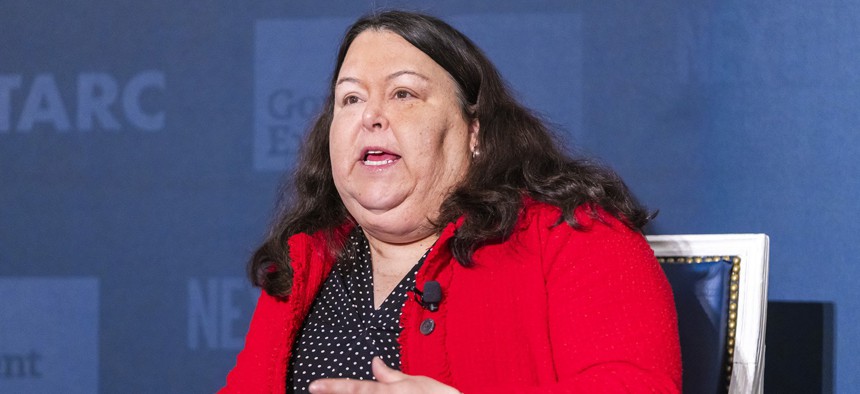
CMS Deputy Administrator and Chief Operating Officer Kim Brandt speaks during the Feb. 18 Fed Tech Priorities Summit. Zaid Hamid/Nextgov/FCW



Centers for Medicare and Medicaid Services COO Kim Brandt talked about her agency’s use cases for artificial intelligence in the ongoing battle against fraudulent medical claims.
The Centers for Medicare and Medicaid Services has been able to save billions of dollars in less than a year by applying artificial intelligence to tackle duplicative contracts and fraudulent claims, according to Kim Brandt, deputy administrator and chief operating officer at CMS, who spoke at the Nextgov/FCW Fed Tech Priorities summit on Feb. 18.
She described the AI system as “a Netflix-type algorithm” that can pinpoint bad actors by using existing information to label an applicant as potentially “high risk” when submitting claims. Brandt clarified that the AI does not allow CMS to prohibit applicants from entering CMS programs, but instead allows them to be placed on an internal watch list for ongoing monitoring.
“Within the first year [of using AI], to be able to get rid of 90% of some of these potentially bad actors, it's a huge thing for us,” Brandt said.
AI has been a welcome addition to the agency’s ongoing fight against fraud. Brandt briefly touched on the “fraud war room,” or the Fraud Detection Operations Center, which was recently established within CMS to conduct detailed claims analyses for anomalies that could indicate fraud. With the deployment of AI in these analyses, CMS was able to analyze claims as they came in, rather than after they’d been paid out.
“As a result of [AI], the team has been able to save $2 billion just since March of last year,” Brandt said. “Our hope is that … in this next year, as we implement that even more widely, it's going to be a huge saver for us.”
Contract duplication is also in the agency's crosshairs. With the use of an internal AI tool, CMS has been able to upload existing contracts and run a program to compare contract details and prevent duplication. Brandt said that the tool further offers cost estimates and what fixed time and material costs should look like.
“It really gives us the ability to use historical knowledge to be able to then make smart financial decisions about how we move forward on the contracts,” she said. “The team has only been using this for a few months now [and] it's already been extremely effective, they think it saved us maybe the better part of several hundred million already.”
Although Brandt said that AI stands to further help the agency in more ways, she isn’t ready to take the human out of the loop yet, asserting that there is “no replication for having that.”
“We're in the trust but verify stage,” she said. “We're using AI and really trying to optimize it however possible, but fact is, you still want to make sure that you’ve got a human. Even with our war room … we use the data analysis, but then we have humans double-checking it to make sure that it's all accurate.”