
AI moratorium was never a ‘long-term solution,’ lawmaker says
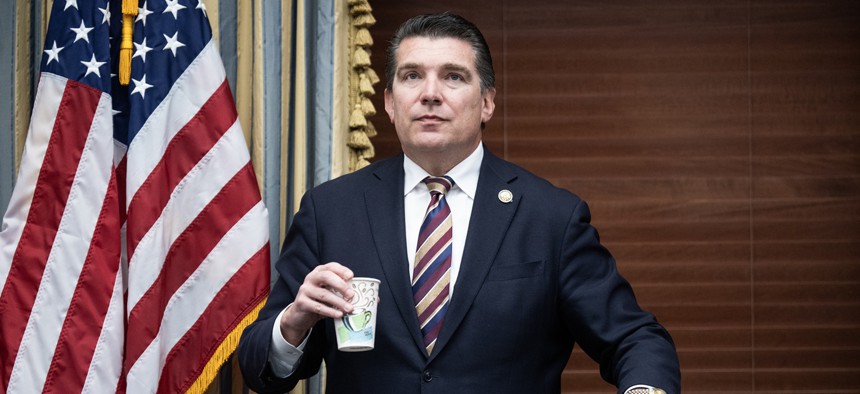
Chairman Jay Obernolte, R-Calif., arrives for the House Science, Space and Technology Subcommittee on Research and Technology hearing titled "Assessing America's AI Action Plan," in Rayburn building on Wednesday, January 14, 2026. Tom Williams/CQ-Roll Call, Inc via Getty Images



Rep. Jay Obernolte, R-Calif., explained that Congress is angling to design a nationwide AI framework that works with state law while offering common guardrails.
The 2025 artificial intelligence moratorium that failed to make it into last year’s budget reconciliation bill was “very misunderstood,” Rep. Jay Obernolte, R-Calif., said Thursday, emphasizing that the federal government still needs to “go first” in establishing an AI regulatory framework for the country.
Speaking at the Incompas Policy Summit, Obernolte advocated for a sector-specific approach to crafting AI regulation that hinges on the risks the technology poses.
The AI moratorium, he explained, was initially intended to be “a messaging amendment.”
“We never expected to even get it out of [the] Energy and Commerce [Committee],” Obernolte, who serves on the committee, said. “We thought that the conversation needed to be had. I was shocked when we got it out of [Energy and Commerce]. I was flabbergasted when it got off the floor of the House, and I wasn't surprised at all when the Senate stripped it out. But I think people took the wrong message away from it.”
He went on to explain that the moratorium provision was meant to help delineate where states have “lanes” in regulating AI and to highlight the need for an overarching national law to establish uniform guardrails.
“What we were saying was not that states shouldn't have a lane in the regulation of AI,” Obernolte said. “What we were saying is that the federal government needs to go first and define where the lanes are, what is preempted as interstate commerce, and where the states can then go innovate.”
The AI moratorium’s introduction and movement through Congress in 2025 fractured typical party lines: despite support from Republicans like Sen. Ted Cruz, R-Texas, and Rep. Rich McCormick, R-Ga., fellow conservatives like Sens. Marsha Blackburn, R-Tenn., and Josh Hawley, R-Mo., spoke out against the measure, citing state legislatures’ rights.
Opponents of the moratorium took issue with its carte blanche approach to delaying state regulations, particularly when Congress has yet to pass any comprehensive, nationwide regulation for the technology.
Speaking on the sidelines of the event with Nextgov/FCW, Obernolte said “the moratorium was never intended to be a long-term solution,” and that its goal was to underscore the need for the federal government to take the first steps to avoid a growing array of conflicting state laws.
He advocated for a solid framework that includes preemptive guardrails to clarify what arenas states can and cannot legislate in, noting that preemption and federal regulation need to come simultaneously.
“I hope that we don't have to do a moratorium. I hope that we can go straight to passing that framework,” Obernolte said. “We need to do both of those two things at the same time in the same piece of legislation.”
Obernolte further stated that he believes fellow GOP lawmakers and Democrats agree with his stance, but added that differences could potentially arise over which issues qualify for exemption from sweeping federal law.
The question of a decade-long moratorium for state AI legislation made its way to the White House when President Donald Trump signed an executive order in December that mandated evaluations of state laws to check which could be deemed onerous and overly burdensome on AI developers.
Exceptions to the preemption executive order were baked into its text. State and local laws related to child safety protections, AI compute and data center infrastructure, state government procurement of AI and other topics to be determined were said to be exempt.
Obernolte praised this action, particularly how it called for Congress and the administration to work together.
“The president went through in his executive order and actually said, ‘these are things I think the states should be regulating, not the federal government.’ I think that was very helpful, and I hope that that gives people some comfort that there are going to be state lanes for regulation,” Obernolte said.