
Senate Democrats decry Trump decision to allow advanced chip sales to China
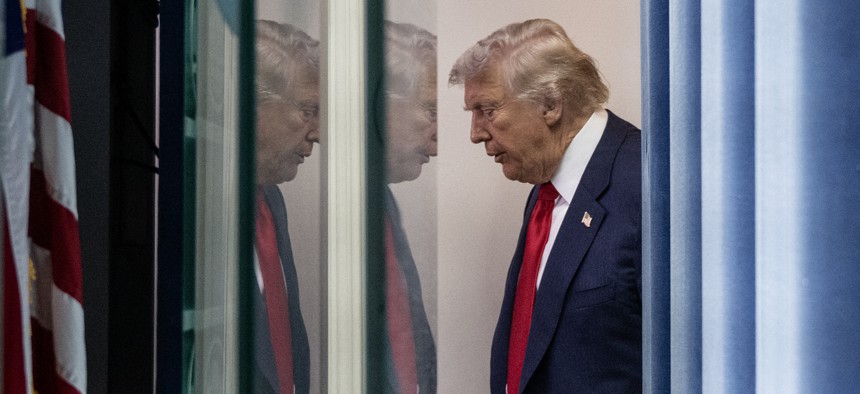
President Donald Trump arrives for a news conference to discuss crime in Washington, DC, in the Brady Press Briefing Room at the White House in Washington, DC, on August 11, 2025. Trump said that same day he had reached an agreement to allow NVIDIA and AMD chip sales to China for a fee. ANDREW CABALLERO-REYNOLDS/AFP via Getty Images





Upper chamber lawmakers want answers from the Trump administration on the 15% fee Trump said NVIDIA and AMD must pay to be able to sell their more advanced products to a major U.S. adversary.
In the midst of Congress’ ongoing recess, six Senate Democrats are asking President Donald Trump to reverse his recent decision to allow sales of advanced American-made supercomputing chips to China for a fee, citing national security concerns and harms to the U.S. in the race to artificial intelligence dominance. They also questioned the larger legality of the decision.
In an Aug. 15 letter signed by Sens. Chuck Schumer, D-N.Y.; Mark Warner, D-Va.; Jack Reed, D-R.I.; Jeanne Shaheen, D-N.H.; Christopher Coons, D-Del.; and Elizabeth Warren, D-Mass., lawmakers cited an Aug. 11 statement Trump made that he and chipmakers NVIDIA and AMD had “negotiate[d] a little deal” to allow the sale of their advanced chips to China for a 15% fee.
Specifically, lawmakers wanted to know which entities or parties were included in the negotiation that gave 15% of chip sales to China to the U.S. government, despite an earlier ban on NVIDIA’s H20 and AMD’s MI308 chips. They are also seeking answers about how that 15% fee will be assessed, by whom and where the collected funds will go, in addition to whether any other companies may be considered for a similar arrangement.
“A cornerstone of U.S. artificial intelligence strategy for years has been to protect America’s advantage in AI computing capability and access to leading-edge hardware, compared to the PRC and other key adversaries,” the letter said. “Our national security and military readiness relies upon American innovators inventing and producing the best technology in the world, and in maintaining that qualitative advantage in sensitive domains.”
The Trump administration is working to strike the balance between protecting a competitive advantage for American companies and their advanced chip technology, while also ensuring the world is running on the U.S. AI technology stack to promote both the U.S. technological market and ethics.
This posture has drawn criticism from House lawmakers as well, who have underscored the same national security issues that could arise if Chinese systems advance thanks to American technology.
“The willingness displayed in this arrangement to ‘negotiate’ away America’s competitive edge that is key to our national security in exchange for what is, in effect, a commission on a sale of AI-enabling technology to our main global competitor, is cause for serious alarm,” the senators wrote.
The lawmakers also questioned the legality of the deal, noting that U.S. code states that “[n]o fee may be charged in connection with the submission, processing, or consideration of any application for a license or other authorization or other request.”
The senators asked the administration to respond to their letter by August 22.