
House BIOTech caucus is weighing IP security and AI-enabled biotech policy
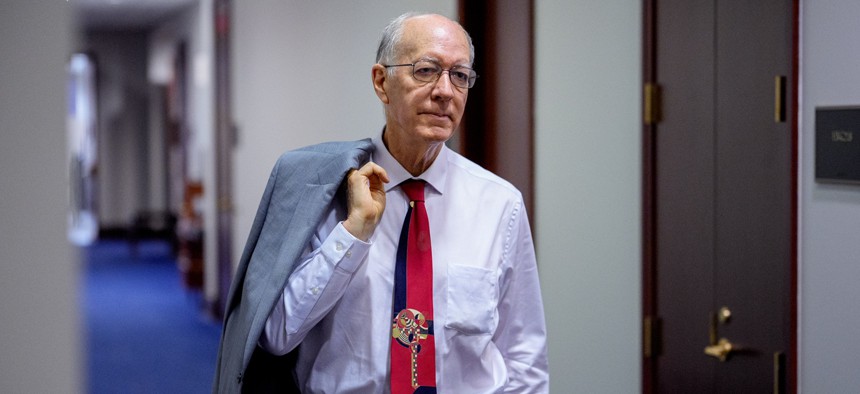
Rep. Bill Foster (D-IL) arrives for a Democratic caucus meeting on Capitol Hill on September 1, 2026 in Washington, DC. Andrew Harnik/Getty Images





Lawmakers on the caucus say they won’t push any new legislation forward before the end of the year, but they spotlit intellectual property protection and AI-enabled gene synthesis as concerns.
The bipartisan House BIOTech Caucus is not slated to put any new legislation forward before the end of the year, saying that the bipartisan group is still holding “a lot of hearings" and “developing ideas” about regulatory approaches to the biotechnology industry.
Reps. Bill Foster, D-Ill., and Pete Sessions, R-Texas, who are members of the caucus, spoke on Wednesday during the Identity Week America conference in Washington, D.C., about the need for digital identity verification as a means to prevent abuse of biometric technologies embedded in daily systems.
Sessions, who serves as one of the vice chairs of the caucus, said the biggest challenge the group is examining is protecting U.S. intellectual property.
“Our biggest issues are dealing with bringing to bear our ability to keep our secrets secret, to keep intellectual property in the United States, to avoid it from going overseas,” Sessions said.
Foster voiced concerns regarding artificial intelligence-enabled biotechnology and its capability to develop novel and dangerous viral pathogens.
“It’s an area where actually I hope that we can get all countries of the world — not just all the free democracies — together, because if this gets used, this technology to synthesize genes, it gets used for the detriment of mankind, possibly with the assistance of AI,” Foster said.
Foster said he saw digital identity verification as a solution to biotechnology security, since having a digital ID to grant biotechnology access to select users would be “crucial” to safeguarding critical but dangerous scientific processes like gene synthesis that are poised to accelerate with the help of AI.
The research area of biotechnology, particularly enabled by AI, has become a topic of policy discussion across both the legislative and executive branches. While lawmakers in the Senate introduced the Biosecurity Modernization and Innovation Act to target the misuse of gene synthesis technology in particular, the White House is also investigating advancements in the intersection of biotechnology and AI.
In July, the White House Office of Science and Technology Policy said it will establish a new oversight body to better understand how biotechnology is evolving alongside AI.
Beyond the public sector, leading AI developers issued an open letter asking policymakers for support in advancing mandatory documentation in nucleic acid synthesis screening to ensure transparency in gene synthesis processes.