
House passes 3-year FISA 702 extension
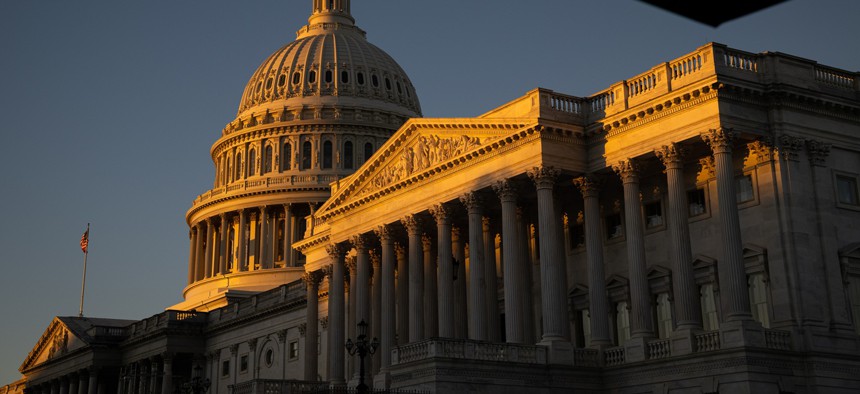
Bloomberg Creative/Getty Images






The bill now moves to the Senate, where it could face obstacles in clearing reauthorization because of a measure that bars the Federal Reserve from issuing digital currency.
The House passed a bill extending authorization for a contentious foreign spying power for three years, after weeks of GOP disputes initially forced Congress to issue a much shorter extension earlier this month to keep the law afloat.
The statute, Section 702 of the Foreign Intelligence Surveillance Act, lets spy agencies warrantlessly collect communications of foreign targets abroad, but it can sweep in Americans’ texts, emails and phone calls when they communicate with targets, raising Fourth Amendment concerns from privacy advocates.
Lawmakers voted 235-191 to extend the authority without a key measure that would require agencies like the FBI and NSA to obtain a warrant before querying U.S. person data collected under 702.
But with the reauthorization bill also came an attached central bank digital currency ban that prohibits the Federal Reserve from developing or issuing a direct-to-consumer digital dollar. A tranche of conservatives have been pushing for such a law for months, arguing a CBDC would permit government surveillance of consumer transactions and infringe upon financial privacy.
Senate Majority Leader John Thune of South Dakota said earlier this week that such a ban is “not happening” in tandem with the FISA 702 renewal. If the Senate rejects the measure, it could send its own version back to the House for a Thursday vote. But the surveillance authority expires after Thursday, leaving little time remaining for further negotiations.
Added provisions in the passed measure include new civil liberties reviews of FBI searches involving Americans, criminal penalties for improper queries, attorney-level approval requirements, expanded congressional access to the intelligence court that oversees the law and a mandated government audit of surveillance targeting procedures.
But those new add-ins are not satisfying civil liberties advocates.
“It’s incredibly disappointing the House approved this measure. This bill is empty-calories through and through. It contains no warrant for querying Americans’ messages, and no meaningful reforms of any kind,” Jake Laperruque, the deputy director of the Center for Democracy and Technology’s Security and Surveillance Project, said after the vote.
“A vote for this bill was a vote to give the FBI and other intelligence agencies a three-year blank check for surveillance abuse,” he added. “We hope senators will stand strong and reject this dangerous proposal.”
“The bill in question contains no meaningful reforms to the 702 program — no probable cause-based warrant requirement to search the digital archive of Americans’ communications swept up under the program and no outside (i.e., non-executive branch) oversight of the program,” said Patrick Eddington, a senior fellow at the Cato Institute who has advocated for abolishing 702 in its current form.
Current and former officials have regularly advocated for clean reauthorizations of the spying power, arguing that it aids in timely national security investigations and stops myriad threats targeting U.S. interests.
“I do a lot of thinking now of my previous life. And the one thing I would tell you is that any time that there was some type of disturbance in the world — whether or not that had to do with counterterrorism, whether or not that had to do with Americans at risk — the first authority that I would go to is 702,” retired Gen. Paul Nakasone, who led the NSA and U.S. Cyber Command, told reporters at a national security event in Nashville last week.
“The importance of the FISA 702 authority to U.S. national security cannot be overstated. It has prevented countless terrorist plots, thwarted cyber-attacks, and allowed for the successful seizure of significant amounts of fentanyl, at the bare minimum,” said Republican Rep. Rick Crawford of Arkansas, who chairs the House Intelligence Committee.
“While no one in Washington can get 100% of what they want all the time, this bill makes measurable reforms to strengthen oversight and accountability, while maintaining the criticality of this national security tool,” he added.
The White House has been advocating for a clean extension of the law.
In March, the Trump administration notified Congress that the Foreign Intelligence Surveillance Court renewed certifications for the surveillance program, letting it operate for another year even amid its potential expiration.
But the split between the court’s recertification process and Capitol Hill’s role in extending Section 702 can create uncertainty for companies required to comply. While the court approves how the program operates, only Congress can authorize it to continue, raising questions about whether firms would still be obligated to provide data if the law lapses.
Over the last few months, the FISA fight has been shaped by rising unease over privacy and government power, with Democrats and advocacy groups questioning how Americans’ communications are handled and processed once collected.
Those concerns have intersected with broader debates over domestic surveillance, immigration enforcement and the potential for advanced artificial intelligence tools to amplify the government’s ability to analyze sensitive personal data.
“This program is rightly controversial, and it is a shame that my Republican colleagues did not use this process to debate thoughtful and bipartisan reforms to further safeguard Americans’ privacy without hamstringing our intelligence agencies’ ability to keep our country and our constituents safe,” Democrat Jim Himes of Connecticut, the ranking member of the House Intelligence panel, said after the bill passed.
“That said, I cannot in good conscience allow this program to expire and once again leave Americans vulnerable to national security threats like the terrorist attack that took the lives of 161 precious residents of Connecticut on September 11, 25 years ago,” he added. “I hope that the House and Senate will now work together to pass a bipartisan FISA reform and reauthorization bill that can be quickly signed into law, and I remain committed to working closely with my colleagues to ensure rigorous oversight that does not allow for the possibility of abuse by this administration.”