
As Trump administration cries ‘fraud,’ experts worry it does more harm than good
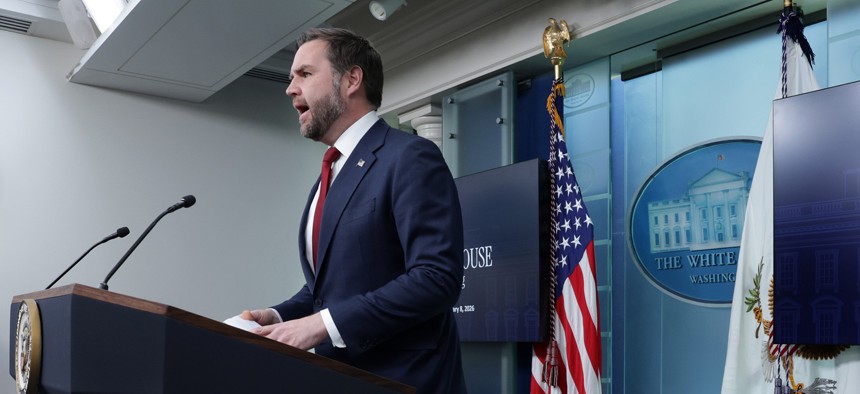
Vice President JD Vance speaks during a news briefing in the James S. Brady Press Briefing Room of the White House on January 08, 2026 to address several topics including the welfare fraud scandal in Minnesota. Alex Wong/Getty Images


 By
Natalie Alms
By
Natalie Alms
“It’s dismaying,” one longtime anti-fraud expert told Nextgov/FCW of how the administration is using fraud as rationale but firing the watchdogs that are tasked with finding it.
Combating fraud in government programs has been a talking point for the White House since the start of the second Trump administration, most recently with a focus on an ongoing social services fraud scandal in Minnesota.
But experts say that the administration is making the problem worse, not better, by making false claims, dismantling the government’s watchdogs, using fraud as a pretext for political goals and more.
'The specter of a politicized inspector general community'
Days after taking office in 2025, Trump broke norms — and law, according to a federal judge — by dismissing nearly 20 inspectors general, whose very jobs are to combat waste, fraud and abuse in the government.
“President Trump's firing of IGs and removal of acting IGs, and then the subsequent appointment of some very political folks as IGs … does raise the specter of a politicized inspector general community,” one of those fired watchdogs, Mark Lee Greenblatt, told Nextgov/FCW.
“That is a major concern,” said Greenblatt, who was the Interior Department’s inspector general until Trump dismissed him days after taking office.
The risk in firing IGs and appointing new ones at the start of a new administration is that these apolitical, independent organizations may favor one administration or another, or pursue partisan attacks, he said.
That’s a worry shared by Max Stier, the president and CEO of the nonpartisan Partnership for Public Service, who recently told reporters that he’s worried the administration’s “hunt for waste” will become a “mechanism to pursue enemies.”
“This administration utilizes the clothing of good government without the substance of it,” he said. “Firing [these inspectors general] for no good reason was the clearest sign that, in fact, waste is not their goal here. Control is their goal. Their choices have been entirely designed to maximize their ability to remove anybody that will get in their way of doing what they want, irrespective of the legality or the constitutionality of their action.”
Concerns of 'co-opting' fraud prevention
The administration’s creation of a new fraud-focused associate deputy attorney general has also sparked concerns about politicized investigations.
Beyond removing watchdogs, Trump’s White House has also cited fraud for a variety of its most controversial actions.
The administration has been “co-opting” the word fraud, said Linda Miller, an anti-fraud expert who worked at the Government Accountability Office — Congress’s oversight arm — for a decade.
“It’s dismaying, to put it mildly,” she said.
The Trump administration pointed to fraud as rationale for shutting down the U.S. Agency for International Development last year, for example. Many of those claims were false or misleading, Snopes assessed.
“It’s not fraud if you don’t agree with how the administration before you spent money,” said Miller. “That’s just a difference of agreement on policy priorities.”
This month, Homeland Security Secretary Kristi Noem cited an ongoing welfare fraud scandal in Minnesota as a reason to send more federal agencies to Minneapolis to support the work of Immigration and Customs Enforcement agents.
The same day that federal agents fatally shot Veterans Affairs ICU nurse Alex Pretti in Minneapolis, President Donald Trump accused Minnesota Governor Tim Walz and other politicians in the state of “inciting Insurrection” as a “COVER UP” for fraud.
Minnesota is in the midst of uncovering a real fraud problem in its social services. Federal prosecutors have estimated that the total fraud could be as much as $9 billion, although Walz has disputed that number.
But the Trump administration has also latched onto misleading claims of fraud in child daycare centers after Nick Shirley, a 23-year-old YouTuber, claimed to find extensive fraud in child care centers in Minnesota. He alleged that they were receiving funds but not providing any services. The state has since sent investigators to do on-site compliance checks at the centers and confirmed that they were all operating normally.
Miller’s frustration comes in part because the government does have actual problems with fraud. GAO estimated in 2024 that the federal government loses roughly $233 billion to $521 billion every year.
The biggest perpetrators of large-scale fraud against the government are organized crime rings and businesses, not individuals getting benefits that misrepresent their eligibility, said Miller.
“It's kind of curious how the administration seems not to be paying much, if any attention to organized threats coming from adversarial nations like Russia,” she said. “But then they also don't seem too concerned about corruption since they rolled back the enforcement of the Foreign Corrupt Practices Act.”
The claims of daycare fraud in Minnesota aren’t the only misleading or false claims of fraud made by the administration.
The Trump administration continues to pursue claims of widespread fraud in the 2020 election that have been repeatedly debunked. This week, FBI agents searched a Georgia election center for ballots and other records from the 2020 election. The Department of Homeland Security has been building a citizenship database to check voter rolls, too — a move experts say could disenfranchise legitimate voters.
Trump officials including Vice President JD Vance claimed last year that 40% of calls to the Social Security Administration were fraudulent.
But anti-fraud checks found only 2 calls out of over 110,000 to potentially be fraudulent after they were installed in response to concerns from the Department of Government Efficiency.
“Ultimately, those sorts of inconsistent messages or outright incorrect information undermine the American public's confidence in the government's information,” said Greenblatt. “That's to our collective detriment.”
Fraud still remains a problem
The White House disputed those experts' concerns about its anti-fraud efforts.
“President Trump pledged to cut the waste, fraud, and abuse in our bloated government, and the Administration is committed to continue delivering on this pledge,” White House spokesman Davis Ingle told Nextgov/FCW in a statement. “In only a year, he has already made significant progress in making the federal government more efficient to better serve the American taxpayer.”
Dylan Hedtler-Gaudette, the acting vice president of policy and government affairs at the Project on Government Oversight, or POGO, told Nextgov/FCW that he was initially hopeful that DOGE could break things that “ought to be broken.”
“But it turns out, they didn't really care about efficiency, effectiveness or waste, fraud [and] abuse,” he said. “They were just using the window dressing of that, the rhetorical justification of waste, fraud, abuse, effectiveness, efficiency, to execute a political agenda.”
Trump has done some helpful things for those in the anti-fraud space, said Miller, namely signing an executive order to help agencies share data for fraud prevention, which has long been a sore spot for watchdogs.
But she added that the Trump administration’s work has largely been more hurtful than helpful in terms of fraud, and muddling what fraud is risks turning people off of combatting the actual fraud problems.
“I've been hearing that a lot lately, like ‘They say fraud is a problem. Fraud is not a problem. They're just using it as a ruse,’” Miller said. “Both things are true — fraud is a problem, and they're using it as a ruse.”
Jordan Burris, who worked on technology in the Office of Management and Budget during the Trump and Biden administrations and now works at digital identity company Socure, told Nextgov/FCW that distractions have made it more difficult for those in the anti-fraud space.
“There have been distractions associated with the politicization of fraud that has made it harder to actually execute on that mission, and further have taken us away from what needs to be done in this moment to combat what we are seeing from nation states and other criminal organizations,” he said, advocating instead for using data science at scale to identify payments that shouldn’t have been made and installing preventative measures to stop money from going to bad actors in the first place.
In early January, the Trump administration froze $10 billion in funding for child care subsidies, social services and cash support for low-income families in California, Colorado, Illinois, Minnesota and New York in the name of fraud prevention, a move that a judge has already blocked with a temporary restraining order. The press release announcing the freeze did not cite any specific instances of ongoing fraud in those states, beyond “identified concerns.”
Democrats have called the administration's withholding of funds retaliation. Hedtler-Gaudette said that the administration is weaponizing fraud by going after it selectively. The freeze is the latest example of the Trump administration withholding funding from Democratic-run parts of the country.
“A huge number of people are being denied supports they are legally entitled to,” said Don Moynihan, a professor of public policy at the University of Michigan. “Fraud has consistently been an excuse to go after safety net programs.”
Previous administrations may also have politicized fraud issues — think of the “welfare queen” narrative — said Miller, adding that what’s happening now is different in magnitude and scope.
She previously ran a consulting group to help the government implement a fraud risk management framework developed by GAO. That work has stopped, though, and the company doesn’t exist anymore, after they lost their government contracts.
“All the work we were doing in the fraud space — we’re not doing it anymore,” said Miller. “And in many cases, the clients that we were working with, are also no longer doing any fraud risk management work.”
If you have a tip you'd like to share, Natalie Alms can be securely contacted at nalms.41 on Signal.
NEXT STORY: Shutdown deal struck after failed Senate vote