
Trump’s intelligence pick pressed on 2020 election, defends handling of New York Times subpoenas
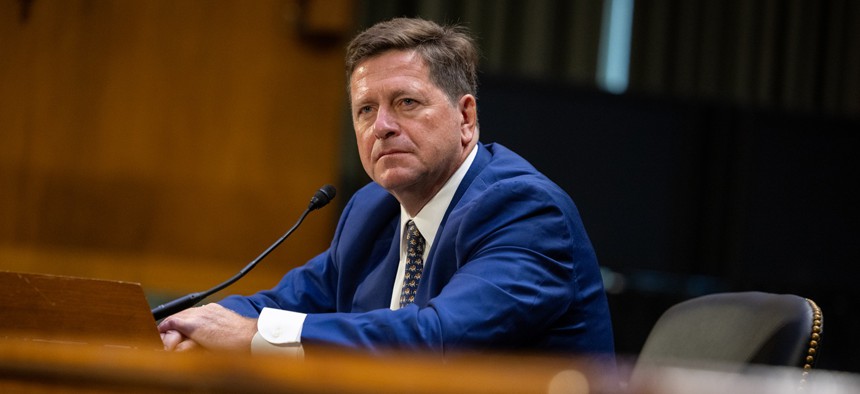
United States attorney for the Southern District of New York Jay Clayton, nominee to be Director of National Intelligence, testifies during his confirmation hearing with the Senate Committee on Intelligence at the Dirksen Senate Office Building in Washington, DC, United States, on July 15, 2026. Nathan Posner/Anadolu via Getty Images






Jay Clayton faced Democratic criticism after repeatedly declining to say Joe Biden won in 2020 and standing by subpoenas issued by his Manhattan prosecutor’s office to four New York Times journalists.
President Donald Trump’s nominee for director of national intelligence faced pointed pushback from Senate Democrats Wednesday over his answers about the 2020 election results and broader election security concerns ahead of this year’s midterms.
Jay Clayton, who currently serves as U.S. attorney for the Southern District of New York, told lawmakers on the Senate Intelligence Committee that former president Joe Biden was “certified” president in 2020 after the election commenced, but would not outright say Biden won when asked multiple times.
“I’m not an election denier,” Clayton contended in the hearing. But the answer was not satisfactory for multiple senators who got into back-and-forths with Clayton over his responses.
“You refuse to answer a basic question about who won a presidential election, but you ask to lead America’s intelligence community?” said Sen. Jon Ossoff, D-Ga. “Isn’t it humiliating to be unable to answer this question, to have to indulge the president’s delusions? We know, you know, everybody in this room knows the truthful answer to that question. Why can you not give it?”
Election security has become a flashpoint at the Office of the Director of National Intelligence as the agency has grown involved in Trump’s effort to revisit the 2020 election. Former DNI Tulsi Gabbard appeared at a February FBI search of a Georgia election facility and oversaw a review of Puerto Rico voting machines, while Trump more recently authorized acting DNI Bill Pulte to declassify 2020 election records.
The activity has fueled concerns that ODNI, which manages America’s intelligence apparatus that is meant to predominantly track and counter overseas threats, is being drawn further into Trump’s election claims. On Thursday night, the president is expected to unveil what the administration says is evidence of foreign interference in the 2020 election and vulnerabilities in voting machines.
Throughout his testimony, Clayton asserted the job of ODNI is to focus on foreign intelligence threats and not domestic matters.
Days before his June 11 nomination, Clayton spoke on CNBC and appeared to criticize the nation’s election administration processes.
“On the [election] integrity side, we are doing an absolutely terrible job, and the American people are right to question it. How come we can have an audit trail in every other aspect of our lives that’s important?” he said at the time.
Sen. Angus King, I-Maine, questioned why Clayton opined on those matters.
“For the record, I wish you would share any evidence you have that asserts that there was any problem of voter fraud significant enough to change the results of an election in this country,” King said.
Asked by King whether there is a voter fraud problem in the nation, Clayton said, “I don’t think we can say definitively whether there is or is not until we have better processes.”
On cybersecurity, he said that the topic was a top-of-mind issue for him, especially on election influence matters. He said he would commit to assessing whether ODNI’s cyber and foreign influence components — which were downsized under Gabbard — should be resourced again.
In his current position, Clayton oversees one of the nation’s most prominent prosecutorial offices. He previously chaired the Securities and Exchange Commission during Trump’s first term, and he spent more than two decades at law firm Sullivan & Cromwell, focusing on corporate transactions and capital markets.
Clayton argued that he worked closely with intelligence and law enforcement on terrorism, espionage, cyber threats and illicit finance cases during that work history. He has no prior experience working inside the intelligence community. Clayton’s office is notably prosecuting deposed Venezuelan leader Nicolás Maduro and his wife on narcoterrorism, drug-trafficking and weapons charges following their capture by U.S. forces in January.
If confirmed, he would inherit an intelligence office already undergoing significant workforce changes. Pulte, a major Trump ally who led the administration’s controversial mortgage fraud investigations last year, has initiated multiple rounds of personnel cuts and received broad permission from Trump to declassify records, prompting concerns from former officials about the exposure of sensitive intelligence capabilities.
Clayton was also questioned during the hearing about his office issuing subpoenas last Friday seeking grand jury testimony from four New York Times journalists who reported that Trump returned from a NATO summit aboard an older Air Force One after security officials raised concerns about the Qatari-gifted aircraft that was meant to replace it. The Times reported that the newer plane lacked some of the prior aircraft’s advanced security features, including antimissile capabilities. Some subpoenas were delivered to the journalists’ homes.
Sen. Ron Wyden, D-Ore., criticized the subpoenas as an attack on press freedom and the First Amendment.
Sen. Kirsten Gillibrand, D-N.Y., also questioned how quickly they were issued, arguing that Clayton’s explanation was difficult to reconcile with the fact that security concerns about the Qatari-donated plane had been known for months.
Clayton defended his handling of the matter, saying he was “comfortable” with the process. He declined to discuss specific details because the investigation into the disclosure of classified information remains ongoing, but said he consulted other lawyers before issuing the subpoenas and respects the First Amendment and the press’s role.
“I’m not going to get into the details. But what I can tell you is that we followed the procedures,” he said.
Trump nominated Clayton last month after his decision to install Pulte as acting intelligence chief drew resistance from Democrats and some Republicans. Clayton’s first scheduled hearing was abruptly postponed after Trump said the Senate should first approve his chosen replacement at the U.S. Attorney’s Office in Manhattan and demanded action on unrelated election legislation.
Sen. Mark Warner, D-Va., the vice chairman of the intelligence panel, told reporters after the hearing that he was disappointed in Clayton’s responses and has “a lot to think about.” The senator previously noted that he has known Clayton for many years and believes “he is a capable public servant.”
“I was very disappointed with a number of Mr. Clayton’s answers. It’s not in many ways reflective of the person that I’ve worked with over the years,” Warner said. “I worry that there seems to be this criteria that this administration is putting out, about no one who’s put up for any position can tell the truth about the 2020 election. That’s deeply unsettling.”