
Mullin’s appointment to lead DHS raises questions about future of CISA
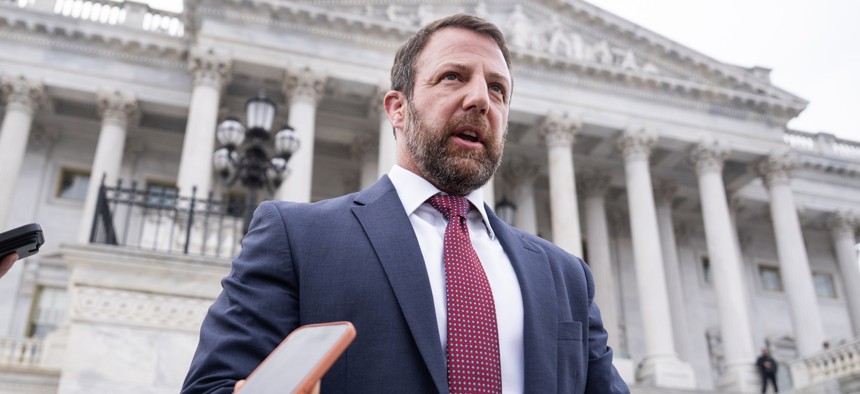
Sen. Markwayne Mullin, R-Okla., talks with reporter outside the U.S. Capitol after President Donald Trump selected him to be Department of Homeland Security secretary to replace Kristi Noem on Thursday, March 5, 2026. Tom Williams/CQ-Roll Call, Inc via Getty Images





Following months of turmoil, Kristi Noem’s exit leaves uncertainty around DHS’s cyber mission, after CISA faced hefty workforce cuts and still contends with a leadership vacuum.
The Trump administration’s decision to tap Oklahoma Republican Sen. Markwayne Mullin to lead the Department of Homeland Security is drawing mixed reactions inside the department and its Cybersecurity and Infrastructure Security Agency, which employees say has struggled to regain its footing after months of staffing cuts and leadership turmoil.
Trump immediately tapped Mullin after firing Kristi Noem from her post on Thursday. It followed two days of congressional testimony, during which she faced tough questions from both parties on fatal shootings by DHS employees, aggressive immigration tactics and excessive spending on an ad contract that featured her.
In Noem’s tenure as DHS secretary, CISA has seen roughly a third of its workforce reduced while navigating leadership shakeups and the effects of a recent shutdown at its parent department that has further strained the agency’s operations.
Amid all of that, CISA’s leadership structure has remained unsettled, and the agency has not had a permanent Senate-confirmed leader in place since President Donald Trump returned to office.
Mullin has worked on a handful of cybersecurity items in Congress, though not as many as some of his peers.
Among his current panel assignments, Mullin sits on three of the upper chamber’s Armed Services subcommittees, including its subcommittee on emerging threats, which focuses on policies related to special operations, intelligence and information operations. Last year, he worked on one bipartisan bill focused on boosting the cyber posture of the 988 suicide prevention and crisis lifeline. He also led a measure focused on improving congressional cyber and IT infrastructure.
Some DHS employees appear relieved at Mullin’s appointment.
“There seem to be positive reflections coming from folks that have worked with [Mullin], and the legislative branch seems to be reacting positively to the news,” said one current DHS official who, like others for this story, spoke on the condition of anonymity because they weren’t authorized to speak publicly and for fear of retribution.
“If we’ve got somebody who can refocus the model inside of DHS on what we are doing for the American people … I think that’s going to be a breath of fresh air,” the official added.
A current CISA employee said they are “looking forward to fresh leadership with a bigger focus on cybersecurity issues.”
Others have a more negative outlook.
“We’re going from one person who didn’t care about cyber to someone who cares about it even less, if that’s possible,” a former CISA official told Nextgov/FCW, referring to Mullin’s relative lack of work in cyber policymaking.
The DHS leader’s cyber chops are considered especially relevant given the ongoing U.S.-Israel war against Iran and with cyber observers on the lookout for signs of Tehran-linked hacking attempts.
“It’s really frustrating that during active military operations that raise the risk to our critical infrastructure significantly, the administration can't find anyone who’s at least remotely qualified to do this job,” added the former official.
Several others are taking a “wait and see” viewpoint.
“The few water cooler chats I’ve had with folks — no one has heard of him, period. So no one has an idea of how it’ll impact CISA,” a second current CISA employee said.
Nextgov/FCW has asked Mullin’s office for comment. As a nominated official, he will have to be confirmed in a Senate vote. The Trump administration “will work to confirm him as quickly as possible,” a White House official said.
The senator is known for his combative style on Capitol Hill and an unconventional resume that includes running a plumbing business and briefly competing as a mixed martial arts fighter before entering politics.
If confirmed, he would oversee CISA’s leadership, in addition to larger DHS operations. This week, the nominee for CISA director, Sean Plankey, left his advisory role with the U.S. Coast Guard, which he said was done to address concerns tied to a Senate hold on his confirmation, Nextgov/FCW first reported.
The Plankey move comes just after a notable leadership shakeup at the cyber agency, in which former CISA acting director Madhu Gottumukkala departed following tensions described in a series of media reports. The circumstances surrounding those reports, the reasons behind several other leadership departures and various other developments have fueled a swirl of speculation and competing narratives that have made it difficult for observers to determine what is actually happening inside the agency.
“I hope they get CISA sorted out. We need a confirmed director to set the specific agency plans and operationalize them,” said a third CISA employee. “And without the strategies, we are stuck in a maintenance mode of only working on what is required by law and regulation. What this also means is that many of us don’t have the other half of our jobs to do.”
A thorough statement issued Thursday by DHS defended Noem’s work and said, under her watch, CISA published some 1,600 products, stopped 2.6 billion malicious connections on federal networks and led around 150 cyber and physical security exercises with stakeholders.
Mullin’s nomination comes amid an ongoing DHS shutdown that has further diminished the number of employees at CISA coming into work.
The shutdown followed the fatal shootings of two Americans — Renee Good and Alex Pretti — by immigration agents in Minneapolis in January, which fueled national protests and hardened a congressional standoff over immigration enforcement reforms and DHS funding.
Government Executive Senior Correspondent Eric Katz contributed to this report.
NEXT STORY: DOD names James “Aaron” Bishop to serve as CISO