
Experts see NSA nominee’s Pacific experience as a boost to US cyber posture on China
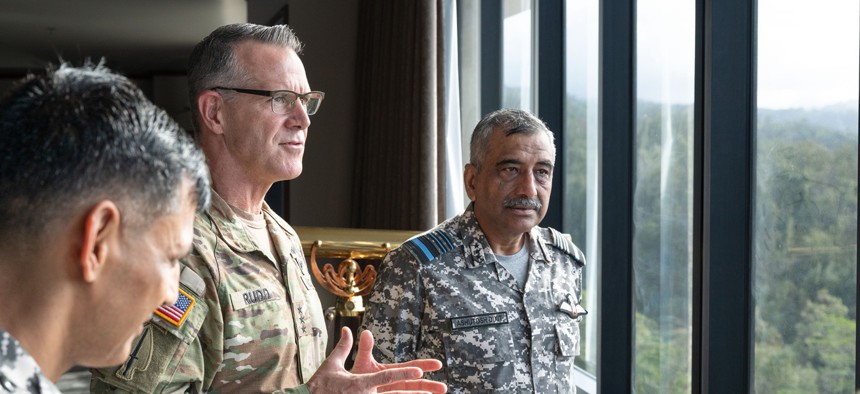
U.S. Indo-Pacific Command Deputy Commander Lt. Gen. Joshua M. Rudd and India Chief of Integrated Defence Staff Air Marshal Ashutosh Dixit co-chaired the 22nd Military Cooperation Group at USINDOPACOM headquarters in Honolulu, Nov. 3-4, 2025. Staff Sgt. Angel Heraldez/U.S. Army





Lt. Gen. Joshua Rudd currently serves as deputy commander of Indo-Pacific Command.
President Donald Trump’s nominee to lead the NSA and U.S. Cyber Command comes from a less traditional background than past military leaders who have held the dual-hatted role, though former officials and China experts say his experience operating in the Indo-Pacific can benefit U.S. cyber operations focused on Beijing.
Army Lt. Gen. Joshua Rudd was nominated last month to lead the foreign eavesdropping giant and digital combatant command. He is currently deputy commander of Indo-Pacific Command, and is scheduled to testify before the Senate Armed Services Committee on Thursday morning.
Rudd’s official biography shows a career spent largely in special operations and joint command roles, including past senior positions at U.S. Indo-Pacific Command. The geographic region of INDOPACOM includes China, as well as major U.S. allies like Japan and Australia.
Despite not having direct cybersecurity or signals intelligence experience, Rudd has almost certainly consumed China-linked cyber intelligence produced by the NSA, said retired Lt. Gen. Charlie “Tuna” Moore, a former deputy commander at U.S. Cyber Command, who is now a distinguished visiting professor at Vanderbilt University’s Institute of National Security.
“While at INDOPACOM, [Rudd] got to clearly see that adversaries like China target civilian infrastructure precisely because it supports military operations, from ports and power to communications and transportation,” he said. “I’m confident [Rudd] has a good sense of China’s cyber capabilities and intentions as well as their cyber weaknesses.”
In mid-2024, investigators uncovered sweeping Chinese intrusions into telecom firms in the U.S. and around the world. During their hacking campaign, the cyberspies accessed “lawful intercept” systems that allow the FBI to obtain targets’ communications with a court warrant.
The U.S. is also tracking another China-tied hacking collective that has burrowed into troves of non-military critical infrastructure. Analysts assess that Beijing intends to sabotage those systems in the event the U.S. military needs to quickly mobilize, especially if it becomes involved in a Chinese invasion of Taiwan.
Chinese hackers have also put legislative affairs systems in their crosshairs over the last year, and they recently sought access to the email inboxes of staff working in multiple House of Representatives committees.
“China is actively trying to get into our civilian water treatment facilities, power plants, transportation systems, network providers, hospitals — you name it,” said Kirsten Asdal, a former Defense Department intelligence adviser who now heads China-focused consultancy firm Asdal Advisory.
“Understanding China’s capabilities and intent against us is key to defending effectively against them in cyberspace,” she added. Rudd’s experience with China through his service in Indo-Pacific Command “is certainly advantageous, to have spent time analyzing the adversary’s strategic behavior and operating patterns.”
In response to the repeated Chinese intrusions, Trump officials and allies have frequently discussed the need for a more forceful, offensive approach to U.S. cyber operations. Rudd “has the opportunity to integrate cyber offensive capabilities even deeper into the Pentagon’s most important war plans,” said Dmitri Alperovich, chairman of the Silverado Policy Accelerator, a national security think tank.
“Given the increasingly dire state of the geopolitical confrontation with China, the Indo-Pacific domain is now one of the most important theaters for the US military,” he added. “Aligning cyber and kinetic capabilities of the U.S. military has never been more important.”
During his testimony, Rudd will likely face questions about a range of topics that land on the NSA’s desk, including how he’d lead the agency during a midterm election year amid governmentwide staffing reductions within federal cyber offices.
He is also likely to face questions about Section 702 of the Foreign Intelligence Surveillance Act, a major surveillance authority in the NSA’s toolbox that expires in April unless reauthorized by Congress and one that has long faced scrutiny from civil society groups over the collection and querying of Americans’ communications.
Intelligence officials have historically supported reauthorizing the statute, while opposing a warrant requirement long sought by civil liberties organizations. The law allows the NSA to target foreigners’ communications abroad without a warrant for foreign intelligence purposes, though it permits the incidental collection of U.S. persons’ communications.
Rudd, if confirmed, will also have to contend with declining morale inside the spy agency, as well as significant workforce cuts that were influenced by Trump 2.0 efforts to reduce government bloat and spending waste.
“Effective leadership, in any domain, is about clearly articulating the mission and its objectives, empowering people to execute, holding teams accountable, and taking responsibility when outcomes fall short,” said Moore, the former Cyber Command deputy commander.
Rudd has “spent his career doing exactly that in the most demanding and extreme operational environments, and that experience will be of great benefit to the men and women of NSA and Cyber Command who operate under tremendous pressure and in persistent competition with our adversaries,” he said.
NEXT STORY: Trump renominates Plankey to lead CISA