
$30B more is needed for air traffic control modernization, Transportation secretary says
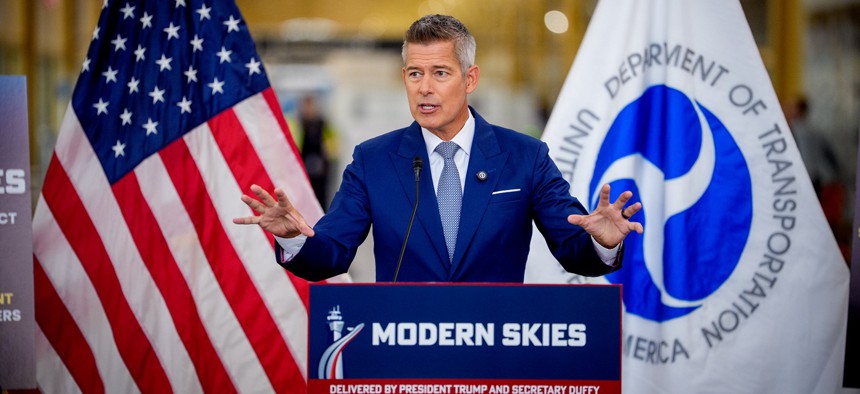
Transportation Secretary Sean Duffy speaks during a news conference at Ronald Reagan Washington National Airport on September 28, 2026 in Arlington, Virginia. Andrew Harnik/Getty Images





FAA Administrator Bryan Bedford also said during a news conference on Monday that the U.S. “could save over 20 years, conservatively, $300 billion” with an overhauled air traffic control system.
The Transportation Department is seeking an additional $30 billion from Congress to complete its massive air traffic control modernization initiative, with the agency’s head saying Monday that the new funds are needed to push the project across the finish line.
Transportation Secretary Sean Duffy first announced the Trump administration’s modernization initiative in May 2025 following several high-profile plane accidents, including a deadly crash between an Army Black Hawk helicopter and a commercial airliner near Ronald Reagan Washington National Airport that January.
Congress initially allocated $12.5 billion toward the modernization project as part of the One Big, Beautiful Bill that was signed into law in July 2025.
During a news conference at Ronald Reagan Washington National Airport, Duffy called that initial allotment “a partial downpayment” but added that the agency has already made rapid progress, including “transitioning from old copper wires to high-speed fiber — all things that have been talked about, but never been done, that we are actually doing right now.”
Prior to the news conference, Sen. Eric Schmitt, R-Mo., introduced the “Modern Skies Act” to provide Transportation with the $30 billion in funding. Appearing alongside Duffy at the event, Schmitt said “the combination of the technology advances, the infrastructure that we can provide — these are all badly needed.”
Duffy said the $30 billion would be distributed relatively evenly across three tranches of the modernization project, including for telecommunications infrastructure and software upgrades, physical airport infrastructure improvements and overhauling the nation’s mid-sized airports. And he added that the administration was setting an ambitious deadline of finishing most air traffic control enhancements by the end of 2028.
“This is a remarkable build speed that's never been seen before, and I think if we get the rest of this money, we can rearchitect our telecom,” Duffy said. “We can build the new software, deploy all of that, and it'll all be done at the same time.”
Speaking at the same event, Federal Aviation Administration Administrator Bryan Bedford also said that replacing legacy systems will result in significant long-term cost savings. He added that significant flight delays that occurred across the northeastern United States last week after construction workers in New Jersey accidentally cut into a fiber line used by an air traffic control center demonstrated the pitfalls of continuing to rely on outdated technologies.
“If we had a modern, resilient system, we could save, over 20 years, conservatively, $300 billion,” Bedford said.
Monday’s announcement came after the FAA rolled out a new artificial intelligence-powered capability, the Strategic Management of Airspace, Routes and Trajectories — or SMART — tool, at several Washington, D.C.-area airports on Sept. 21.
An FAA factsheet says “using AI, SMART analyzes airline schedules, weather, airport capacity, airspace conditions, and operational constraints to predict traffic flows and identify potential conflicts before they occur.”
While Duffy said new tools like SMART can help enhance air traffic control management, he noted that broader modernization efforts are needed because the FAA still relies on an operating system from the 1990s.
“I can operate SMART on that old operating system, but I want a new operating system so I can give new tools to the air traffic controllers,” he said.