
After reductions, VA chief says facilities can 'hire where they need and what they need'
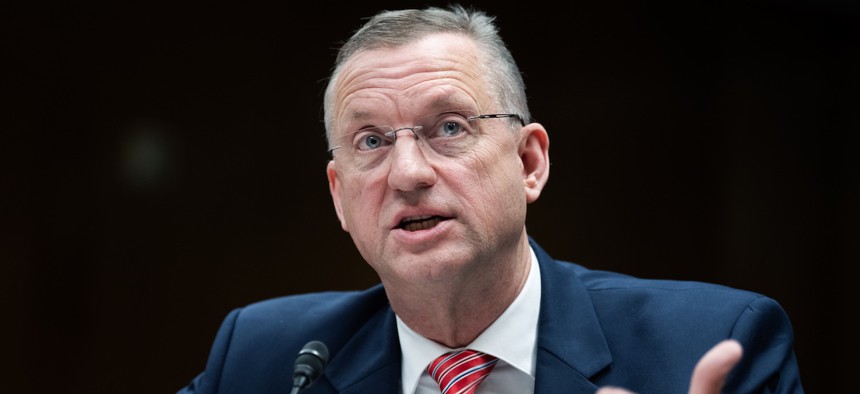
VA Secretary Doug Collins told lawmakers on Thursday that the department has eight pilot programs underway to get new hires onboarded more quickly. Tom Williams/CQ-Roll Call, Inc via Getty Images




 By
Eric Katz
By
Eric Katz
Those facilities must still operate within overall staffing constraints, however.
The Veterans Affairs Department can hire any employee it wants at any time, the head of the agency told lawmakers on Thursday as he sought to address concerns about staffing declines and new restrictions that have set ceilings on workforce levels.
No VA facility is facing constraints on bringing in new personnel, Secretary Doug Collins said, who once again stressed that previous hiring efforts outpaced demand for health care through the department. He made the comments despite VA placing staffing caps on each facility that led to the elimination of tens of thousands of vacant positions and were designed to add layers of review to be surpassed.
“We will hire every need that we have in the department,” Collins said before a panel of the Senate Appropriations Committee. “Our hospitals have the complete autonomy to hire where they need and what they need going forward.”
Collins’ comments came following his push to reduce VA’s workforce by 30,000 employees last year and the subsequent vacancy eliminations. The reductions have raised some bipartisan concerns, though Collins has maintained that his department was overbloated and VA care has not suffered. Between 2019 and 2025, he said, VA’s workforce grew by 14% while its interactions with veterans increased by just 6%.
VA has put “baselines” into place that set staffing levels for each facility, as Government Executive first reported last year. VA components cannot surpass their high-level personnel caps without approval from the department’s human resources and finance offices. Still, Collins said after the hearing the baselines would not impact any hiring effort.
“They're [full-time equivalent] accounts that are assigned to each facility,” the secretary said. “Those FTE accounts are not in a position to keep anybody from being hired.”
One VA official said it is accurate that VA facilities have "autonomy to hire what they need," but must operate within certain boundaries. They cannot simply hire as many employees as they want, the official said, though they maintain flexibility. Facility leaders have been instructed to escalate anything that has an impact on care delivery and hiring of doctors and nurses is always supported.
After years of growth, VA saw a net decrease in both doctors and nurses in 2025. Sen. Jon Ossoff, D-Ga., the top Democrat on the subcommittee that held Thursday’s hearing, noted that VA’s fiscal 2027 budget would see further reductions in both categories. He added that proposed increases in the department’s budget would disproportionately go toward private sector care rather than to offerings within VA’s system.
“We see growing demand for VA care, but we're not seeing here the request for the investments in clinical staff to reflect that,” Ossoff said.
Collins noted that VA has eight pilot programs underway to get new hires onboarded more quickly, including by allowing employees to begin working before they fully go through the vetting process. The department is looking to expand those pilots by the end of the year and is hopeful it can bring average time-to-hire to between 30 and 40 days. VA has already demonstrated progress on that front, Collins said.
He also requested lawmakers provide more flexibility on the top pay levels for VA doctors. Congress previously authorized the department to exceed the existing $400,000 pay ceiling for 300 employees, which VA is currently working on implementing. That represents just 1.5% of VA’s doctors, however, and Collins said lawmakers should instead choose five specialties and wave pay caps for all doctors within them.
“My spouse, I have three kids, and at Christmas, she made sure that every kid had the same number of presents to open,” Collins said, alluding to the “inequities” created by the limited number of pay cap waivers Congress created.
Collins acknowledged that VA plans to close a handful of its contract facilities this year, though he said those medical offices were not performing up to the department’s standards and veterans would be able to receive care in other areas.
Share your news tips with Eric: ekatz@govexec.com, or securely on Signal: erickatz.28
NEXT STORY: ‘Faster and more disruptive’ tech underscores need to revamp the Fed's operations, its governor says