
NASA’s self-driving Mars rover sets an off-world mileage record
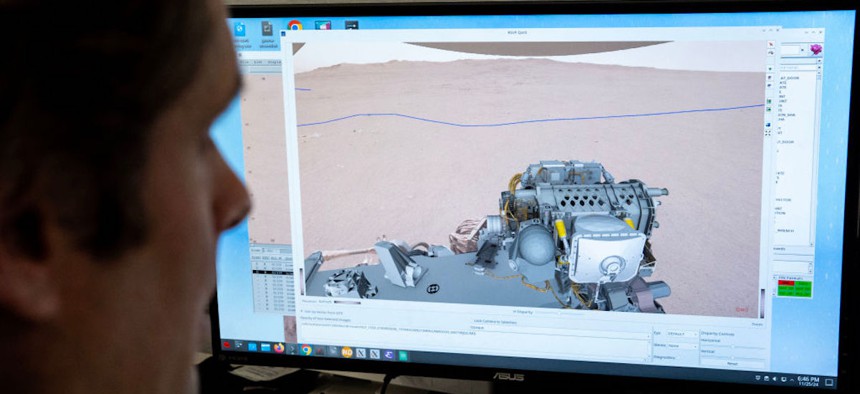
Perseverance rover driver Joseph Carsten plans NASA's Perseverance Mars rover's route for the next Mars mission day at the Jet Propulsion Laboratory, JPL, in Pasadena, California on Monday November 25, 2024. Melina Mara / The Washington Post via Getty Images






NASA’s Perseverance rover just broke the longest off-planet driving distance record thanks largely to its impressive auto navigation and self-driving systems.
The classic lunar rovers that astronauts drove during the Apollo missions have become some of the most recognizable vehicles ever built. They raced across the moon in grainy television broadcasts during the 1970s and have since appeared in countless documentaries, movies and museum displays. But despite their fame, none of them ever made it more than about 22 miles.
On Oct. 11, NASA’s Perseverance rover quietly surpassed them all, along with every other vehicle ever operated on another world. Its odometer reached 28.10 miles, or 45.22 kilometers, narrowly exceeding the 28.06-mile record set by NASA’s Opportunity rover.
NASA marked the occasion with an animated map showing the winding route Perseverance has followed since landing in Jezero Crater in February 2021. During that journey, it crossed an ancient lakebed, climbed through a fossilized river delta and reached the crater’s rim.
Now, it might have endurance, but it won’t be breaking any speed records. The rover needed about five and a half years to set its distance record. And the rover it just passed, Opportunity, took nearly 15 years to establish the previous benchmark.
Perseverance, which started its mission in 2020, has a lot of technical improvements compared with Opportunity, which began exploring Mars in 2004. It’s also a larger vehicle built for endurance. But it’s not just a matter of Perseverance having better wheels, more power and a higher top speed. One of the key reasons for Perseverance’s ability to go the distance is how much driving authority NASA has gradually transferred from human operators on Earth to software operating on Mars.
More than 90% of the distance traveled by Perseverance was covered using its AutoNav autonomous navigation system. By comparison, NASA says that Opportunity and its twin rover, Spirit, used an earlier form of the AutoNav system for about 5% of their travels.
The AutoNav system is important because a command from Earth can take more than 20 minutes to reach Mars, depending on where the planets are in their respective orbits around the sun. Waiting for a response can stretch a simple exchange considerably longer. That is a long time for a rover to sit at a crossroads while operators decide whether it should go left or right around an obstacle. Ideally, AutoNav allows Earthbound operators to assign a destination and let the rover determine the safest way to get there.
The earliest forms of the navigation program showed good proof of concept, but were generally not advanced enough to trust with longer journeys, especially over the incredibly challenging Martian terrain. For example, the first NASA rover to operate on Mars, the microwave oven-sized Sojourner, could only evaluate about 20 different points in the terrain when deciding where it could safely move, enough to spot obvious pitfalls but not some of the more hidden challenges or trouble spots lying in wait along its chosen path.
By contrast, the upgraded AutoNav system inside Perseverance processes 600,000 points of terrain every single time it looks at the ground ahead. That in turn allows it to create a three-dimensional map, identify rocks, steep slopes and sand traps, then select a safe route between destinations chosen by human operators. According to Vandi Verma, a senior engineer, rover planner and driver at NASA’s Jet Propulsion Laboratory, the process is called “thinking while driving” because the rover is processing its route while its wheels are turning.
This new capability gives Perseverance the ability to travel up to 1,351 feet during a single Martian day. That might not impress anyone accustomed to Earth’s highway speeds, but it represents a major improvement for a robotic vehicle moving through an uncharted desert without roads, GPS or immediate human assistance.
NASA is also experimenting with using generative AI to remove another potential bottleneck from the rover’s travels. AutoNav can decide how to avoid a rock or sand trap once Perseverance is moving, but human rover planners have traditionally needed to study a lot of orbital imagery and terrain data to select the waypoints that define its broader route.
During two demonstration drives in December 2025, NASA instead used vision-language models to analyze high-resolution orbital images and terrain-slope data. Working with the same information used by human planners, the AI identified bedrock, outcrops, boulder fields and sand ripples, then generated a continuous route and the waypoints needed to follow it.
Perseverance traveled 689 feet during the first AI-planned drive and 807 feet during the second. NASA engineers did not blindly accept the results. Before transmitting the commands to Mars, they ran the proposed routes through a digital twin of the rover and verified more than 500,000 telemetry variables to ensure the instructions were compatible with its software.
“The fundamental elements of generative AI are showing a lot of promise in streamlining the pillars of autonomous navigation for off-planet driving: perception, localization, and planning and control,” Verma said.
That test did not turn Perseverance loose to select its own scientific destinations. Humans still decided where the rover needed to go, while generative AI helped plot the route and AutoNav handled obstacles encountered along the way. But those technologies are steadily removing the pauses, manual planning and localization checks that once limited how much ground a rover could cover.
NASA recently extended Perseverance’s mission through approximately the end of 2028, and all of its mobility systems remain fully operational. The rover is now traveling toward an area called Idubi, where scientists hope to find evidence of ancient hydrothermal systems and learn whether those environments might once have supported life.
“The rover that broke this record did so by making its own decisions about the path,” said Mark Maimone, deputy team chief for robotic operations on Perseverance. “Given the autonomy to just go, Perseverance is a better driver than the one that landed, and we’re not done. Our newest software teaches Perseverance to steer less and roll more, and to check its own position against orbital maps mid-drive.”
That means 28.10 miles probably won’t remain the record for very long. But the more significant achievement is how Perseverance reached it. NASA has steadily moved navigation decisions from operators on Earth to increasingly capable systems on Mars, giving the rover more time to explore and less time waiting for someone back home to tell it which way to turn.
John Breeden II is an award-winning journalist and reviewer with over 20 years of experience covering technology. He is the CEO of the Tech Writers Bureau, a group that creates technological thought leadership content for organizations of all sizes. Twitter: @LabGuys