
Democratic Congress likely to scrutinize Medicaid work requirements, Medicare AI test
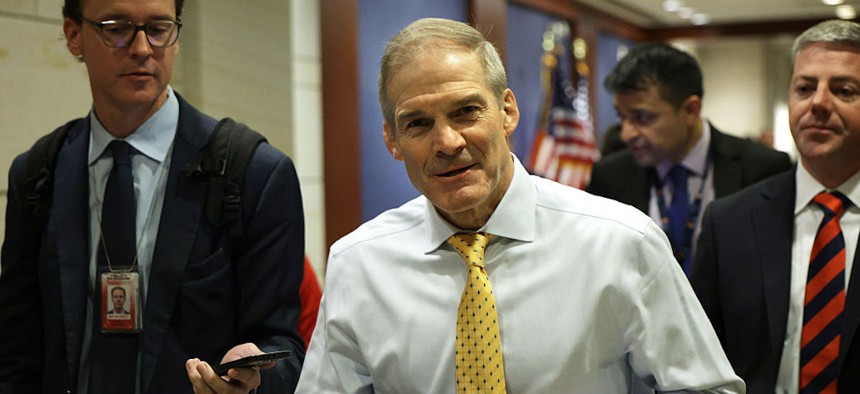
U.S. Rep. Jim Jordan (R-OH) arrives at a House Republican Conference meeting at the U.S. Capitol on November 10, 2026 in Washington, DC. House Republicans have elected Jordan to be their next leader for the Conference for the new Congress in January. Alex Wong/Getty Images





Democrats have said they will quickly move on both health technology issues in the coming session.
A Democratic Congress will likely move to repeal Medicaid cuts — including suspending or delaying work requirements that state officials are racing to implement with new technologies — and an artificial intelligence-supported Medicare coverage pilot.
Sixteen Senate Democrats asked leadership to impose a two-year delay in implementation of Medicaid work requirements in the next legislative vehicle, according to a Monday letter first reported by Punchbowl News.
“States had fewer than 18 months to make complex eligibility and enrollment systems changes, conduct readiness reviews, train staff, and educate enrollees, during a time when many states are already budget-constrained and experiencing staff shortages at the agencies responsible,” the letter — led by Sens. Raphael Warnock, D-Ga., and Ben Ray Lujan, D-N.M. — warned.
Sen. Ron Wyden, D-Ore., similarly told reporters Monday that Medicaid work requirements would be reversed “as quickly as possible,” according to the Oregon Capitol Chronicle.
The comments are the latest Democratic scrutiny of a One Big Beautiful Bill Act requirement that certain Medicaid recipients work, volunteer or study for at least 80 hours per month to maintain coverage.
Wyden and Warnock led an August letter calling for the Trump administration to delay an interim final rule for Medicaid work requirements, warning it would create a “bureaucratic maze that will fail eligible Americans.”
Wyden, Warnock and Sen. Elizabeth Warren, D-Mass., also released an October interim report urging increased oversight of Medicaid technology contractors, which said it is particularly urgent as companies help states implement work requirements.
But Medicaid work requirements launch nationally on Jan. 1 — before Democrats take control of both chambers of Congress.
That timing “does not change the near-term operational priority in states that have expanded Medicaid to get ready to launch work reporting requirements and six-month redeterminations,” according to a blog post from law firm Manatt.
Importantly, Medicaid recipients and technologists are also facing legal whiplash with work requirements. A court struck down the definition of “medical frailty” last month, and four states asked a court to halt the Jan. 1 deadline.
As court rulings play out, Democrats will still likely move fast to give states a reprieve in implementing work requirements.
A House Healthcare Working Group memo released in September identified reversing Medicaid cuts as a policy Democrats should advance within the first 100 hours of the next Congress. Rep. Frank Pallone, D-N.J., similarly identified reversing Medicaid cuts as a top legislative priority in a letter seeking colleagues’ support to become chairman of the House Energy and Commerce Committee.
The Working Group memo also identified ending the Medicare WISeR model that tests AI-supported coverage review as a policy Democrats should advance within the first 100 hours of the next Congress.
The memo noted that the Seniors Deserve SMARTER Care Act, an existing bill that would ban the Medicare pilot, could realize the policy priority.
“Congress needs to continue to conduct rigorous oversight to secure answers, understand the full scope of the model’s failures, and hold the administration accountable. We must also pass my bill to repeal the model and put an end to this dangerous AI experiment,” Washington Democratic Rep. Suzan DelBene, who introduced the bill, told Nextgov/FCW.
Unlike a repeal of Medicaid work requirements, a ban of the AI-assisted Medicare pilot enjoys bipartisan support. The House Appropriations Committee, with both Democratic and Republican support, unanimously advanced an amendment that would halt the experiment earlier this year.
Jerome Adams, Surgeon General under the first Trump administration, said Tuesday morning at The Hill’s Health Next Summit he is “very confident” that President Donald Trump would not veto bipartisan health care legislation.
At the same event, Larry Bucshon, a former Indiana Republican congressman, said he expects Trump would sign bipartisan legislation that the American people support.