
Washington promises UFO disclosure. History suggests otherwise.
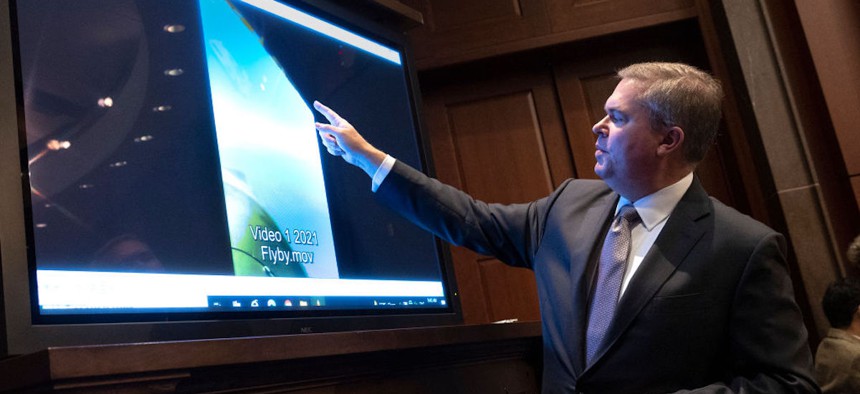
U.S. Deputy Director of Naval Intelligence Scott Bray explains a video of an unidentified aerial phenomena as he testifies before a House Intelligence Committee subcommittee hearing at the U.S. Capitol on May 17, 2022 in Washington, DC. Kevin Dietsch / Staff/ Getty Images





Disclosure may not reveal alien visitors, but it will reveal something equally important: how science, measurement and skepticism slowly turn mystery into understanding.
Many years ago, I was sitting on a boat in the middle of Lake Mead outside of Las Vegas. It was an impossibly dark night and the brilliant sea of stars overhead was perfectly reflected in the still, black water all around me. It was a quiet, hot summer night that I was enjoying with some friends.
That’s when the UFO came and crashed our party. My potential alien encounter started out as a pinpoint of light that was not much bigger than one of those brilliant stars. It came straight down out of the sky and hovered a few miles away at the shore of the lake. It moved quickly along the shoreline, making 90-degree turns and other maneuvers that no helicopter or jet could have accomplished. It stayed there for just a few minutes before shooting straight back up into the night sky and blinking out, disappearing as quickly as it came.
All I had to record the event was a very low-megapixel digital camera (smartphone cameras were not yet a thing). From my spot on the water miles away from the UFO, I couldn’t capture much beyond a little point of light off in the distance. But by every definition, I had just encountered a UFO, an unidentified flying object.
To this day, I wonder what I really saw. Could it have been a drone? Maybe, but that too was a technology that had not yet been fully developed, and certainly not commercialized. Was it an alien? Probably not, but you never know. In any case, that encounter makes it easy for me to understand many people’s fascination with UFOs.
The government promises full disclosure, again
Washington is once again preparing to open the vault on unidentified flying objects.
President Donald Trump recently announced that he intends to direct federal agencies to begin identifying and releasing government files related to UFOs, unidentified aerial phenomena and potential extraterrestrial evidence, citing strong public interest in the topic. Scientific American reported that the announcement would trigger the release of federal UFO records even though no confirmed evidence of extraterrestrial visitation currently exists.
If that sounds familiar, it should. The federal government has already gone through multiple rounds of UFO disclosure over the past several years, each accompanied by intense public anticipation followed by far more grounded conclusions. In fact, Washington has arguably never stopped investigating strange objects in the sky going all the way back to the Air Force’s Project Blue Book in the 1950s. The difference today is not that the government is suddenly taking UFOs seriously. It’s that public expectations continue to outpace what government investigations actually find.
Back in 2021, I wrote about an earlier wave of government UFO transparency following the release of a congressionally mandated intelligence report examining military encounters with unidentified aerial phenomena. At the time, excitement surged as many observers expected definitive answers about alien technology. Instead, investigators reached a much more mundane conclusion: most sightings lacked sufficient data for identification, and none demonstrated extraterrestrial origins. In most cases, those events were recorded with devices even more primitive than my old digital camera.
Subsequent investigations reinforced the government’s position that UFOs had mundane, not extraterrestrial, origins. For example, NASA’s independent UAP (unidentified anomalous phenomena) study team concluded in 2023 that there was no evidence linking UFO sightings to alien spacecraft, even while acknowledging that many aerial encounters remain unexplained.
Meanwhile, the Pentagon’s All-domain Anomaly Resolution Office conducted a sweeping historical review of government UFO investigations dating back to 1945 and found no evidence of hidden alien programs or recovered extraterrestrial technology. Instead, many incidents turned out to involve balloons, drones, sensor anomalies or ordinary aircraft operating in unusual conditions.
Transparency is already happening
One reason the latest disclosure push feels familiar is because Congress already began formalizing UFO transparency. The National Archives has been developing new rules for collecting and publishing unidentified aerial phenomena records as part of a broader government effort to centralize decades of investigations. At the same time, reports of unidentified encounters involving U.S. military personnel have continued to rise, largely due to improved sensor technology and reduced stigma around reporting unusual observations.
Scientific American similarly summarized the scientific consensus: better data gathering, not extraterrestrials, is the likely explanation behind many modern sightings. Sadly, at least for those who want to believe in aliens, most modern UFO investigations are less about extraterrestrial visitors and more about understanding both the improvements and the inherent limits of human technology.
Advanced military radar systems now detect objects that older sensors simply missed. Machine learning tools analyze flight patterns once dismissed as noise. High-resolution imaging reveals atmospheric phenomena, experimental aircraft and foreign surveillance platforms that previously went unnoticed. What once appeared mysterious is increasingly turning out to be a measurement or analysis problem.
Not that the government will ever stop looking for and studying UFOs. It’s in everyone’s best interest to keep an eye on the skies. Our national defense depends on it. Watching for UFOs can help protect restricted airspace, detect foreign surveillance technologies, improve sensor fusion across military systems and prevent risks to aviation safety. That is why UFO investigations today function less like science fiction and more like advanced aerospace analytics.
What might actually come next
If additional UFO records are released, they will likely include pilot reports, radar data, historical case files and technical analyses that were previously classified or difficult to access. They may reveal bureaucratic debates, incomplete investigations and evolving scientific understanding too. And they may even confirm that some incidents remain unresolved.
What they are unlikely to disclose is any definitive evidence of extraterrestrial visitors.
That outcome may disappoint those hoping for confirmation of alien contact. But it highlights a government increasingly willing to examine unknown phenomena openly, using science and technology rather than speculation.
Washington may promise UFO disclosure again. But history suggests the result will look familiar. The mystery will shrink, the data will grow and the skies will remain full of questions that are fascinating precisely because they are human problems to solve.
I still think about that night on Lake Mead sometimes. Whatever I saw streaking across the desert sky probably had an explanation rooted in physics, technology or simple misinterpretation. Yet the experience remains powerful precisely because I never fully solved it.
Government UFO investigations work much the same way. Each report brings us closer to understanding what we are seeing, even if it rarely confirms what we hope to find. Disclosure may not reveal alien visitors, but it reveals something equally important: how science, measurement and skepticism slowly turn mystery into understanding. In the end, official UFO disclosures tell us less about extraterrestrials and far more about humanity’s enduring effort to understand the unknown.
John Breeden II is an award-winning journalist and reviewer with over 20 years of experience covering technology. He is the CEO of the Tech Writers Bureau, a group that creates technological thought leadership content for organizations of all sizes. Twitter: @LabGuys