
SSA phone wait times longer than publicly reported metrics, per OIG report
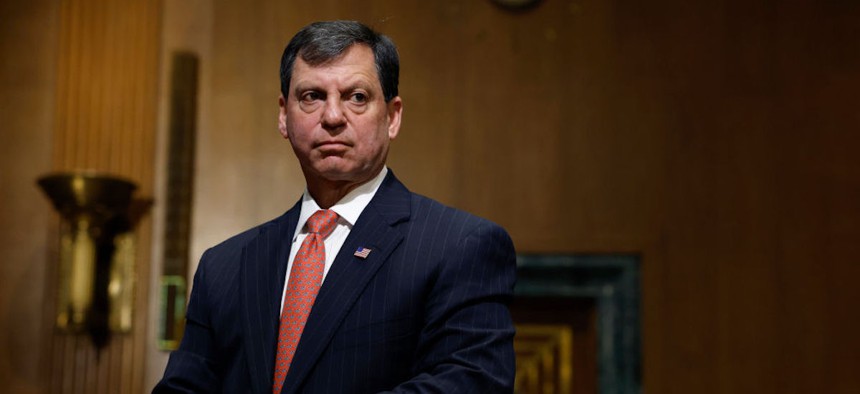
Frank Bisignano, President Donald Trump’s nominee to be Commissioner of Social Security Administration, testifies at his confirmation hearing on March 25, 2025. Bisignano told lawmakers over the summer that SSA changed its wait time metrics so as to not discourage people from calling the agency. Kevin Dietsch / Staff/ Getty Images



 By
Natalie Alms
By
Natalie Alms
The agency’s “average speed of answer” metric masks longer call wait times, according to data in a recent OIG report.
The Social Security Administration’s leadership is claiming victory after the agency’s watchdog released a new report on its phone line showing service improvements in fiscal 2025. But the report isn’t likely to quiet critics, who say the agency’s publicly listed metrics are misleading.
The Office of the Inspector General’s report comes at the request of Sen. Elizabeth Warren, D-Mass., who zeroed in on call data after SSA changed the type of data it reports publicly over the summer, removing information like callback wait times.
At that point, SSA began to rely more heavily on the “average speed of answer” of its phone lines — 15.9 minutes in fiscal 2025, as compared to 27.9 minutes the year prior.
But the OIG report shows how this metric is dramatically lower than the amount of time it takes to get ahold of an SSA employee by waiting on hold or requesting a callback.
The average speed of answer includes people who wait on hold to speak with an agent until they get to that person or, critically, opt to get a callback. The agency counts callers that immediately request a callback as having a wait time of zero, bringing down the average.
In reality, callers who opt for a callback do have to wait: this year, they waited for an average of one hour and 51 minutes for SSA to call them back.
And if you zoom in on callers who didn’t take the callback option and waited to speak to an employee, their average wait time is 59 minutes — a difference of about 43 minutes compared to the average speed of answer.
This wait time statistic is included in the inspector general report, but the agency doesn’t report that measure publicly anymore. SSA Commissioner Frank Bisignano told lawmakers over the summer that SSA changed the metrics so as to not discourage people from calling the agency.
Wait times for people who abandon their quest for help and hang up also aren’t included in wait time calculations, nor are those that get busy signals, according to the OIG.
Warren probed the agency about its phone wait times in late June, after her staff surveyed the wait times to get to an agent without a callback. They found an average wait time of an hour and 45 minutes, although many of their calls were dropped.
The inspector general reported a wait time of 64.5 minutes that month, or just over an hour, for callers who opted to wait on hold to speak to an agent instead of requesting a callback.
The average speed of answer for June, meanwhile, was 13.3 minutes.
Bisignano and the agency have used the terms ‘wait time’ and ‘average speed of answer’ interchangeably.
“The bottom line is that Donald Trump’s Social Security chief lied about call wait times to cover up his customer service mess,” Warren told Nextgov/FCW in a statement. “This new watchdog report reveals that true wait times were more than three times higher than what Commissioner Bisignano claimed, and tens of millions of callers were simply unable to get help on the phone at all.”
The agency, meanwhile, is focusing on other parts of the report, which states that the metrics SSA reported were accurate, and that overall, the agency’s phone performance improved in fiscal 2025.
The average speed of answer times were lower in fiscal 2025 than 2024, although the report doesn’t include historical data for wait times to speak to an agent or other metrics.
“The results of the audit come as no surprise to anyone following the historic progress we are making at the agency under President Trump’s leadership,” Bisignano said in a statement.
“We are serving more Americans at significantly faster speeds than ever before,” he continued. “While partisan politicians are attempting to undermine trust in SSA, we are determined to continue improving customer service online, on the phone, and in person at field offices.”
The phone line improvements are the result of a new telecommunications platform the agency moved to in 2024 and the reassignment of over a thousand employees to answer phone calls over the summer, the new inspector general report says.
Those reassignments helped strained phone lines — the speed of answer, average wait time and wait time for callbacks all went down between June and July — but sparked worries about how the loss of employees in field offices already struggling with staffing could cause additional problems. As of June, staffing was down 13% in field offices compared to October 2024.
The inspector general didn’t look into how the reassignments affected field offices.
Overall, the agency handled 65% more calls this year as compared to last, likely due to the Social Security Fairness Act of 2023, the report says.
The report comes at the end of a tumultuous year for SSA, which has become a political flash point.
Since January, the agency has operated under four different leaders. In the early days of the administration, it was a focal point for the controversial Department of Government Efficiency, which advanced misleading claims about fraud on the agency’s rolls and phone lines.
Internally, SSA’s already historically-low workforce has also been pared down after SSA leadership set a goal to lose 7,000 employees in March.
The agency’s phone lines have been at the center of controversy, too, as SSA ramped up automation and planned — and often abandoned — various new requirements for callers to prove their identity meant to cut down on fraud.
Thirty-seven percent of calls were handled by automation this year, and 35% by employees.
Nearly 3 million callers used the agency’s automated system to handle their calls every month this year, as opposed to 300,000 last year.
Still, nearly 4 million people hung up on SSA’s automated system before getting help between May and September, or 2% of all callers.
It's not easy to measure how helpful the automated system is to callers, as SSA doesn’t conduct post-call surveys of people who used automation to handle their call, according to the report, instead collecting that feedback via an online form.
Three percent of callers got a busy signal, and 25% of calls to SSA, or 21.3 million calls, were reported as “abandoned.”
That bucket included instances when a caller hangs up while waiting on hold; when a caller doesn’t answer a callback from the agency and when SSA doesn’t get to their requested callback by the end of the day, at which point the agency doesn’t call them back altogether, per the agency’s policy.
People abandoned their calls to the agency after waiting between 22 and 38 minutes for help.
If you have a tip you'd like to share, Natalie Alms can be securely contacted at nalms.41 on Signal.
NEXT STORY: Agriculture focuses on SNAP fraud, while experts worry EBT theft will go unabated