
Social Security plans new restrictions for its phone line, citing fraud
Wesley Lapointe/For The Washington Post via Getty Images




 By
Natalie Alms
By
Natalie Alms
New identity proofing requirements for certain transactions, like changing an address, could especially impact people in rural areas, with transportation difficulties and with limited technology know-how.
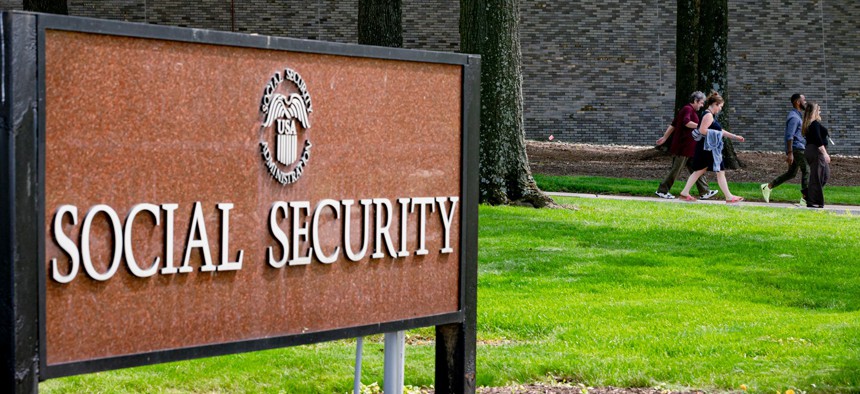
The Social Security Administration is preparing to require callers to go through online identity proofing requirements before they can complete certain transactions like changing their address with the agency over the phone.
The restrictions could push many needing assistance into SSA’s field offices as it expands the identity checks it put in place on direct deposit changes made over the phone in the spring.
SSA is now planning to require people to go online to get a one-time code if they want to request a claims status, change their address, get tax statements or get a benefit verification letter via SSA’s phone lines, according to agency documents posted on July 18. SSA wants to install the new checks, which it says are necessary to address fraud, by August 18.
The policy could make it especially difficult for people with limited tech savvy to access the agency and especially affect beneficiaries in rural areas, with limited mobility and with limited transportation options. SSA estimates in the public document that the change will drive 3.4 million people who “decline” to use the service into field offices for in-person identity proofing.
To get the required code, callers need an online Social Security account. Creating one requires users to go through identity verification checks via private vendor ID.me or the government-run Login.gov.
People can also use their online account to complete the transactions that now require these additional identity checks, although that’s the same online account they need to use to get the one-time code.
SSA says that the new requirements are needed to address fraud.
Although the agency’s inspector general previously reported in 2012 about the fraud risks associated with direct deposit changes, SSA hasn’t provided many details about the risks associated with the additional tasks SSA is adding more identity proofing requirements to.
Overall, fraud is a miniscule percentage of the payments the agency makes, according to a recent oversight report.
“For these tasks, there is nothing that I'm aware of that indicates these are significant fraud risks at all,” Kathleen Romig, director of social security and disability policy at the Center on Budget and Policy Priorities, told Nextgov/FCW. She previously worked at the agency. “There's all kinds of evidence that it burdens the public on the people who really need their Social Security benefits.”
Michelle Spadafore, a senior supervising attorney at the New York Legal Assistance Group and project director of the organization’s disability advocacy project, echoed that concern.
“Individuals who need to contact SSA about this information are disabled or elderly,” she told Nextgov/FCW over email. “The steps required to set up an account to access SSA's new PIN are beyond the capabilities of many recipients.”
Setting up an account requires going through an identity proofing process that entails taking a picture of your ID to match with a selfie.
“For SSA beneficiaries who have a personal my Social Security account, the PIN will enable them with convenient and secure authentication when they call the National 800 Number. Using the new feature will save beneficiaries 3 minutes once they are connected with an SSA agent,” an SSA spokesperson said in a statement.
The feature is “optional,” they said. “If caller does not have a my Social Security account or chooses not to use the PIN feature, the customer experience will be no different than it is today, and they will continue to use the existing authentication methods.”
SSA did not elaborate on how the experience would be “no different” under the new PIN requirements.
The document — submitted to the Office of Management and Budget for approval under the Paperwork Reduction Act— says that “if the code fails validation,” SSA phone agents can have the caller try again or refer them to “the option to conduct business either online through the respondent’s my Social Security account, or in person at a field office.”
Other Federal Register notices from SSA focused on the direct deposit process note that there is an exception process for people who can’t get through the process or visit a field office.
On the ground, SSA field offices have already lost thousands of staff under the Trump administration’s push to shrink the federal workforce. Field office staffing is down by at least 1,200 employees, per agency budget documents, and SSA has also reassigned about 1,000 field office employees to answer the agency’s phones.
The potential influx of people into field offices is “impossible,” one SSA employee who works in a field office told Nextgov/FCW. “They already took 1,000 customer service representatives nationwide to answer the phone. They are normally working at reception. Who would take care of all these people?”
The changes could also tie up staff with these requests, potentially meaning that they “won't have time to process the more complicated workloads they normally cover, causing delays in processing applications, appeals, and benefit payments,” said Spadafore.
It’s the latest change to the agency’s phone line since Trump took office in January.
SSA previously announced in March that it was eliminating the option for people to file claims or change bank information over the phone, although it later changed the policy to allow claims to be made while the agency runs a new anti-fraud check on the back end. More recently, the agency’s use of artificial intelligence on the phone lines has been criticized for degrading service.
“It’s Groundhog Day at the Social Security Administration,” Nancy Altman, president of advocacy group Social Security Works, said in a statement about the latest changes to phone lines.
“Earlier this year, the Trump administration abruptly announced a plan to force millions more Americans into overcrowded, overburdened field offices. Faced with negative press coverage and public outrage, they said they would reverse course,” she continued. “But now, this terrible policy is back.”
As of mid-May, SSA has found hardly any fraud for benefit claims made of the phone, with only two of over 110,000 claims being flagged as having a high probability of being fraudulent using the new anti-fraud check. Holds placed on phone claims to run those checks were slowing down retirement processing, though, leading the agency to do away with a three-day hold it had in place to run the fraud checks.
Identity proofing requirements for people wanting changes to their direct deposit information over the phone, however, remain in place after SSA installed them in late April. Those are what are now being expanded to additional phone transactions.
Previously, people could answer knowledge-based questions over the phone to verify their identity and change their direct deposit information. That method of identity proofing is regarded by security professionals as being limited in its usefulness, especially as data leaks make it easier for bad actors to get the information they’d need to bypass them online.
Now, the additional restrictions are being installed without input from the public, the AARP wrote in a letter on Tuesday asking SSA Commissioner Frank Bisignano to reconsider the policy.
“For many older Americans, the phone is how they access Social Security services without having to rely on complicated technology or long, difficult or costly trips to field offices,” the AARP letter says. “Limiting phone-based services would remove the primary way they are able to get the help they need from the Social Security Administration.”
Even within the agency, the planned changes aren’t widely known and are coming as a surprise to those who would be charged with implementing them, two employees told Nextgov/FCW.
“Morale is already at an all time low,” one said, noting that “I won't be surprised if the extra stress convinces more employees to leave the agency.”
SSA Commissioner Frank Bisignano, a financial services businessman, has said that he plans to pursue a “technology agenda” at the agency, “while continuing to meet our customers where they want to be met, whether online, on the phone or in field offices.”
He took over the agency in May after months of turmoil, during which SSA announced plans to shed 7,000 employees and made headlines over the work of the controversial Department of Government Efficiency.
Sen. Elizabeth Warren, D-Mass., launched a Social Security “war room” in response to the changes at the agency, and told Nextgov/FCW “every new policy from Trump’s Social Security Administration that makes it harder to get help is really just a backdoor cut to benefits” when asked about the coming restrictions.
The former acting commissioner at SSA, Leland Dudek, was installed in February as the temporary head after being placed on administrative leave for helping DOGE operatives, who had clashed with the previous acting SSA commissioner over DOGE’s requests to access sensitive SSA data.
Dudek was a mid-level SSA employee who had worked on anti-fraud issues at the agency before being made acting head. He made expanding identity proofing a priority in that position.
“When they cry fraud, fraud, fraud, fraud, fraud — notwithstanding the fact that there is a relatively small amount of fraud in the Social Security program — they accomplish their goal of undermining trust in the agency by attacking its reputation, and they also use it to justify their dismantling and degrading of its customer service,” Martin O’Malley, Biden’s head of Social Security, told Nextgov/FCW.
“They have to turn enough of us against the agency in order to do what they want with that trust fund,” he said. “Or to make a buck on fixing the emergency they precipitate by destroying its capacity to function.”
If you have a tip you'd like to share, Natalie Alms can be securely contacted at nalms.41 on Signal.
NEXT STORY: GSA announces centralized travel service ‘GO.Gov’