
Tax chief pushes 'AI-first IRS' to get more out of agency's workforce
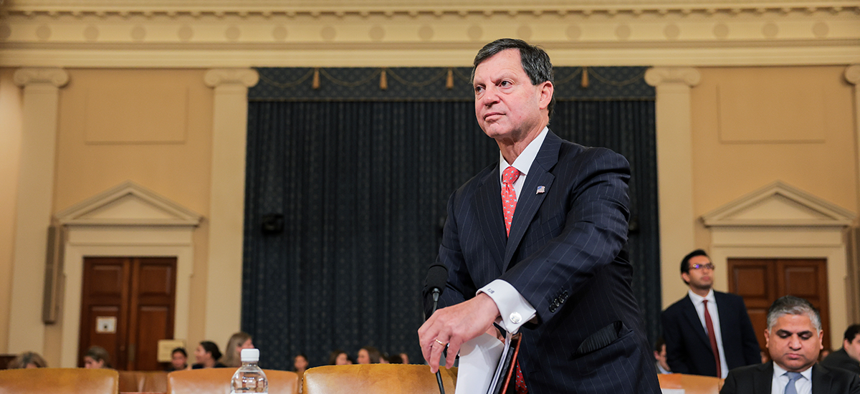
IRS Chief Executive Officer Frank Bisignano told employees in an all-staff meeting Wednesday that an “AI-first IRS” will make its workforce more productive, after the agency cut more than a quarter of its headcount last year. Anna Moneymaker/Getty Images





 By
Jory Heckman
By
Jory Heckman
The IRS made more than 4,000 hires this year, but its headcount remains mostly unchanged after cutting more than a quarter of its workforce last year.
The IRS is looking to move more aggressively to adopt artificial intelligence tools, with the goal of being more responsive to taxpayers seeking help – while also ensuring individuals and businesses pay what they owe the tax agency.
IRS Chief Executive Officer Frank Bisignano told employees in an all-staff meeting Wednesday that an “AI-first IRS” will make its workforce more productive, after the agency cut more than a quarter of its headcount under prior leadership last year. He said AI won’t replace IRS employees' jobs, but will “deliver larger collections and better client service to the American public.”
“It has the benefit of improving every employee's job. It is not designed to eliminate jobs," Bisignano said, according to a transcript and audio recording obtained by Government Executive.
Bisignano and other senior IRS officials said greater adoption of AI tools will also reduce wait times for taxpayers, and shrink the “tax gap” between the revenue the IRS collects every year, and the amount individuals and companies actually owe.
The IRS cut tens of thousands of jobs last year — more than a quarter of its workforce — and fell short of its hiring goals for this year’s filing season. Bisignano told lawmakers the IRS carried out a successful filing season this year, despite losing more than 25,000 employees.
He told employees that IRS has “added to the ranks of the workforce,” and is focused on “getting more tech out the door.”
“I feel good about where staffing is, and anybody who reports to me always submits whatever they need to get the resources they need,” he told employees.
IRS Chief Human Capital Officer Alex Kweskin said the IRS made more than 4,000 hires this year, but that when accounting for retirements and attrition, the agency’s headcount remains mostly unchanged.
“Our headcount started the year at 74,000, and we are ending the year at 74,000. It's remained effectively flat all year long,” Kweskin said, adding that the agency will “continue to hire” ahead of the filing season.
Former IRS Commissioner Charles Rettig, Trump’s first-term pick to run the agency, told lawmakers in 2021 that the tax gap could be as much as $1 trillion a year, and that the agency is often too “outgunned” in terms of staffing and resources to go after tax cheats.
“When you think about the tax gap, obviously our ability to do a better job there through technology will be big,” Bisignano said. “Five years from now, I mean, if you look at the speed of change, what I see is an IRS that has a mid-90s compliance rate,” he said.
The IRS' most recent estimate of the voluntary tax compliance rate is about 85%. The New York Times recently reported that the IRS, under the second Trump administration, has fallen behind on producing annual tax-gap estimates. The IRS last estimated in October 2024 that about $700 billion in taxes owed went uncollected in 2022. The Yale Budget Lab estimated that last year’s staffing cuts resulted a $861 billion decrease in revenue collected by the IRS.
The IRS all-staff meeting came a day after the Trump administration unveiled America.gov, a website that uses an AI chatbot to point users to services provided by federal agencies. At the event, President Donald Trump signed an executive order mandating that agencies ensure public-facing services integrate directly with America.gov as soon as possible.
Bisignano spent much of last year rolling out his playbook for a “digital-first IRS,” focused in part on reducing the total number of phone calls the IRS receives, and instead moving taxpayers onto online, self-service platforms.
The IRS recently rolled out a new mobile app, which Bisignano described as a “great example of work we're doing to meet taxpayers where they want to be met.”
The IRS had a busier time than usual preparing for last year’s tax filing season, because of changes from Trump’s One Big, Beautiful Bill Act. But next filling season will be even more complicated, because more tax filing changes from the legislation will go in effect starting in 2027.
“This year for filing season ‘27, it is twice as complex,” IRS Chief Information Officer Kaschit Pandya told employees. “We have twice as many provisions to implement for filing season ‘27 than we did for filing season ‘26.”
Pandya said the IRS is already using AI to process amended tax returns more quickly. The agency receives about 5 million amended tax returns annually, and that the IRS is using AI to accelerate the processing of “hundreds of thousands” of returns.
The IRS in February put about 1,500 IT and human resources employees on involuntary details to frontline taxpayer service jobs. Among their duties, employees were directed to help reduce a “huge backlog” of amended tax returns.
Pandya said that previously, an amended individual return “might take multiple weeks to process.”
“[The] average time can be 12, 14, 16 weeks. Through AI and automation, we have seen that go down to under three days,” he said.
If you have a tip that can contribute to our reporting, Jory Heckman can be securely contacted at jheckman.29 on Signal.
NEXT STORY: AI firms should be held liable for their models’ actions, lawmakers say