
House Democrats seek watchdog review of AI-powered air traffic control systems
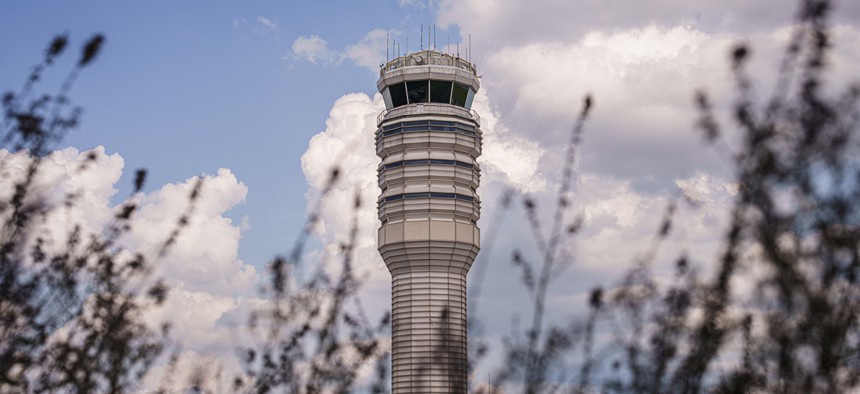
J. David Ake/Getty Images




The inclusion of AI capabilities has “rightfully raised serious questions about its reliability and safety benefits,” House Transportation and Infrastructure Committee Democrats wrote in a letter to GAO.
Almost two dozen Democrats on the House Transportation and Infrastructure Committee are calling for a congressional watchdog to audit the Federal Aviation Administration’s creation and use of new tools designed to provide better airspace supervision.
Transportation Secretary Sean Duffy unveiled the White House's air traffic control modernization initiative in May 2025 following several high-profile plane accidents, including a deadly crash between an Army Black Hawk helicopter and a commercial airliner near Ronald Reagan Washington National Airport that January. While the effort includes some brick-and-mortar upgrades, much of the push is focused on upgrading the legacy technologies underpinning air traffic control systems.
In a Tuesday letter led by Reps. Rick Larsen, D-Wash. — the panel’s ranking member — and André Carson, D-Ind. — the Aviation Subcommittee’s top Democrat — committee lawmakers expressed concerns about the FAA’s adoption of more advanced capabilities as part of the Trump administration’s broader push to overhaul the systems overseeing the nation’s airspace, and they called for the Government Accountability Office to examine the technologies’ development.
As part of the technology overhaul, the FAA announced a 12-year, $875 million contract with Air Space Intelligence in June to provide two new systems: a Strategic Management of Airspace, Routes and Trajectories — or SMART — tool and Flow Management Data and Services — or FMDS — for a modernized Air Traffic Control System Command Center.
The agency has said that FMDS will replace its current traffic flow management system, with the artificial intelligence-powered SMART tool “serving as an enhancement” within the new system. SMART is designed to combine 200 different data streams into one system to provide better flight traffic oversight, including syncing information like flight paths and weather patterns.
The FAA announced on Sept. 21 that it deployed SMART to monitor airspace in the Washington, D.C. region. That rollout, though, was reportedly met with some initial hesitation from airline executives, as well as Rep. Don Beyer, D-Va., whose district includes Reagan National Airport. One of the criticisms was that air traffic controllers did not have any input in the tool’s creation.
“The use of artificial intelligence within SMART has rightfully raised serious questions about its reliability and safety benefits, particularly on its potential to interfere with decision-making by experienced air traffic controllers or to hallucinate safety-critical information,” the committee Democrats wrote. “These concerns are exacerbated by the Administration’s decision to pilot such a recently developed and technologically complex ATC tool in heavily congested airspace, including the National Capitol Region.”
In an interview with Nextgov/FCW following SMART’s rollout for D.C.-area airports, Beyer said growing global concerns about the capabilities of more advanced AI models led to his office receiving worrisome feedback from constituents about the tool’s deployment. He said, however, that a subsequent conversation with FAA Administrator Bryan Bedford helped to alleviate some of his concerns, including the assurance that SMART was designed by air traffic controllers who aren't in the towers right now but are the “30- and 40-year guys who've been doing it all their lives.”
When it came to SMART’s initial deployment for D.C.-region airspace monitoring, Beyer said “I think the feedback was you almost need big, busy airports in order to generate enough information to make AI relevant.”
Despite FAA’s assurances, however, Beyer and the letter’s signatories have both expressed a desire for further testing and oversight to ensure that SMART is safe.
The House Transportation and Infrastructure Democrats’ letter requests that GAO analyze FAA’s oversight and development activities, including the agency’s safety risk management activities when it comes to both SMART and FMDS. They also called for the watchdog to identify “any quantifiable performance metrics” the FAA is using to monitor the two systems, as well as evaluate the agency’s deployment strategy for SMART and FMDS.
Transportation has pushed back on some of the questions about its use of more advanced systems to enhance the nation’s air traffic control management, with Duffy saying during an appearance on Fox News last month that SMART is “a tool that’s used to better manage traffic” and that air traffic controllers “are the ones who will always manage airspace.”
Duffy has also tried to distinguish between the FAA’s adoption of SMART, and other more powerful frontier AI models that have raised safety and security alarms.
During an event hosted by the National Artificial Intelligence Association in Washington, D.C. last month, Duffy said the air traffic control system upgrades are “going to be driven not by the most complicated AI, but AI that will provide information to [controllers], and will, I think, have a huge impact on the flying public.”
Congress initially allocated $12.5 billion toward the Trump administration’s ambitious air traffic control modernization project as part of the One Big, Beautiful Bill that was signed into law in July 2025. Transportation is seeking an additional $30 billion to finish the wide-ranging initiative, which it hopes to largely complete by December 2028.