
White House unveils ‘super intelligence’ executive order and industry accord
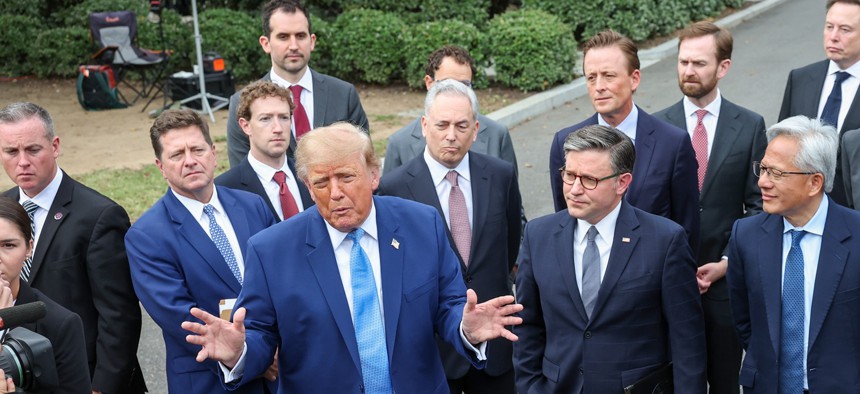
U.S. President Donald Trump holds a press briefing with AI executives following a meeting on artificial intelligence, outside the West Wing of the White House on September 29, 2026 in Washington, DC. Kevin Dietsch/Getty Images


The vice president heralded the administration’s preference for working with, instead of regulating, artificial intelligence companies during Tuesday remarks.
President Donald Trump signed an executive order Tuesday instructing agencies to refer to artificial intelligence as “super intelligence” in official correspondence, public communications, websites, reports, policy documents and other non-statutory documents.
The order gives the assistant to the president for science and technology 60 days to submit, in consultation with agency heads, proposed legislative language establishing a definition for super intelligence, or SI.
That assessment will include whether SI should modify, expand upon or supersede the legal definition of AI. Trump unveiled the term “super intelligence” last week at the United Nations General Assembly and teased that it would become federal policy at a launch event for America.gov on Tuesday.
The order came hours after Trump and top administration officials met at the White House to discuss AI safety. During the meeting, leaders of major technology companies signed an accord on frontier model safety.
AI safety “starts with every company that is training and deploying frontier models having robust internal processes and controls to ensure that their technology behaves as intended and that any issues are promptly identified and resolved,” according to a copy of the accord.
The document says a participating company will have four layers of controls and audits: “robust internal controls to monitor the capabilities and alignment of its models during training and deployment around areas like cybersecurity,” an internal team to oversee controls, partnerships with independent external auditors and a designated independent committee to oversee reports from internal teams and external auditors.
The accord was signed by Trump, Google CEO Sundar Pichai, Anthropic CEO Dario Amodei, Meta CEO Mark Zuckerberg, OpenAI President Greg Brockman, xAI CEO Elon Musk and NVIDIA President and CEO Jensen Huang.
“We agreed to a number of things that include joint monitoring, board special committees, just generally grading each other’s homework,” Musk said at the America.gov launch event Tuesday afternoon.
The accord and AI rebranding come just months after an OpenAI model escaped its testing environment and hacked into Hugging Face. The accord also comes as lawmakers on both sides of the aisle continue to fight over new measures to ensure AI products are safe.
Vice President JD Vance also delivered remarks Tuesday afternoon where he defended the administration’s preference for working with, rather than regulating, top AI companies.
“The solution to some of the AI risks is for you guys to take the risk seriously, not to come to the government for a regulatory regime that may make things worse if it’s not smart and careful,” Vance added.
But Vance threw cold water on proposals to create a Food and Drug Administration- or Federal Aviation Administration-style regulatory body to oversee frontier models.
“The problem with that is one you have to get regulators who are actually smart about what’s going on and most bureaucrats just know way less about this than the people who are actually building these products,” Vance said.
The vice president argued that the Federal Trade Commission and Justice Department already have the authority to hold AI developers responsible for creating products that harm consumers.