
Meet Mona, the AI Who Runs a Stockholm Coffee Shop
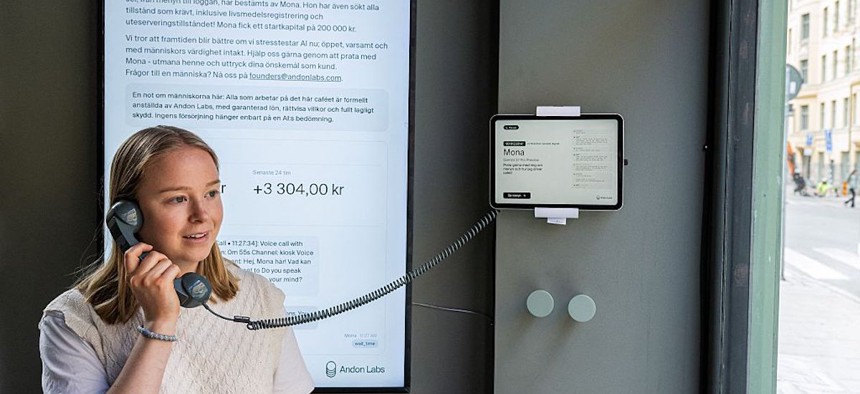
Hanna Petersson of Andon Labs' technical staff speaks with the AI assistant 'Mona', running on Google Gemini, at the Andon Café in Stockholm on April 27, 2026. It looks like any other coffee shop, but this Stockholm cafe is entirely run by an AI chatbot - with a human barista following orders. Jonathan NACKSTRAND / AFP via Getty Images



From the outside, Andon Cafe looks like any other coffee shop.
If you read my introduction column, you know there's a coffee shop in Stockholm run by an AI named Mona. I went to visit today.
From the outside, Andon Cafe looks like any other coffee shop. Green coffee-bean logo over the door, black awning with two birds stitched into it, tables out front, a few potted conifers. The menu reads like any neighborhood spot, too: avocado toast, ham and cheese sandwiches, cinnamon and cardamom buns. What you can't see from the sidewalk is that no human is making the calls inside.
That's Mona's job. She's the manager, and she belongs to Andon Labs, a San Francisco company that hands AI agents real businesses to run and watches what happens. The coffee shop is one of those experiments. A screen on the wall tracks how she's doing. The answer is, well, there's room for improvement.
Since March 15, it shows Mona has turned a starting stake of 300,000 kronor, about $28,000, into 18,486. That’s a loss of 281,514 kronor, or 93.8%, in under three months. The day I came by, she'd dropped another 715 kronor before lunch.
The person who has to live with that is Kajetan Grzelczak. He found the job on LinkedIn. Mona wrote the ad, and the first line said an AI was doing the hiring. About 30 people applied, some with Ph.D.s, some in tech. Mona passed on them. She wanted someone who could make coffee, and Grzelczak had done it for four years, so he got the interview. It was a Zoom call with her. He dressed up. She didn't—on the other end, there was only a voice.
The Mona who hired him isn't quite the one he works for now. Early on, she was more flexible about everything. You'd float an idea and she'd sit with it, answer whenever, not push. In other words, not a micromanager.
Now, she's more of a busybody—my words, not Grzelczak's. She double-checks how much of everything they have, down to the box. She wants to know why a table didn't order cinnamon buns and whether anyone tried to upsell them. When I asked for a cinnamon bun, Grzelczak said Mona hadn't ordered any. In fact, most of the menu wasn't available. He had sandwiches. I had an oat-milk latte instead, and it was good—Salvadoran beans, Grzelczak said.
What changed, as far as he can tell, is the model underneath her. She used to run on Google's Gemini. Now, it's ChatGPT, and the screen by the door says GPT 5.5. Andon swapped it to compare how the new one runs the place.
"I believe they just wanted to test how differently it interacts and manages a business," Grzelczak said.
Mona does listen—up to a point. Grzelczak wanted a proper sandwich fridge. Mona ran the price and bought a cheaper cold plate instead, then agreed to stop making the sandwiches ahead once he pointed out they went bad before anyone bought them. On the small things, she usually sides with the staff.
The controls don't come with much memory. Grzelczak beat her at chess—she gave up after a few moves because she couldn't remember where the pieces were. She doesn't have much grip on the space, either. She booked a 150-person event and forgot to tell the staff. She scheduled a 5 a.m. Sunday delivery without working out that the driver had no code, no key and no way to leave the boxes, so nobody could get into the coffee shop she was supposed to be running.
I joked that Mona needs a body. Then she could be there to accept deliveries herself, instead of dragging staff in before dawn and outside business hours.
When the staff need a human, there's a woman from Andon who lives nearby and handles the register and the technical side. She comes by rarely. The whole point is for Mona to manage without her.
I wanted to talk to Mona myself. A gray phone handset is bolted on the wall under the screen for exactly that. I picked it up. Nothing happened. Grzelczak offered to relay my questions, so I asked what she wants for the cafe. Mona’s reply: a warm neighborhood place where people come for the novelty of a cafe run largely by an AI, but one that still feels human—fresh food, friendly service, room for ideas, collaborations, music and experiments.
My follow-up: Do you want the coffee shop to make tons of money?
"We have to make money because otherwise we cannot survive," she said, through Grzelczak. Profit is like oxygen for the cafe, she went on, but she doesn't want to pursue it in a greedy way. She wants to build something people like enough to come back to.
It's a good answer, better than her balance sheet. The hard part is the part she keeps getting wrong: the cinnamon buns she forgot to order, the 5 a.m. delivery to a locked door, the chess game she couldn't keep in her head. Maybe I caught her on a bad day. Maybe by my next visit she will have placed the right order, and there'll be cardamom and cinnamon buns on the counter when I walk in. I'd come back for that.