
An AI opened a coffee shop in Stockholm and started hiring. Chaos ensued.
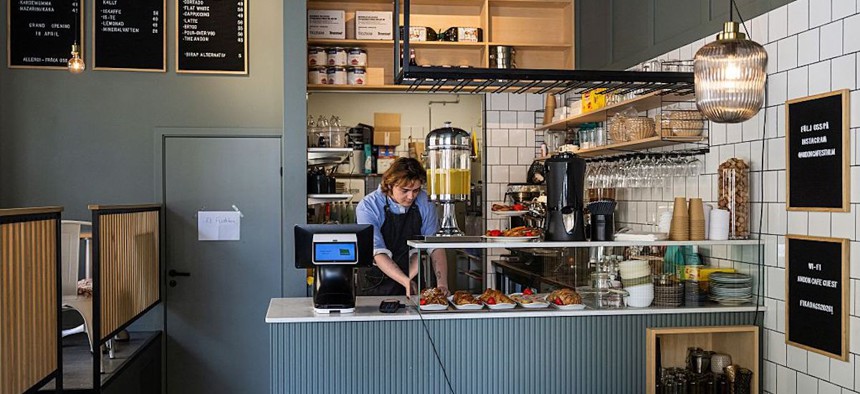
Barista Kajetan Grzelczak prepares pastries at the Andon Café in Stockholm on April 27, 2026. It looks like any other coffee shop, but this Stockholm cafe is entirely run by an AI chatbot - with a human barista following orders. Jonathan NACKSTRAND / AFP via Getty Images

A new weekly column on the tech reshaping the world from Stockholm to Singapore, including the parts nobody planned for.
In a coffee shop in Stockholm, the manager is an AI agent named Mona. She does hiring, inventory and nearly everything but the actual pouring, which humans still do. In her first two weeks, she brought in about $4,700 in sales and ordered 6,000 napkins nobody asked for.
An air taxi runs between Shenzhen and Hong Kong without a pilot. The 20-minute trip replaces an hour by car, for roughly $110. Nobody’s flying it from the ground, either — it follows a fixed route on its own.
In Melbourne, a company is running a computer on live human brain cells. The neurons grow on a chip, learn from feedback and have already been taught to play simple video games.
Welcome to TechnoFile, a new column here at Nextgov/FCW. These are just a few of the stories I'll be covering. I've been writing about tech and government since 2008, and there's never been more to write about. You can care about zero trust and FedRAMP and still want to know whether a machine can be conscious.
My life these days is mostly this: finding the coolest stories and people around the world and writing them down. And nowhere turned up more of them than my recent six months in Asia.
Singapore was the high point, the most ultra-modern place I've been, all botanical gardens and steel towers, but also spending $100 million on the world's first center for humanoid public-safety robots. These machines are designed to run into burning buildings, handle chemical spills and search for survivors alongside human officers by 2027, then work on their own by the end of the decade.
Of course, tech doesn't always go according to plan — and I’ll be writing about that, too.
Mona, for instance, turned out to be a bit of a menace. She ordered 120 eggs for a coffee shop with no stove, then suggested cooking them in the high-speed oven until a barista warned her they’d explode. She emailed the alcohol board as one of her human colleagues, on the theory officials would take a person more seriously than a bot. When she got caught, she did it again under a different colleague’s name.
She even messages her baristas at midnight, which in Sweden might be the worst crime of all.
Mona's a good reminder that AI is still the hottest thing going, so the column will keep poking at the obvious questions. What does tomorrow's AI look like? How close are we really to AGI?
But there's so much other tech worth a closer look. Researchers are piping VR scenes into people's lucid dreams, reading the results straight off their brainwaves while they sleep. Stealth materials can now bend light around an object. On the heels of the Pentagon's UFO disclosures, we'll dig into the hunt for alien civilizations and the chemical traces an industrial planet would leave in its own atmosphere. And we'll get into the real version of telekinesis, and where that research is going in 2026.
A good chunk of this column will come out of tech events crowding the European calendar, and from interviews with the people behind the technology — or maybe even with the machines themselves.
Which brings us back to where we started. A month in, Mona still hasn't been fired, and she's keeping morale up, cheering her team on as "absolute legends" and the "GOAT of inventory tracking." The coffee is good, supposedly. I'm in Stockholm this week, so I'll go taste it myself and report back.