
Pentagon will ‘never again’ rely on a single AI provider, official says
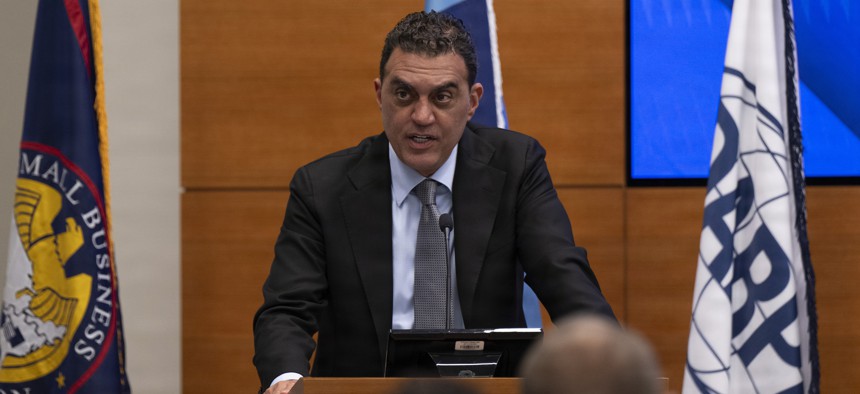
Undersecretary of Defense for Research and Engineering Emil Michael attends a Defense Advanced Research Projects Agency event at DARPA Headquarters, Arlington, Va., April 29, 2026. Staff Sgt. Milton Hamilton/Air Force


Defense Under Secretary for Research and Engineering Emil Michael said new agreements with Big Tech companies are a “counterstatement” to the ongoing Anthropic-Pentagon conflict as the agency prioritizes flexible contracts.
Leadership at the Pentagon reiterated the agency’s commitment to diversifying its artificial intelligence service providers, with Under Secretary of Defense for Research and Engineering Emil Michael taking the stage Thursday at an event in Washington, D.C., to stress that his department is never being “single-threaded with any one model.”
Speaking during the Special Competitive Studies Project’s AI+ Expo event, Michael said that the recent deals between eight leading AI developers and the Department of Defense are both a private sector statement of support for working with the government, as well as a step towards the Pentagon’s goal to diversify its tech stack with different providers.
“We were single-threaded on one vendor, one AI vendor at the Department of War, and to integrate into classified systems is not just putting your software on a public cloud and having it work,” Michael said, referring to his agency’s contract with Anthropic. “These are sophisticated, protective systems that take a lot of work to integrate on, so it wasn't like I could just turn on a few other models that easily. But never again we’ll be single-threaded with any one model.”
Michael continued to say that the new deals with Amazon Web Services, Google, Microsoft, NVIDIA, OpenAI, Reflection, Oracle and SpaceX are “a statement by the biggest tech companies in the world who are involved in the AI space … and have them say, ‘We support the Department of War, we support the U.S. government, and we support the… armed services for all lawful use cases.”
Michael’s comments come in the midst of an ongoing dispute between Anthropic and the Department of Defense following the company’s refusal to have its technology used in operations involving autonomous weaponry and American surveillance.
The fallout of that dispute resulted in the Pentagon designating Anthropic a supply chain risk and the White House ordering agencies to begin removing the company's products from their tech stacks. A judge put a hold on those actions in late March pending ongoing litigation over the government’s actions.
The release of Anthropic’s advanced cybersecurity-focused model, Mythos Preview, changed the discussion. Access to Mythos and its advanced capabilities for detecting cybersecurity flaws is tantalizing for the U.S. government, prompting internal drafts of policy plans that would enable some agencies to use Anthropic’s cutting-edge model.
Michael said that the advent of Mythos signals the forthcoming evolution of cyber-capable AI models.
“The Mythos moment is really a cyber moment, and it's: ‘How is the U.S. government going to deal with cyber?’” Michael said.
Major tech companies are responding to Michael’s drive to diversify the Pentagon’s vendor portfolio. Rand Waldron, the vice president of the Global Government Sector for Oracle Cloud Infrastructure, told Nextgov/FCW that Defense officials are asking cloud service providers like Oracle to prioritize interconnectedness in the effort to avoid vendor lock-in.
“From what I can see, the Department of War has some very savvy people who … don't want to go all in on one [model] because then six months later, they may need to go all in on another,” Waldron said.
He explained that there will likely be models that are more finely-tuned to particular use cases, such as code generation, data analytics, supply chain management or targeting in warfighter operations. One model from a single provider may not effectively serve each of these workflows.
“I don't believe that all those different use cases will end up being the exact same model at any given time,” Waldron said.
The Pentagon’s desire to expand the service offerings available for its workforce has precedent. Waldron said that DOD and the intelligence community have laid the foundation for a flexible approach to AI services acquisition, citing the creation of the Commercial Cloud Enterprise and Joint Warfighting Cloud Capability contracting vehicles as the blueprints for future contracting structure.
“It's not like they're trying to replace Anthropic with another model provider,” Waldron said. “They want to replace Anthropic with four model providers.”