
Argonne launches high-performance computing-backed AI research service
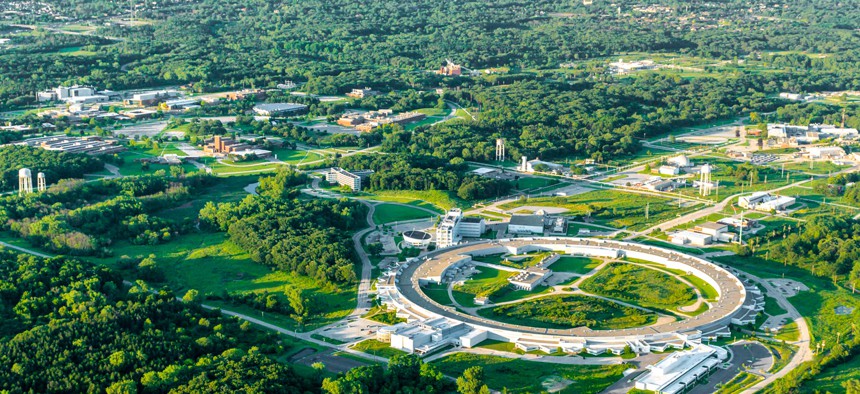
Aerial image of Argonne National Laboratory. Argonne National Laboratory/Flickr




The new platform headquartered at Argonne National Laboratory grants Department of Energy researchers remote access to advanced AI models for scientific discovery.
Argonne National Laboratory announced on Tuesday that it launched a new platform to offer researchers access to various artificial intelligence models, the latest move supporting the Department of Energy’s mission to spur advanced research and innovation in AI.
The lab is deploying an AI inference service — a cloud-like offering that is designed to analyze data, make connections and supply predictions — to facilitate scientific access to leading AI models. The service will provide an array of large language models and scientific foundation models to users in the national lab apparatus.
“Our inference service helps close the gap between developing AI models and putting them to work in scientific research,” Michael Papka, the director of the Argonne Leadership Computing Facility, said in a press release. “By offering AI inference as a shared resource, we enable researchers to apply AI at scale to their data, simulations, and experiments, without the burden of building and maintaining their own infrastructure.”
Hardware powering the inference service is headquartered within Argonne. Leveraging the lab’s flagship exascale computer, Aurora, the inference service will also run on Argonne’s NVIDIA DGX A100 cluster, Sophia, along with the ALCF’s SambaNova SN40L chip cluster, Metis.
The models offered via Argonne’s inference service — which include commercial and in-house options — are pre-trained. Granting researchers facilitated access to powerful, tailored models will help them “spend less time managing models and more time testing hypotheses,” said Venkat Vishwanath, AI and machine learning lead at the ALCF.
The current models available include open-weight models, domain-specific science foundation models, among others, Papka told Nextgov/FCW.
“Instead of taking days or weeks to analyze data, scientists can rapidly interpret results, refine experiments and explore complex systems in ways that weren’t practical before,” Vishwanath said.
The new offering is based on a 2025 paper that outlined a framework “to give researchers the ability to run multiple AI tasks in parallel on different models without relying on commercial cloud services.”
This effort contributes to Energy’s ongoing Genesis Mission, a project that aims to spur advanced research and innovation in AI by leveraging federal datasets and resources.
Per the press release, researchers at Los Alamos National Laboratory, Brookhaven National Laboratory, Lawrence Berkeley National Laboratory, Fermi National Accelerator Laboratory, Lawrence Livermore National Laboratory, Oak Ridge National Laboratory, Sandia National Laboratories and Thomas Jefferson National Accelerator Facility are also able to access the inference service.
The service can leverage its model access to work beyond research in AI. Although it functions as a new pillar in the Genesis Mission, ALCF says that the inference service can be applied to other fields, such as research in fusion energy, chemistry and materials science.