
Lieu and Obernolte introduce consolidated AI bill package
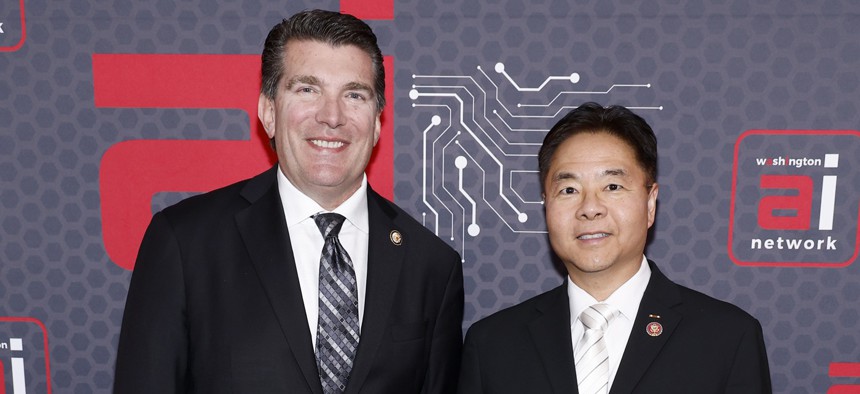
(L-R) Representative Jay Obernolte and Representative Ted Lieu attend AI Honors hosted by the Washington AI Network at Waldorf Astoria on June 03, 2025 in Washington, DC. Paul Morigi/Getty Images for Haddad Media






The American Leadership in Artificial Intelligence Act takes provisions from previous bills and the 2024 Bipartisan AI Task Force report to move forward AI policies with support from both sides of the aisle.
Two California lawmakers introduced a sweeping bill Monday that aims to push several bipartisan artificial intelligence regulatory efforts forward via a single package.
The legislation includes six titles covering a broad range of AI goals: strengthening standards, testing and evaluations; building research infrastructure and spurring groundbreaking research; modernizing federal AI governance, procurement and security; protecting workers and empowering small businesses; safeguarding Americans and deterring harmful deepfakes; and expanding education, literacy and inclusion.
Reps. Ted Lieu, D-Calif, and Jay Obernolte, R-Calif., introduced the American Leadership in AI Act as an amalgamation of over 20 previous legislative proposals and recommendations made by the Bipartisan Artificial Intelligence Task Force that tackle aspects of the U.S. AI regulation and innovation that both parties have supported.
“The American Leadership in AI Act builds on the strong bipartisan foundation already laid by our colleagues, incorporating and advancing bipartisan legislation previously introduced by Members across the House,” both lawmakers stated in a press release. “By unifying these efforts, this package reflects the thoughtful, consensus-driven work already underway and translates it into a cohesive strategy to strengthen U.S. leadership in AI.”
Lieu and Obernolte led the Bipartisan AI Task Force that convened during the last Congress. The work from that effort culminated in a 2024 report that offered recommendations on how to best execute AI regulation nationwide, focusing on sector-specific approaches to risk mitigation.
The American Leadership in AI Act begins by asking the National Institute of Standards and Technology to participate in standards setting that ensures U.S. AI systems can operate and compete globally.
Sections that follow focus on launching multiple pilot programs to further U.S. AI objectives — including one for standards setting — and prize challenges to spur agency AI innovation.
The bill also aims to modernize government procurement, dedicating a section to supporting agency implementation and use of AI within the government. It includes a provision for “ensuring accountability” for acquisition and use of AI should it result in “flawed, inaccurate, or biased decisions that would impact individuals.”
To support society as it adapts to AI, the bill includes provisions that modify the Internal Revenue Code to offer tax deductions for employers granting their employees cybersecurity education. It also directs the federal government to participate in crafting and disseminating AI literacy and education, specifically through grant funding opportunities.
Congress has yet to pass comprehensive AI legislation, resulting in state governments that have stepped in to fill the void to regulate the growing technology.
That dynamic has led to both the White House and members of Congress proposing that the federal government place a moratorium on state laws in order to protect innovation and give the federal government more time to craft unifying regulation. State leaders, meanwhile, have argued that Congress’s failure to pass its own regulations has made it necessary for the more localized governments to step in.
The Trump administration’s recent framework envisions delineating specific lanes for states to regulate, namely child safety, while allowing the federal government to unify states under pro-innovation laws.