
Lawmaker looks to award grants for veteran suicide prevention AI models
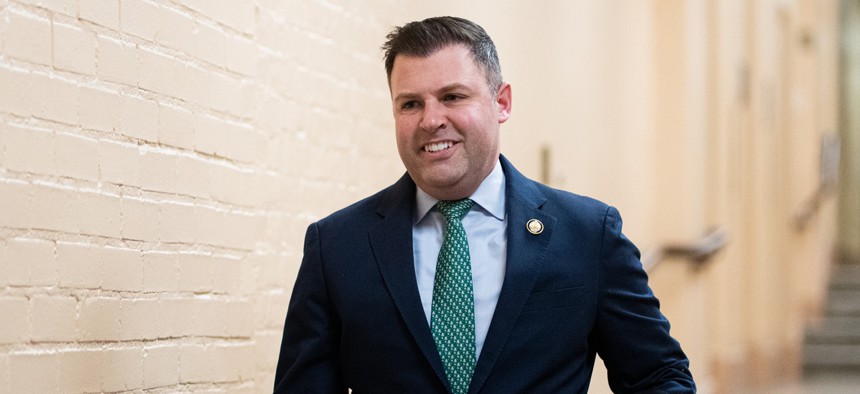
Rep. Ryan Mackenzie, R-Pa., arrives for the House Republican Conference meeting in the U.S. Capitol on Wednesday, December 10, 2025. Bill Clark/CQ-Roll Call, Inc via Getty Images





Rep. Ryan Mackenzie, R-Pa., told Nextgov/FCW that he wants to provide grant funding to figure out which risks “are the ones that we should be paying attention to most closely that contribute to incidents of suicide.”
As the Department of Veterans Affairs further expands its use of machine learning and artificial intelligence tools to identify veterans in crisis, one House lawmaker is looking to provide support to organizations outside the agency that want to leverage the power of these emerging capabilities for veteran-focused suicide prevention efforts.
In January, the House Veterans’ Affairs Subcommittee on Health held a legislative hearing that included consideration of a discussion draft from Rep. Ryan Mackenzie, R-Pa., that would direct VA “to carry out a program to award grants for the development of predictive models to evaluate risk factors that contribute to the incidence of suicide among veterans.”
Mackenzie’s proposed measure, the Data Driven Suicide Prevention and Outreach Act, looks to build on some of the promising internal AI-powered approaches that VA has already been taking to provide more targeted support and assistance to veterans at high risk of self-harm.
VA’s 2025 AI use case inventory, which was publicly released at the end of January, included 367 examples of the department’s adoption and exploration of the emerging capabilities. Five of these use cases included a direct focus on pinpointing veterans experiencing suicidal ideation, with those approaches either in the deployed or pre-deployment phases.
One of VA’s most notable examples of leveraging AI capabilities to direct targeted support to veterans in crisis is the Recovery Engagement and Coordination for Health-Veteran Enhanced Treatment — or REACH VET — program, which Nextgov/FCW previously explored in-depth as part of a review of the department’s uses of emerging capabilities for suicide prevention.
The predictive model, which was launched in 2017, identifies veterans in the top 0.1% of suicide risk by analyzing health records for specific indicators of potential self-harm in order to provide them with more focused support. VA subsequently released an updated REACH VET model last year to include new risk factors, such as military sexual trauma.
In an interview with Nextgov/FCW, Mackenzie said his legislative effort includes “recognizing VA initiatives, like REACH VET, that already have been out there and use predictive analytics to identify vets who are at the highest statistical risk for suicide, and proactively kind of connect them with tailored care and outreach.”
VA’s latest National Veteran Suicide Prevention Annual Report, which was released in March, found that 6,398 veterans died by suicide in 2023 — 44 fewer deaths than reported in 2022, and a total that VA said “was lower than 14 of the previous 15 years.”
The same report, however, found that 61% of retired servicemembers who died by suicide in 2023 had not received any VA healthcare services in the year before they took their own lives.
Mackenzie said that statistic, as well as the growing adoption of AI across state and federal agencies, caught his attention.
His proposal would further VA’s efforts by providing support to nonprofits, academic institutions, private research organizations and other groups looking to leverage AI and predictive models to better identify suicide risk factors among the veteran population. Only one grant recipient would be selected in each of VA’s 18 Veterans Integrated Service Networks, or VISNs, although VA has rolled out plans for a major reorganization that would consolidate many of those networks. The grant program would sunset by Sept. 30, 2029.
Mackenzie said his measure would “allow grant funding for the development of those predictive models created with AI and machine learning, so that we can figure out what’s best to evaluate those risk factors and figure out which ones are the ones that we should be paying attention to most closely that contribute to incidents of suicide.”
VA already has several initiatives that provide funding and support to outside organizations working to support veterans in crisis, although they are broader in scope than the program proposed by Mackenzie.
The agency announced earlier this month that it would award up to $112 million to eligible organizations during fiscal year 2027 through the Staff Sergeant Parker Gordon Fox Suicide Prevention Grant Program. VA said the program “supports non-clinical, innovative and community-driven approaches to suicide prevention — particularly for Veterans who may not yet be connected to VA care and those living in under-resourced or high-risk areas.”
VA also launched Mission Daybreak in 2022 to award grants to groups pursuing innovative solutions to the veteran suicide crisis. Although the initiative began as a $20 million grand challenge, VA has since continued Mission Daybreak through a Broad Agency Announcement to source and fund research and proposals from external innovators.
During a panel at the HIMSS Conference in Las Vegas earlier this month, Haipeng “Mark” Zhang — acting assistant under secretary for health in the Veterans Health Administration’s office of discovery, education and affiliate networks — said he didn’t know if VA would renew the BAA again, but added that “I think the fact that we did it already is a pretty big sign.”
Mackenzie said grants awarded under his proposal would be more targeted “towards organizations that have demonstrated expertise in healthcare, AI, data security [and] clinical deployment.”
In addition to groups with experience administering predictive analytics in healthcare settings, the congressman’s measure would give grant priority, in part, to eligible entities that are located in areas with a high veteran suicide rate, high rates of calls to the Veterans Crisis Line and that experience long wait times for VA-provided mental healthcare services.
According to the discussion draft, award preference would also be given to recipients “that agree to make any predictive model or finding resulting from activities funded … for Department of Veterans Affairs-wide implementation and evaluation.”
The congressman said AI “is not a replacement, but a force multiplier” for clinicians and providers, one that can enhance their ability to deliver care by offering them additional insights for human-led treatments. For his proposed grant program, Mackenzie said the data analysis will operate in the background and should enhance care “because things are going to be brought to [a provider’s] attention that maybe an individual clinician wouldn't have picked up on.”
Mackenzie’s discussion draft has received mixed support from some major veteran service organizations.
The Wounded Warrior Project announced that it was pleased to support his measure, saying, in part, that grant funding for the development of predictive models focused on evaluating suicide risk factors “could help clinicians prioritize interventions and tailor care, improving outcomes and saving lives.”
The Veterans of Foreign Wars voiced opposition to the proposal, however, expressing concern about the expanding use of AI in veteran care and the creation of “a parallel grant structure that republishes work VA is already authorized and funded to do, diverting attention and resources away from improving and fully implementing current efforts.”
Mackenzie said he appreciates the feedback his discussion draft has received and added that he is working with relevant stakeholders and the House Veterans’ Affairs Committee’s staff to hone the measure before formally introducing it at a later date.
“The challenges that our veterans face and the increased incidence of veteran suicide are certainly a concerning thing, and so we're presenting here a very good way to improve veterans’ care, and ultimately the outcomes of that care,” he said. “And it's not a replacement for any kind of healthcare professionals at the VA. We view it as an additive to increase their abilities and their bandwidth to help provide care for more of our veterans, which is so necessary.”