
Trump plans to sign order preempting state AI laws
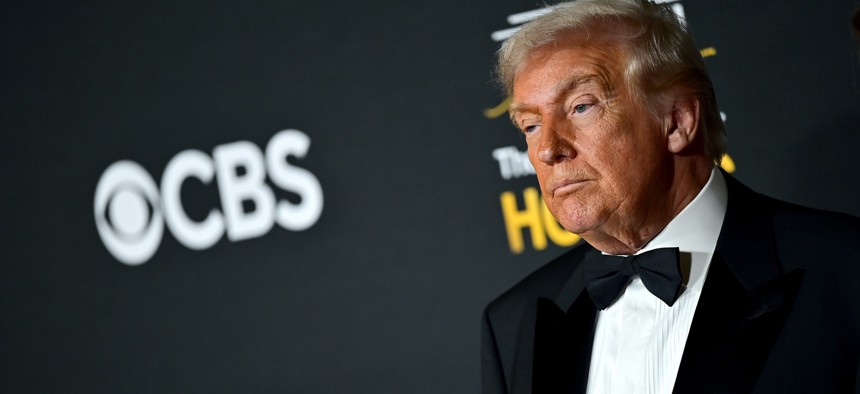
President Donald J. Trump attends the 48th Kennedy Center Honors at The Kennedy Center on December 07, 2025 in Washington, DC. Shannon Finney/WireImage





Congressional efforts to legally place a 10-year moratorium on state artificial intelligence regulation have thus-far failed to garner enough support.
President Donald Trump confirmed on Monday that he plans to sign a new executive order focused on ensuring U.S. leadership in artificial intelligence development through “one rule” to counter the spectrum of differing state regulations.
Trump said in a post on his Truth Social platform that the U.S. is currently ahead in the global race for AI dominance, but a patchwork of differing state laws threatens this lead.
“We are beating ALL COUNTRIES at this point in the race, but that won’t last long if we are going to have 50 States, many of them bad actors, involved in RULES and the APPROVAL PROCESS,” the post read. “THERE CAN BE NO DOUBT ABOUT THIS! AI WILL BE DESTROYED IN ITS INFANCY! I will be doing a ONE RULE Executive Order this week. You can’t expect a company to get 50 Approvals every time they want to do something. THAT WILL NEVER WORK!”
The promised executive action follows the legislative failure of a proposed decade-long moratorium on states’ ability to regulate AI at the local level, helmed by Sen. Ted Cruz, R-Texas. The provision was left out of both the 2026 National Defense Authorization Act and the One Big Beautiful Bill Act.
A draft version of the potential executive order establishing a prohibition on new state AI regulation was circulated in late November. That draft relied on tying federal funding to whether states kept “onerous” AI laws off their books.
Some industry groups have raised concerns over the preference this executive order gives to major tech companies, especially given the absence of federal laws that protect data privacy and minors online.
“Right now, state laws are our best defense against AI chatbots that have sexual conversations with kids and even encourage them to harm themselves, deepfake revenge porn and half-baked algorithms that make decisions about our employment and health care,” Emily Peterson-Cassin, the policy director at Demand Progress said in a statement. “Punishing states for enacting AI safeguards only makes sense if the president’s goal is to please the Big Tech elites who helped pay for his campaign, his inauguration and his ballroom.”
Brendan Steinhauser, the CEO of The Alliance for Secure AI, echoed this sentiment.
“Any executive order that threatens or punishes states for enacting AI laws to protect their citizens is an alarming overreach that is not driven by the public interest, but by the influence of Big Tech elites like David Sacks,” Steinhauser said in a statement. “True innovation thrives through collaboration, not through the centralized control of billionaires and unelected bureaucrats colluding to determine the future of AI.”
Alternatively, D.C. think tank R Street Institute voiced support for state preemption as a necessary alternative to Congress’s lack of advancing any sweeping federal law.
"The coming executive order reflects the frustration of a White House that has thus far had to carry AI policy largely on its own. Congress is such a dysfunctional mess currently that they cannot carry out their constitutional responsibility to create a national AI policy framework to [address] the conflicting patchwork of [confusing] states and local laws,” Adam Thierer, a senior fellow at the R Street Institute told Nextgov/FCW. “So, Trump and the White House are now going to push the envelope to see how much they can do on their own to guarantee American leadership on AI going forward.”