
Shutdown could delay Congress ‘getting serious’ about AI policy
ANDREW CABALLERO-REYNOLDS/AFP via Getty Images



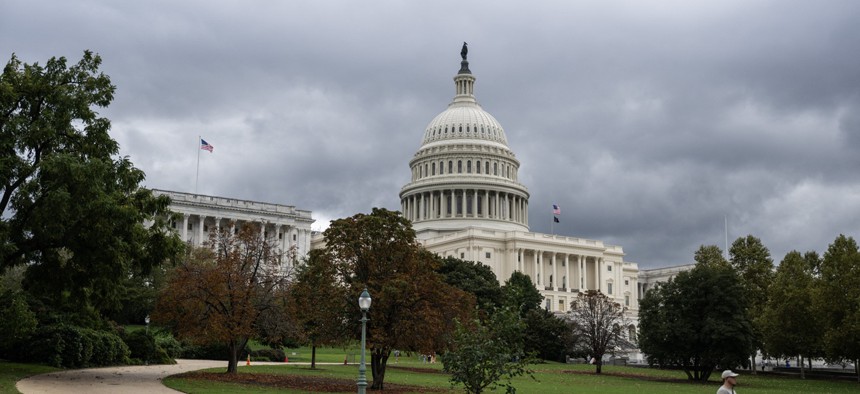
The shutdown hobbled congressional activity on artificial intelligence legislation, a setback that could hinder the Trump administration's broader tech policy plans.
Policy experts are anticipating a delay in the the implementation of federal technology requirements as a result of the ongoing government shutdown.
Complex issues surrounding emerging tech innovation and regulation are among the legislative projects that have been forced to take a backseat during the lapse in government funding, those experts say, and they are likely to not get priority as other, larger bills steal focus.
“The federal shutdown will affect a lot of ongoing and important legislative activity, and for AI policy it means further delay in Congress getting serious about creating a national policy framework,” Adam Thierer, a senior research fellow at the R Street Institute, told Nextgov/FCW.
Some of the stalled bills include the landmark annual defense policy bill — the National Defense Authorization Act — along with more specific policy bills, such as the AI sandbox proposed by Sen. Ted Cruz, R-Texas, and the AI risk evaluation bill led by Sen. Josh Hawley, R-Mo., among others.
“It is our hope that Congress will vote to end the government shutdown, and give the companies, workers, and consumers that keep the U.S. economy moving certainty to continue to drive America’s leadership in AI and innovation,” Jason Oxman, the president of the Information Technology Industry Council, said in a statement.
Craig Albright, the senior vice president for U.S. government relations at the Business Software Alliance, said that 2026’s NDAA will likely take up most of the oxygen in Congress.
“The NDAA [is] something that’s going to be a big hurry whenever [Congress] opens back up,” Albright told Nextgov/FCW.
Senate lawmakers on Thursday, however, reportedly struck a deal to vote on 17 standalone NDAA amendments. Politico, which first reported the news, said the agreement also included a vote on a manager’s package of around 50 largely non-controversial measures and passage of the larger bill “at a time to be determined.”
The AI provisions Albright spotlighted in the NDAA have substantial implications for AI adoption in the military as well as procurement protocols. Beyond defense, however, Albright doesn’t expect AI-centric legislation to dominate the end of the year in Congress, but more bills could be introduced.
“While we don't necessarily expect a surge in AI legislation once the government reopens, having the government reopened and Congress back to normal business enables more work on AI legislation by Senate Commerce [Committee] and others,” Albright said.
Albright also underscored the interruption the shutdown caused for executive efforts to incorporate AI into government operations, a key tenant in President Trump’s AI Action Plan.
Other experts, such as Thierer, worry over the potential regulatory patchwork that could bloom absent sweeping federal AI law.
State legislatures, on the other hand, had a busy year when it came to AI regulatory legislation. Although many are now out of session, Albright said that he expects legislatures in states like California and Colorado –– both of whom have passed sweeping AI legislation this year –– to be comparably busy with AI next year.
“If the Congress cannot get back in action soon and get something done, it effectively means that Democratic governors will be setting AI policy for the nation through a Blue State regulatory patchwork that is inspired by the old Biden AI agenda, which President Trump has worked to undo since taking office,” Thierer said. “The Trump AI Action Plan will end up being a meaningless exercise unless Congress gets back to work and asserts its authority to oversee interstate algorithmic commerce.”
NEXT STORY: OpenAI, AMD announce 6 gigawatt partnership