
White House tech director breaks down plan to balance AI national security and export promotion
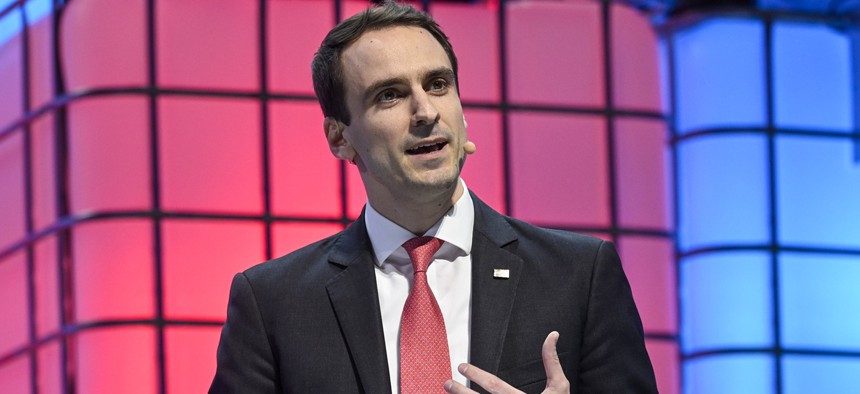
OSTP Director Michale Kratsios, pictured here at a 2019 Web Summit event, said on July 30 that the administration is looking to balance export controls with the proliferation of U.S. technology. Horacio Villalobos/Corbis via Getty Images


White House OSTP Director Michael Kratsios said that the “highest end of semiconductors” should fall under export controls, but the administration still wants the world using U.S. technology.
The Trump administration’s sweeping artificial intelligence policy aims to ensure that a U.S.-led technology stack is used at home and abroad, according to the Office of Science and Technology Policy Director Michael Kratsios.
Speaking Wednesday morning at the Center for Strategic and International Studies, Kratsios dissected the three executive orders on AI policy signed by President Donald Trump last week. Kratsios said they help to establish the administration’s three AI-policy pillars: leading in AI innovation, developing infrastructure, and supporting technology exports.
“We have to have the most dominant technological stack in the world, and that's critically important for our national economic security,” he said.
Kratsios focused on the latter element as critical to domestic and national security, identifying the potential for sensitive data breaches if AI systems used by the government are made internationally.
“The way that these … models operate on the government level is all the government data that the government has is going to be ingested into models to provide citizen services — whether it's the way you pay your taxes, whether it's through health care records, whether it's small things that apply to get a permit through international park or a campsite. All of this stuff is going to be part of the AI fabric, and it would be a huge problem if the model that is fine tuned to generate these AI solutions isn't from America,” he said.
Kratsios noted that the administration is preparing to take new action regarding one key component of the technology stack: semiconductor chips. Following Trump’s rescission of the Biden administration’s AI diffusion rule, forthcoming guidance will reiterate protections for large scale chip transactions, particularly to adversarial nations. He noted that traditional security restrictions on chip license transactions will apply, such as limits on intelligence and military actors.
He further identified concerns about chip export security as being broadly twofold: the physical diversion of semiconductor chips, both for edge devices and large-scale data centers; and prohibited actors’ ability to access, run or train their AI models on U.S. data centers.
“The thing we have to remember [is], what are we most worried about?” Kratsios said. “Are we most worried about, sort of small scale, sort of inference runs for some Chinese app? Probably not. What they're most worried about is large-scale runs that are for training sophisticated models.”
A “stringent and strong” regime of know-your-customer requirements imposed on data center operators along with monitoring for the scope of AI training runs is what Kratsios believes will help identify bad actors.
“We generally believe … that the highest end of semiconductors need to continue to be export controlled, not allowed into China, and that's important for our ability to maintain our leadership in this race,” he said.
Doubling down on a key provision in the export control executive order, Kratsios said that activating agencies like the Department of Commerce’s Bureau of Industry and Security can help support a clear export regime.
“You can have the best export controls in the books, but if you're not able to effectively enforce them because they're resource constrained, that's a challenge,” he said, adding that this is something Commerce Secretary Howard Lutnick and BIS Secretary Jeffrey Kessler, along with Hill lawmakers, are working on. “We have to find ways to provide the tools that BIS needs to be the enforcement.”
Kratsios added that not every American tech product will be cut off from China. He said the Trump administration is weighing the trade offs of protecting U.S. security while ensuring American tech companies have access to the global market and get the world running on U.S. products.
“We have the best chips, we have the best clouds, we have the best models, we have the best applications,” he said. “Everyone in the world should be using our technology, and we should make it easy for the world to use it. We want everyone in the world developing AI.”
Commerce recently gave tech giant NVIDIA the green light to resume sales of its H20 chips to China, although the move has received some bipartisan pushback over concerns that Beijing will use the semiconductors to advance its military capabilities. A NVIDIA spokesperson previously told Nextgov/FCW that criticisms of the ban’s reversal “are misguided and inconsistent with the Administration's AI Action Plan.”
NEXT STORY: Agency AI use doubled in 2024, GAO finds