
Feds tie counterterrorism grants to election security measures
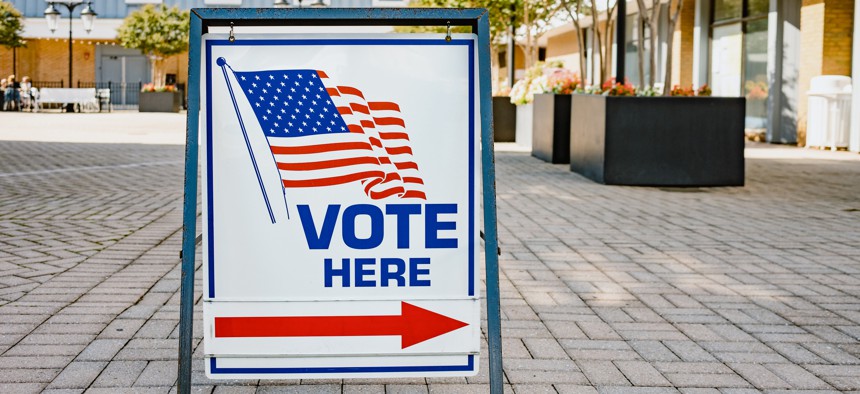
Grace Cary via Getty Images




 By
Chris Teale
By
Chris Teale
The new guidance from FEMA would require states to take various steps on elections before receiving funds. Government groups criticized the move as an overreach.
The Federal Emergency Management Agency announced late last week that states must implement various election security measures before they can receive homeland security grants.
In its funding opportunity for the $1 billion Homeland Security Grant Program, FEMA and the Department of Homeland Security, its parent agency, said states would need to take what FEMA called “critical, common-sense steps to protect U.S. elections,” to receive any funds.
Those steps include submitting a plan for transitioning away from electronic voting systems that use bar codes and QR codes to count votes and onto equipment that uses hand-marked paper ballots. They also would be required to manually audit at least 5% of all ballots cast after every federal election and reconcile the number of voters who participated in each federal election with the number of ballots cast.
Within 120 days of accepting a grant award, states would be required to use the U.S. Citizenship and Immigration Services’ Systematic Alien Verification for Entitlements system to verify the citizenship status of everyone listed in the state voter registration database. States would also be required to use the SAVE system or another system to verify the citizenship of anyone working at polling places or operating election systems.
“Election security is national security and protecting the Nation’s critical infrastructure is a top priority,” Homeland Security Secretary Markwayne Mullin said in a statement. “Under President Trump’s leadership, we are taking decisive action to protect election systems from threats like foreign interference, insider threats, and cyberattacks. These new requirements for homeland security grant recipients will preserve election integrity and ensure that Americans can trust the results.”
Government groups have already raised objections and concerns that these new requirements might divert a public safety program away from its original mission.
“Election administration has long been a state and local responsibility,” said Irma Esparza Diggs, director of federal advocacy at the National League of Cities, in an email. “Using homeland security grants to influence state election policies raises concerns about federal overreach and the potential erosion of state and local authority. Homeland security funding should remain dedicated to its core purpose of protecting communities from terrorism, cyber threats and other public safety risks.”
This latest gambit comes after a tumultuous week in election administration, after President Donald Trump fired two members of the Election Assistance Commission and another resigned, leaving the body without any sitting commissioners just months before November’s midterm elections.
In addition, the Trump administration has taken legal action to try to obtain voter data from secretaries of state, though it has so far been unsuccessful in court against states opposed to those measures. The administration also cut staff at the Cybersecurity and Infrastructure Security Agency and ended federal funding for the Elections Infrastructure Information Sharing and Analysis Center.
This move to tie grant funding to election-related demands has echoes of an executive order Trump signed last year. That order mandated changes to the national registration form and decertification of vote tabulators that use QR codes. When the EAC did not act on those mandates, the Trump administration earlier this year ordered the U.S. Postal Service to require states to provide citizenship lists for residents voting by mail. Parts of that order were also blocked in court.
Using these homeland security grants to change states’ elections policies is a new move, however. The grants are typically used by state, local, Tribal and territorial governments to prevent, protect themselves against, mitigate, respond to and recover from acts of terrorism. It includes three programs designed to fund various activities for preparedness, including planning, organization, equipment purchase, training, exercises and management and administration.
“The Trump administration says these grant conditions take ‘decisive action’ to protect elections from foreign interference and cyberattacks, but they do the opposite, interfering with national security at the moment officials can least afford it,” said Tim Harper, project lead for elections and democracy at the nonprofit Center for Democracy and Technology, in an email. “[Now], this notice threatens to withhold 20% of a state’s entire homeland security grant, taking hostage the very funds that support fusion centers and other unrelated national security funding for things like bomb squad equipment and active-shooter preparedness. If this administration actually wants to strengthen election security, it would restore the partnerships and cyber funding officials depend on, not threaten public safety in the name of advancing partisan election rules.”
Other local officials said they are reviewing the new guidance from FEMA but are concerned with some of the parameters.
“Counties are on the front lines of both election administration and homeland security preparedness, and many rely on Homeland Security Grant Program funding to protect critical infrastructure, train first responders and secure public spaces,” Eryn Hurley, chief government affairs officer at the National Association of Counties, said in an email. “[Our] priority is ensuring that any new compliance requirements come with adequate guidance, reasonable implementation timeframes and support so that counties aren’t forced to choose between meeting new federal mandates and maintaining the public safety services these grants are designed to fund.”