
Single-member surveillance watchdog backs 702 powers, raising independence questions
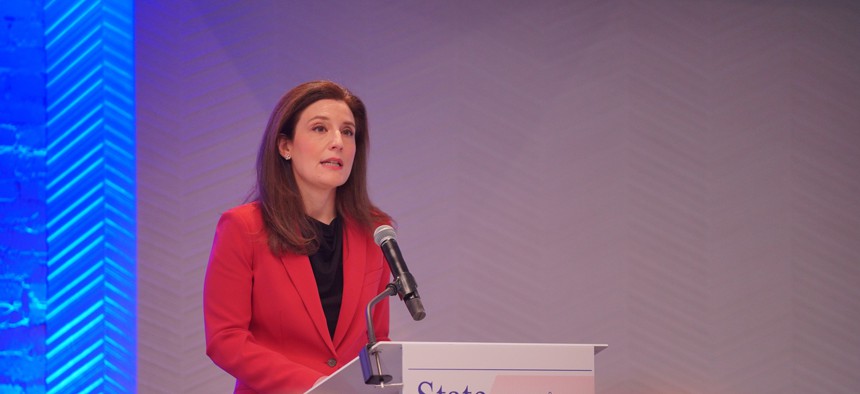
Privacy and Civil Liberties Oversight Board Member Beth Williams speaks at the February 11, 2025 State of the Net Conference. Internet Education Foundation




A staff report from the Privacy and Civil Liberties Oversight Board praises the value of Section 702 of FISA, though all but one of the board’s members were removed last year.
A staff report produced under the government’s top surveillance oversight watchdog largely praises the value of a controversial spying authority set to lapse later this month, raising concerns from civil liberties groups who question the validity of the findings.
Last year, President Donald Trump pushed for three Democrats serving on the Privacy and Civil Liberties Oversight Board to resign from their posts. It left just one Republican, Beth Williams, as the sole board member of the panel that was formed about two decades ago to investigate intelligence community infringements into civil liberties.
The report issued Thursday examines Section 702 of the Foreign Intelligence Surveillance Act, which allows the FBI, NSA and others to collect communications of foreigners abroad without a warrant. The law remains controversial because it can incidentally sweep up Americans’ communications, raising concerns among critics about compliance with the Fourth Amendment. The authority is set to expire April 20 unless renewed by Congress.
In 2024, lawmakers reauthorized the program for two years, adopting a number of reforms focused largely on FBI compliance with targeting procedures. The reforms didn’t include a long-sought measure from privacy advocates to include a warrant requirement for searches of U.S. person data collected under 702.
In the Thursday report, issued under a “Sub-Quorum Policy” without a full board, staff concluded that Section 702 continues to provide significant intelligence value and that recent reforms have improved compliance. The board, at a full slate, normally has five members, and a three-member quorum is required to conduct oversight business.
The report says that declining FBI searches for Americans’ information within Section 702 data may reflect hesitation that could affect detection of threats against the nation, a notable emphasis for a watchdog that has historically focused on misuse of the authority.
“A failure to conduct U.S. person queries, where appropriate, could lead to a failure to identify threats, make crucial connections, and protect national security,” the report says.
Civil liberties advocates were quick to point out their issues with the report.
“The board was designed to be multi-member and an independent institution,” said Kia Hamadanchy, senior policy counsel at the American Civil Liberties Union. “This is neither, given the PCLOB was gutted by the Trump administration. The report is a product of a single member hostile to civil liberties concerns who above all else prioritizes supporting the administration and intelligence community. It should not be taken seriously.”
“This is not a real PCLOB report, it’s a BethCLOB report,” said Jake Laperruque, deputy director of the Center for Democracy and Technology’s Security and Surveillance Project, referring to Williams as the sole member of the panel. “The basic concept of the board was a multi-member and an independent institution; this is neither.”
PCLOB has played a major role in surfacing violations tied to 702 because its members can review classified data affiliated with the statutes’ collection process. The FBI has acknowledged that it improperly used Section 702, specifically admitting to searching for information on individuals involved in the January 6, 2021, U.S. Capitol riot, as well as people arrested during 2020 racial justice protests following the police killing of George Floyd.
Intelligence derived from 702 has allowed the U.S. to stop terrorist attacks and track cyber threats. Thursday's report says that Section 702 data, including information from approved U.S. person queries, gave the nation’s diplomats key insights on U.S. hostages abroad, aiding negotiations and contributing to the safe return of several of them.
Collected 702 communications are stored in classified databases, where analysts query them for foreign intelligence. Search terms — known as “selectors” — can include names, phone numbers or email addresses of targeted individuals. Analysts may query stored U.S. person data when they believe doing so is reasonably likely to return useful information for investigations.
The law, enacted in 2008, codified parts of the once-secret Stellarwind surveillance program created under the Bush administration after the Sept. 11, 2001, terrorist attacks. In 2013, former NSA contractor Edward Snowden disclosed documents detailing how the authority was used, fueling a global debate over privacy and mass surveillance.
On Thursday, the intelligence community also released its annual transparency report detailing how major surveillance authorities are used. FBI searches of Americans’ information under Section 702 rose to 7,413 in 2025, up from 5,518 the year prior, but still far below the more than 57,000 queries conducted in 2023.
Requests to reveal the identities of Americans referenced in intelligence reporting, known as unmaskings, also rose sharply, underscoring that U.S. person data continues to play a major role in foreign intelligence analysis. Unmaskings are frequently used in the victim notification process when entities are targeted by hackers.
“Donald Trump illegally fired members of the Privacy and Civil Liberties Oversight Board — now the only board member left is a former Trump appointee,” said Sen. Ron Wyden, D-Ore., a longtime privacy advocate who sits on the Senate Intelligence Committee. Williams served in the Justice Department as Assistant Attorney General for the Office of Legal Policy in Trump’s first term.
“She just put out a report that says Trump needs to do more warrantless spying on Americans,” Wyden added. “No one should fall for it.”
A PCLOB spokesperson said the board “continues to produce professional staff reports under agency sub-quorum rules adopted by the quorate board in October 2024.”
Editor's note: This article has been updated to include a comment from PCLOB.