
Senators to revive reform effort for controversial spying law
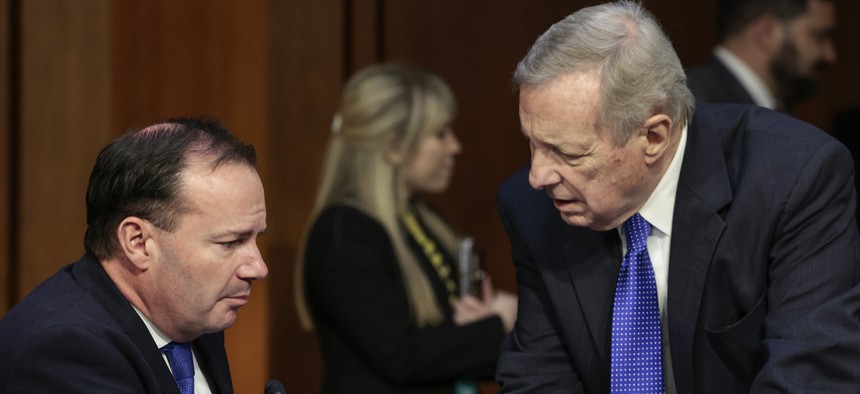
(L-R) Sen. Mike Lee (R-UT) confers with Sen. Dick Durbin (D-IL) as they return from a break in a Senate Judiciary Committee business meeting on April 4, 2022 in Washington, DC Anna Moneymaker/Getty Images






The proposed changes to Section 702 of FISA would mandate warrants for searches of U.S. person communications and revisit a 2024 provision that critics say widened the government’s surveillance reach.
Two lawmakers on the Senate Judiciary Committee plan to reintroduce a bill Thursday that seeks to make major reforms to a controversial spying law on track to lapse this spring, Nextgov/FCW has learned.
Sens. Dick Durbin, D-Ill., and Mike Lee, R-Utah, are expected to reintroduce the SAFE Act, which would amend Section 702 of the Foreign Intelligence Surveillance Act, according to two people with knowledge of the plans.
Section 702 allows spy agencies to target communications of foreigners abroad without a warrant, but the process can also sweep up the texts, emails and phone calls of Americans talking to targeted persons, raising civil liberties concerns.
The bill, which is a rehash of the senators’ 2024 reform measure that previously did not pass, would add a warrant requirement for queries of U.S. person data collected under the program and also clarify language tied to communications services providers that must comply with the statute, said the people, who requested anonymity to communicate details about the legislation.
Collections of U.S.-tied data under the program have sometimes been followed by unauthorized searches of Americans’ communications, which have been extensively documented by government oversight bodies in recent years. The findings fueled reforms designed to improve law enforcement compliance with existing rules that were adopted when Congress last renewed the authority in April 2024 for two years. Section 702 is set to expire again after April 19 unless lawmakers vote to extend it.
The 2024 renewal also expanded the definition of communications service providers that can be compelled to assist with 702 collection, a change that is widely believed and has been reported to include data centers. The SAFE Act would seek to clarify or narrow that provision, which critics say broadened the scope of who can be compelled to aid in surveillance.
Some lawmakers and civil society groups argue a warrant should be mandated for searches of collected 702 data that include U.S. persons’ communications, as it would create legal safeguards to protect Americans against unreasonable searches under Fourth Amendment protections. Warrants for such queries have been historically opposed by law enforcement and intelligence officials, who argue they can slow down timely investigations.
Efforts to require warrants for 702 searches involving Americans’ communications came close to success during the 2024 reauthorization debate, when a House amendment failed after a 212–212 tied vote.
“Section 702 is a valuable tool to help keep our nation safe. However, it’s being used to conduct thousands of warrantless searches of Americans’ private communications,” Durbin said in a statement to Nextgov/FCW. “That’s unacceptable. Our bipartisan SAFE Act is a commonsense solution to continue protecting our country from foreign threats — while safeguarding Americans’ civil liberties and privacy.”
“Americans should not have to fear warrantless spying from their own government. Our bipartisan legislation creates commonsense safeguards against the abuse of FISA 702 and loopholes exploiting the commercial data of law-abiding citizens,” Lee said in a statement.
The 702 debate has united both progressives and Trump allies, who have been heavily critical of FISA abuses documented by government oversight bodies. The FBI has acknowledged improper uses of Section 702, specifically admitting to searching for information on individuals involved in the January 6, 2021, U.S. Capitol riot, as well as people arrested during 2020 racial justice protests following the police killing of George Floyd.
The White House convened top-level staff and lawmakers on Tuesday to discuss a potential solution to the renewal, a senior Trump administration official told Nextgov/FCW.
“The president, several of his top advisers, and lawmakers will be participating in a discussion at the White House today about FISA Section 702 renewal. As always, the president is the final decision-maker on policy matters,” the official said.
During the 2024 reauthorization cycle, President Donald Trump — then a presidential candidate — publicly called for Congress to “kill” FISA, though he was conflating the specific Section 702 authority up for renewal with the broader law in which it’s housed. His demand stemmed from FBI-led investigations into his 2016 campaign’s ties to Russia, specifically the FISA warrants used to surveil former advisor Carter Page, which he and allies characterized as a weaponization of the intelligence community.
The FBI and other major national security components have long viewed Section 702 as a cornerstone spying tool. The bureau has privately warned congressional staffers that it’s very concerned about the law lapsing this spring, Nextgov/FCW previously reported.
Collected 702 communications are stored in classified databases, where analysts query them for foreign intelligence. Search terms — known officially as “selectors” — can include names, phone numbers or email addresses of targeted individuals.
Because a warrant is not required under the program, the Foreign Intelligence Surveillance Court signs off on the rules that govern how analysts choose their targets and how they handle any U.S. communications swept up in collection procedures. Analysts may query stored U.S. person data when they believe doing so is reasonably likely to return useful info for investigations.
Lawmakers, civil liberties organizations and other officials have asked the Trump administration for months about its stance on the authority, though the White House has not taken an official public position.
The dynamic hit a tipping point last week when lawmakers in a classified briefing grew frustrated with FBI and NSA officials who could not provide them with a clear answer on the White House’s position, CNN reported Monday.
Section 702 was enacted in 2008 to formalize elements of the Bush administration’s post-9/11 warrantless spying programs. In 2013, former NSA contractor Edward Snowden disclosed documents detailing how the authority was used, fueling a global debate over privacy and mass surveillance.