
House Democrats ask GAO to review CISA workforce cuts
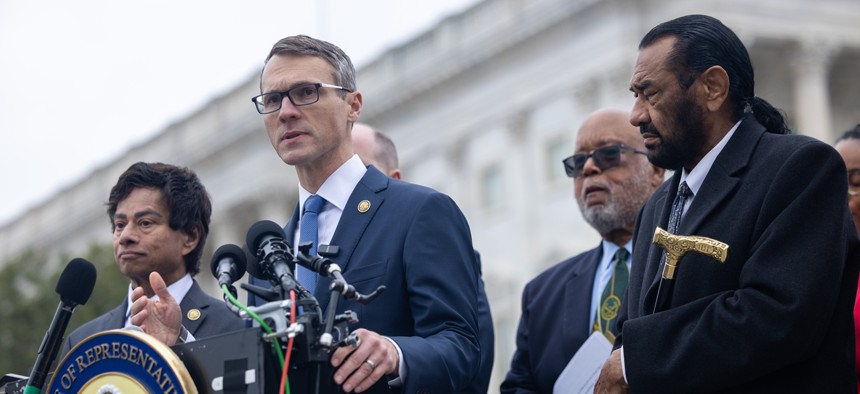
Congressman James Walkinshaw (D-VA) speaks at a press conference with other Democratic members of House Homeland Security Committee outside the U.S. Capitol in Washington, DC on January 14, 2026. Nathan Posner/Anadolu via Getty Images





Lawmakers want Congress’ watchdog to assess what capabilities were lost after the cyber agency shed roughly one-third of its staff.
Five House Democrats are asking Congress’ investigative arm to examine how significant staffing cuts at the Cybersecurity and Infrastructure Security Agency have affected the government’s ability to defend federal networks and critical infrastructure.
The lawmakers are calling on the Government Accountability Office — the top congressional watchdog that audits and evaluates federal programs — to examine the impact of personnel and program reductions enacted at CISA since President Donald Trump returned to the White House, according to a letter first seen by Nextgov/FCW.
The request, addressed to acting Comptroller General Orice Williams Brown, is led by Reps. James Walkinshaw, D-Va., Delia Ramirez, D-Ill., and Bennie Thompson, D-Miss., the ranking member on the House Homeland Security Committee. Ramirez is the top Democrat on the panel’s cybersecurity subcommittee, where Walkinshaw also serves. Reps. Seth Magaziner, D-R.I., and LaMonica McIver, D-N.J., who also serve on the cyber panel, joined the request.
The lawmakers say CISA has lost nearly a third of its workforce “at precisely the moment when our adversaries are accelerating attacks against critical infrastructure,” leaving Congress without a clear picture of which capabilities were lost and whether remaining teams can keep pace with growing cyber and physical threats.
The concerns have grown during the war with Iran, as CISA and the FBI help utilities navigate cyberattacks affecting at least 12 states that some U.S. officials suspect may be tied to Tehran.
The lawmakers are asking GAO to examine how CISA’s workforce has changed over the past five years, including its size, composition, geographic distribution and reliance on contractors. They also want the watchdog to identify which programs were affected by the reductions and what consequences CISA and its industry and government partners have reported.
The letter further asks GAO to evaluate what data CISA uses to make workforce decisions and whether its human capital strategy aligns with its current and future mission needs.
“Little is known about the impact of these workforce reductions on CISA’s programs and services,” the lawmakers write, arguing it’s unclear whether the agency is positioned to replace the skills it has lost.
Nextgov/FCW has asked CISA and GAO for comment.
CISA is now attempting to rebuild parts of its workforce after layoffs, voluntary departures and other personnel actions reduced staffing from roughly 3,300 employees to about 2,200. Acting Director Nick Andersen has said the agency plans to hire about 330 people, while Homeland Security Secretary Markwayne Mullin has said CISA may need roughly 600 additional staff and that hiring could take a year or more.
Walkinshaw previously told Nextgov/FCW that restaffing the agency would be “a very difficult thing to do,” noting that cyber personnel have seen colleagues pushed out and their work publicly criticized by administration officials.
The workforce picture has also been complicated by internal DHS transfers. CISA’s former acting director told lawmakers in February that about 70 agency employees were reassigned to other DHS offices, while just over 30 moved into CISA.
At the same time, the administration’s fiscal 2027 budget request calls for eliminating roughly 870 CISA positions, including cutting staff tied to election security, stakeholder engagement and workforce development. House appropriators have since advanced a bill that would provide CISA with about $400 million more than the White House requested and set aside $31 million for critical hires. The measure has not received a House floor vote, and the Senate has not released its version, leaving the agency’s final funding and staffing levels unsettled.
The cuts were part of the Trump administration’s broader push to shrink the federal workforce, but CISA has drawn particular scrutiny over its past election security work.
That fight dates back to Trump’s first term, when he fired CISA’s first director, Chris Krebs, after Krebs rejected Trump’s false claims that the 2020 election had been stolen from him. Republicans have concurrently accused the agency of censoring conservative speech when it worked with social media platforms to flag election- and COVID-related misinformation in and around the 2020 race.