
After year of pushing employees out, OPM embraces familiar recruiting playbook
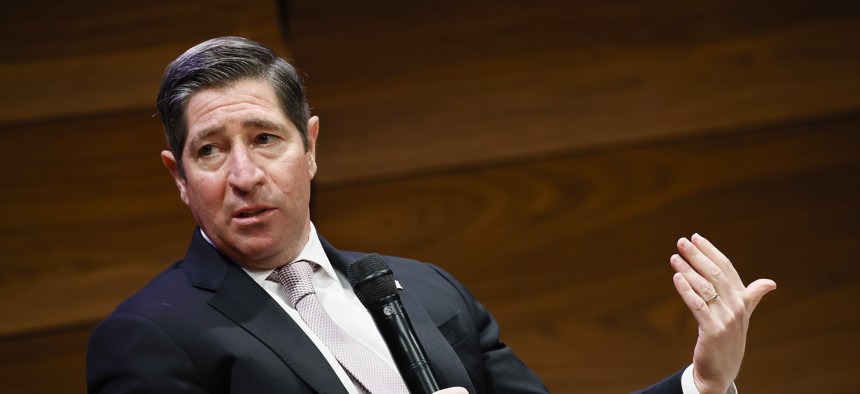
Office of Personnel Management Director Scott Kupor speaks at an event on Jan. 14. He said on Tuesday, with respect to agency recruiting, that “we’ve got to find people where they are." Paul Morigi / Getty Images





In order for agencies to attain top talent, Office of Personnel Director Scott Kupor pointed to job websites specific to college students, multi-agency position postings and tech recruiting programs — all strategies that the Biden administration also employed.
President Donald Trump came into his second term with the goal of downsizing the civil service, and his administration in nearly one-and-a-half years has more than erased gains to the government workforce that occurred under former President Joe Biden. Despite the emphasis on removing or otherwise pushing out agency staffers, Office of Personnel Director Scott Kupor said that he is seeking to streamline the process for bringing people into government.
In fact, several of the proposals he laid out at a Tuesday event hosted by Axios are similar to efforts Biden officials pursued to improve agency hiring.
“We’ve got to find people where they are,” Kupor said, specifically advocating for the use of Handshake, a popular networking website for college students.
Agencies have been using that platform for years. Handshake actually reported in 2024 that the college graduating class of that year applied for a higher percentage of government jobs on its website than the prior year’s senior cohort.
On Tuesday, Kupor also seemed to reference shared certifications, which enable different agencies to hire candidates from the same job announcement. In particular, he bemoaned that a job seeker who is rejected at one agency may be well-qualified for — but unaware of — a position at a different department.
“In the perfect world that I want, [if] you are somebody who wants a job with the federal government [and] you tell us what your general interests are, quite frankly we should push to you the opportunities that we think are relevant,” he said. “If it turns out the first one isn’t right, then we should push you to the second one, third one.”
Shared certifications have been a feature of OPM hiring plans under both the Biden and Trump administrations.
Kupor also argued that the federal government should not target younger workers for recruitment with the assumption that they’ll want to spend their entire careers in the public sector.
“We’ve had this marketing message, which is, come [to the government] and we basically will give you a 40-year career,” he said. “I’m obviously older than this age cohort, but I happen to have daughters in this age cohort, and I don’t believe anybody under the age of 30 today thinks in more than two- or three-year increments.”
But in recent years, experts have pointed to agencies’ historical association with stable employment as one of the top reasons that could persuade early-career workers to want to serve in government.
In its 2024 report, Handshake found that job stability was the top factor that graduating seniors in the survey reported would make them more likely to apply for a job. As a result, the company said this was, in part, what made the federal government attractive at the time to new workers.
And Michelle Amante, senior vice president of government programs at the Partnership for Public Service nonprofit, told Government Executive in April 2025 that the Trump administration’s mass removals of federal employees would cause government jobs to lose their appeal as stable positions safe from layoffs, which many civil servants accept as a tradeoff for making less money.
“We are going to lose Generation Z. They are not likely to want to come back and work for the government,” she said. “And then the generation after them, Generation Alpha, they're watching all of this play out. They're in their formative years watching what is happening in government. Why would they want to come work for an employer that not only does not provide stability but also does not provide a good environment to work in — where federal employees feel traumatized day in and day out?”
Gen Z refers to individuals born between 1997 to 2012, and Gen Alpha designates those born after.
Kupor, who worked for decades in the tech industry as an executive and investor, said that he was drawn to OPM because he’s found that workforce strength is an underappreciated factor in what makes organizations successful.
“What I’ve learned over my 16 years now in the venturing world is, what really matters at the end of the day is the talent that you have,” he said.
On Tuesday, Kupor also touted Tech Force, which was launched at the end of 2025 to recruit early-career software and data engineers into the government. In many respects, the program is similar to the U.S. Digital Corps, which was started in 2021 to provide opportunities in agencies to younger tech talent.
While OPM set a goal to bring on 1,000 individuals through Tech Force as soon as March, officials on May 28 said they’ve made 180 to 200 hires and have only onboarded 10 people.
If you have a tip that can contribute to our reporting, Sean Michael Newhouse can be reached securely at seanthenewsboy.45 on Signal.
NEXT STORY: VA CIO nominee vows to create program management office