
Social Security is directing employees who normally process benefits to answer phones instead
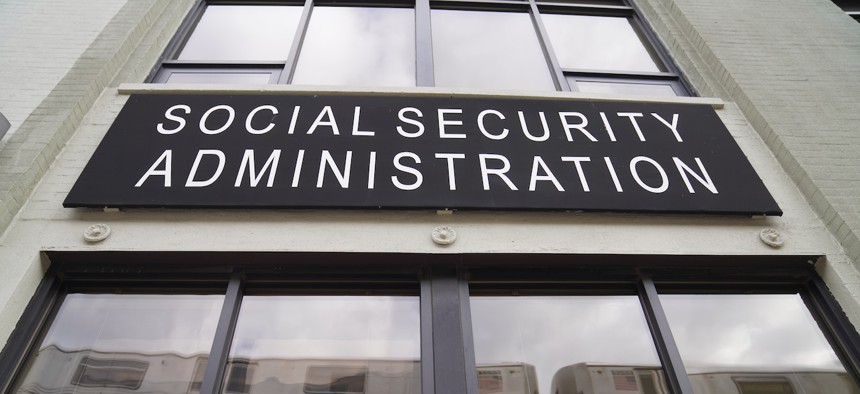
SSA’s processing center backlog—which stood at 6 million pending cases last year—is down by nearly 20% or over a million cases, the agency told Congress in November. Zhang Fengguo/Xinhua via Getty Images



After shedding thousands of employees, SSA is reassigning workers amid fears the moves will cause backlogs to grow.
Updated Feb. 9 at 9:52 a.m.
The Social Security Administration is shifting more employees to its phone line, a move that employees say risks adding to backlogs and processing times for the public as employees who typically handle those workloads are reassigned to take calls.
Employees who receive and process retirement and disability claims, manage the agency’s technology and work in the agency's finances unit will be answering SSA’s phone line after only hours of training. The reshuffling comes after SSA pushed out over 7,400 employees last year, according to newly released government data. That total eclipsed the Trump administration’s intended target of shedding 7,000 SSA workers, a target it announced a year ago.
That loss of workers included 1,387 contact representatives at the SSA, which is now fielding applications for replacements at several locations around the country.
The total number of affected employees now being moved to answer phones is unclear. Last month, the agency moved up to 800 employees from its processing centers, field office support units and workload support units to call answering duties, according to an email notice obtained by Government Executive.
On Wednesday, the agency said that it would be moving employees from its disability adjudication, financial and management, field office services, risk and quality, digital services and chief information officer units, according to another email. The employees SSA reassigned last week included benefits authorizers, claims authorizers and post-entitlement technical experts, who process claims and appeals to help seniors and disabled Americans receive their benefits.
These employees are on top of at least 1,000 field offices employees SSA moved to its phone line over the summer. The agency reassigned an additional 500 field office employees to 1-800 number duties in December, according to the union representing those workers.
Reassigned employees said it made little sense to answer calls for individuals awaiting information about the status of their claims and benefits while removing the people responsible for processing those claims and benefits.
“Why are we being forced away from the backlog of appeals and cases and forced onto the phones to take calls from people wondering what the status of their claim is and where their back benefits are?” one reassigned employee asked. “We are the workers who process the claims they are waiting for.”
Both processing centers and workload support units “are behind in those workloads,” another employee said. SSA workers said they fear falling further behind, or unwinding some of the progress they have made.
SSA’s processing center backlog—which stood at 6 million pending cases last year—is down by nearly 20% or over a million cases, the agency told Congress in November. It includes claims, but also other transactions like address changes.
Field offices maintained a 12 million case backlog, which includes both claims and other types of transactions, The Washington Post reported late last year.
“Most of the calls we are receiving are inquiries about why their claim or paperwork hasn't been processed. Well, those things aren't getting done because the people who normally do it are answering phones,” said one SSA field office employee in an office where some employees have been answering the 1-800 number since the summer.
The agency has touted reductions to its disability claims backlog, which as of December sat at 844,081 cases, down from a high in June 2024 of 1.26 million pending claims. That workload is mostly handled by states, although SSA has been supporting that work.
Several employees at processing centers said they received only three hours of training before being placed onto phone answering duties that same day. That is despite the agency telling its union that workers in other parts of the agency would receive eight hours of training. Employees said even that level of training would be insufficient due the complexity of issues that can arise on a call, even the simpler matters that SSA said are being routed their way.
Staff at every SSA processing center is thought to be taking reassignments to phone duties, employees said. At one facility, at least, an employee said every benefits authorizer is now answering phones full time.
“We aren’t doing other work so there will be a backlog of that,” the employee said.
An employee at another facility said management has sent at least 50 employees to phone duty. At the end of that to-be-determined rotation, another 50 employees will take their place.
“So the backlog we were doing so well at reducing will now grow,” the employee said.
An SSA spokesperson declined to address concerns that the reassignments would cause backlogs to spike, saying instead that the agency was shifting employees around to ensure it is operating at “peak efficiency.”
“With our focus on technology and process engineering, we have realized significant operational efficiencies throughout the agency, allowing us to deploy additional staff to assist customers on the National 800 Number,” said the spokesperson, who declined to be named. “This strategic deployment furthers our efforts to deliver the world-class customer service the American people deserve."
Many of the employees reassigned to phone duty have never performed such work previously and were asked to begin immediately after receiving a three-hour training. Others worked the phones during a surge several years ago, but did so only after receiving months of training and being shadowed by a full-time phone operator. In their normal day jobs, the employees have no direct contact with the public.
While employees have familiarity with some of the issues that callers to the SSA 1-800 number will pose, they said they do not have the full knowledge base. Some employees in their normal duties work only on retirement claims, for example, while others only on disability cases. Employees began answering phones the day after they found out about the reassignments, according to multiple impacted workers.
Rich Couture, spokesperson for the American Federation of Government Employees chapter that represents SSA employees, said the agency needs more staff for answering calls and throughout its divisions. He expressed concern that claims processing work will now pile up while reassigned employees struggle to adapt to new roles for which they are ill-prepared.
SSA has “pushed out thousands of experienced frontline workers through buyouts and layoff threats, including many seasoned 1-800-number employees,” Couture said. “Those unnecessary losses aggravated the agency’s already-diminished service capacity, given our 50-year staffing low.”
Frank Bosignano, SSA’s administrator, has deployed a similarly unorthodox approach at his federal side gig: CEO of the Internal Revenue Service. At the tax agency, Government Executive reported that Bosignano is moving hundreds of human resources and other staff with no experience working directly on tax issues to phone-answering duties. IRS has shed more than 20,000 employees since President Trump took office and has struggled to hire in preparation for tax filing season, leading the agency to tap HR employees to ensure “tax season doesn’t grind to a halt.”
SSA employees noted they did not have the proper equipment or software access to begin the work and in some cases were unable to go into the office to seek a resolution due to snow-related closures. Reassigned workers said they are “panicking” about their new roles.
“They are all very upset, frustrated, angry,” one employee said, adding that managers are similarly displeased as they are losing staff while still under pressure to meet case completion quotas.
Reassigned workers are ostensibly handling simple calls, such as those involving changes of address, updates on claims status or Social Security card replacements. They do not actually process claims, as many of the employees would be doing in their normal day jobs. Those who have already started their new assignments said the calls just in the first week have become more complex than those for which they were trained, however.
One caller asked for a new card but was incarcerated, a reassigned employee said, adding complicated layers to the resolution process. Other calls involved individuals who were in the middle of the immigration process and were not sure if they had existing Social Security numbers, had the same number as someone else or only spoke Spanish. Staff were not trained for those circumstances, the employee said, leading to delays and management’s involvement.
Presented with these claims from employees, a senior SSA official said the workers were mistaken.
“If there's going to be this claim that individuals aren't receiving the necessary training, I mean, it's just not true,” the official said.
A spokesperson added that SSA employees will receive "appropriate training" and "ongoing technical support."
“Through technology and intelligent call routing these employees will handle calls in line with their training to assist customers at the first point of contact,” the spokesperson said. “If additional support is requested, there is an escalation process in place to transfer these calls to lead technical staff to meet the customer’s needs in these situations.”
Another employee said a lack of familiarity with the software used to answer phones has created obstacles and delays in handling calls. Staff have encountered difficulty in identifying supervisors or customer service representatives with experience to assist them, even as staff have received some additional on-the-job training.
“It's literally been learning as we go,” the reassigned employee said. “We are still lost.”
This story has been updated with additional detail.
Share your news tips with us: Eric Katz: ekatz@govexec.com, Signal: erickatz.28
NEXT STORY: Agencies lost around 20,000 tech workers last year — and now the Trump admin is hiring