
NSA plans major reorganization with new AI, China and cyber centers
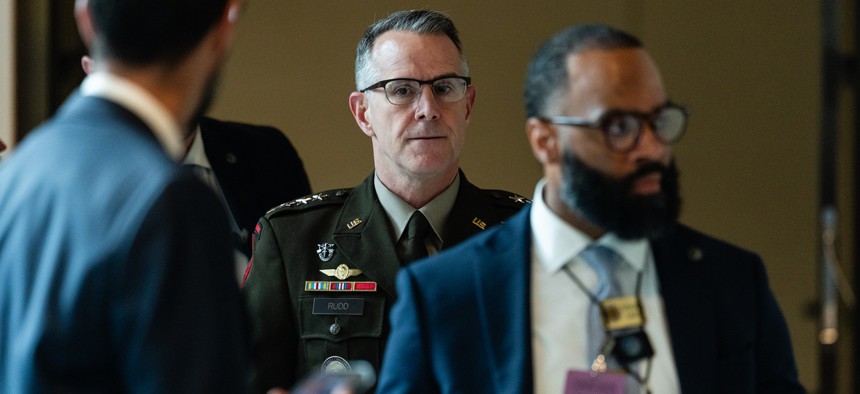
General Joshua M. Rudd, commander of the U.S. Cyber Command and director of the National Security Agency and Chief of the Central Security Service, arrives to a closed Senate Appropriations Committee hearing at the U.S. Capitol on June 2, 2026 in Washington, DC. Eric Lee/Getty Images





The overhaul would create five mission centers, with implementation expected to begin in October.
The National Security Agency is preparing a sweeping reorganization that would establish five mission centers focused on artificial intelligence, China, cybersecurity, combat support and global intelligence, according to a person familiar with the matter.
The plan, developed under NSA head Gen. Joshua Rudd, would put new mission directors in charge of those areas as the agency adjusts its structure around emerging technology and national security priorities.
The person spoke on the condition of anonymity to communicate details of the new arrangement. It would mark one of the most significant organizational changes at the intelligence agency in a decade.
The Washington Post first reported the planned overhaul Sunday.
“While detailed personnel specifics cannot be provided at this time, NSA’s focus is to ensure that the organizational restructuring of Agency priorities enhances the Agency’s ability to fulfill its critical national security missions at both speed and scale,” an agency spokesperson said, noting that the agency’s “core missions remain unchanged.”
New mission directors are expected to submit organizational plans in the coming weeks, with implementation of the structure beginning in October and a goal of reaching full operational capacity some time in January of next year.
Some key details appear to remain unsettled, including whether the centers would replace existing divisions or add a management layer over the agency’s current structure.
The agency collects and analyzes intercepted foreign communications and other electronic signals to inform U.S. national security decisions. It also helps protect sensitive government networks and encryption systems against foreign threats.
Rudd, who was confirmed in March, also leads U.S. Cyber Command, the Defense Department unit responsible for offensive and defensive cyber operations. It’s not clear how the reorg would affect operational relationships between the combatant command and the foreign eavesdropping giant. Both organizations are headquartered at the sprawling Fort Meade campus in Maryland, with personnel extending across the United States and overseas.
Under the plan, the NSA’s elite Tailored Access Operations hacking unit is expected to be lodged under the global intelligence arm and receive additional resources once the federal government’s budget resets at the end of this month. The unit, recently reconstituted under Rudd, specializes in penetrating foreign digital targets.
The proposed AI center comes as NSA officials publicly describe a growing role for the technology in both intelligence analysis and cybersecurity.
At the Billington Cybersecurity Summit last week, cybersecurity directorate chief David Imbordino said the agency is exploring AI tools to help analysts sort through enormous quantities of collected information and identify useful material faster, and he said the technology could accelerate analysis that currently takes days or weeks.
NSA Deputy Director Tim Kosiba similarly said last month that the agency is engaging leading commercial developers as it seeks broader access to their systems. New AI models are increasingly capable of finding software flaws and writing code to exploit them, prompting global debates over safety standards, who should have access to the tools and how governments should use them.
“We want access to all the models, and we’re going to take advantage of that,” Kosiba said at an intelligence conference in Bethesda, Maryland.
NSA is also helping implement a June executive order establishing a voluntary process for government scrutiny of advanced AI systems’ hacking capabilities before their wider release. The agency’s director is responsible for determining which models qualify for that process, in consultation with other federal offices.
The restructuring follows an earlier overhaul, known as NSA 21, launched in 2016 under then-Director Mike Rogers. That effort sought to reorganize the agency into six directorates.