
FAFSA's turnaround wasn't a miracle. That's the point.
Richard Stephen/Getty Images

COMMENTARY | Paying for their education should not depend on whether a system failed badly enough to get fixed in the first place.
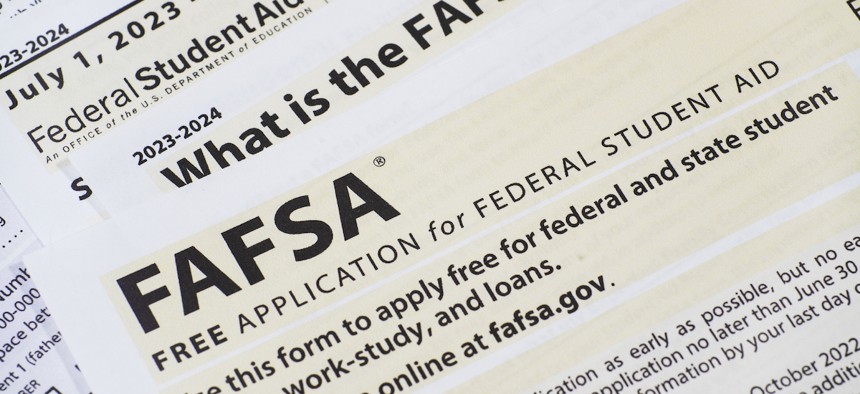
School is back in session, and so is the clock on financial aid for millions of students. The 2027–28 Free Application for Federal Student Aid (FAFSA) is scheduled to open Oct. 1.
This on-time opening cycle is great news: government technology working well for the people it serves. But more often, we hear about these systems working well only after something goes terribly wrong.
In 2013, HealthCare.gov crashed within hours of its launch, leaving people attempting to enroll for coverage stuck behind error messages for weeks. In 2020, as COVID-19 layoffs surged, state unemployment insurance systems crumbled under the volume influx, leaving newly jobless people waiting months for benefits that many needed immediately.
And in 2024, FAFSA joined the list. The U.S. Department of Education’s (ED) Federal Student Aid office (FSA) left millions of students and families scrambling after a systemwide meltdown. Behind it was a fragmented redesign, spread across multiple vendor systems, with no single point of technical ownership and no ability to catch failures before they reached the public. The “new” FAFSA launched three months late from its promised date. Calculation errors rendered hundreds of thousands of applications unusable, pushing financial aid offices to attempt manual workarounds while the records were reprocessed.
In each case, specialized teams were brought in to clean up. To the public, the failures looked inevitable and the fixes looked like miracles.
In 2026, the FAFSA story is different. The same office, under the same statute and the same October deadline, has delivered its best cycle on record. The 2026–27 FAFSA opened Sept. 24, 2025, the earliest launch in the program’s history, and the high school class of 2026 went on to set an all-time record for FAFSA completion: 59.1 percent, nearly five points above the previous high.
What’s made the difference? Moving away from individuals fixing problems as they arise to a more robust, proactive engineering practice. This practice includes automated tests that run every time the code changes, monitoring that flags trouble before a student clicks submit, and the ability to trace a single application from start to finish when something goes wrong. FSA built that practice with our team, and FSA runs it. The result is a system that finds its own mistakes instead of making them in public.
The numbers back this up. Before the joint redesign, an initial analysis of real-time processing revealed a baseline of only 0.8 percent of online applications processed in under one minute with the majority falling into the standard window timeframe of one to three days. Today, new FAFSA transactions take seconds, not days, to process. 91.8 percent of transactions are now processed in under 10 seconds with a median of two seconds and 63 percent of initially rejected applications are corrected to completion within the same hour, at a median of about 26 minutes. None of this is a miracle, and the work remains ongoing. Unlike the crisis-driven fixes, the new FAFSA is designed to improve as it runs.
Right now FSA is beta testing a two-phase approach to the 2027-2028 FAFSA cycle. The first phase began Aug. 5, 2026, followed by the Beta 2 phase in September. The extensive testing allows for real students and families to submit applications prior to the public launch to detect issues. So far they’ve turned up identity-verification glitches, parents’ uncertainty about their role in the process, and a few confusing questions. Catching these problems now means not dumping them on millions of families later.
FAFSA is not unique. Dozens of public systems, from state aid portals to unemployment insurance, are one procurement decision away from repeating FSA’s 2024 fallout story. The choice is whether to pay for the “boring work” up front or after the meltdown occurs. The agencies, lawmakers, and procurement officers who fund and manage these systems can help decide that now, while FAFSA is working, instead of after the next one breaks.
The millions of students whose futures depend on these systems are the same ones who will become doctors, engineers, teachers, and the people who shape our society for generations to come. Paying for their education should not depend on whether a system failed badly enough to get fixed in the first place.
Christopher Inman is a principal infrastructure engineer at Nava PBC. Before joining Nava, he spent more than a decade as a federal engineer and engineering supervisor at the Office of Personnel Management and the Centers for Medicare & Medicaid Services, working on USAJOBS.gov, HealthCare.gov and Medicare systems. At Nava, he works with Federal Student Aid (FSA), where he leads platform work that helps FSA identify issues across FAFSA systems and take greater ownership of its technology.