
From crime labs to space rocks, NIST helps identify mystery chemicals
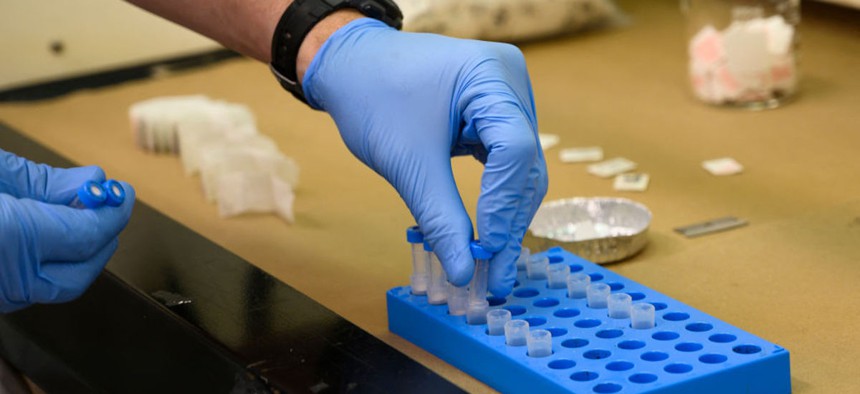
HEALTH-US-DRUGS-FENTANYL-CHINA-MEXICO A Drug Enforcement Administration (DEA) chemist checks confiscated powder containing fentanyl at the DEA Northeast Regional Laboratory on October 8, 2019 in New York. DON EMMERT / Contributor / Getty Images




An expanded federal library of chemical fingerprints helps scientists identify unknown substances found in forensic evidence, drugs, environmental samples and even material collected beyond Earth.
On television crime dramas, investigators often recover an unknown powder or residue, send it to a laboratory and learn exactly what it is before the next commercial break. The real science is slower and more complicated, but one part of that familiar plot device is very real.
Forensic scientists can run an unknown substance through a mass spectrometer, generate a distinctive chemical fingerprint and compare the result against an enormous reference library maintained by the National Institute of Standards and Technology.
NIST recently released a major update to that library, adding tens of thousands of compounds that researchers, manufacturers and forensic scientists can use to help identify mystery substances. The expanded collection includes chemical fingerprints associated with everything from synthetic opioids and environmental contaminants to compounds detected on Mars and organic material recovered from an asteroid.
Those fingerprints are formally known as mass spectra. To create one, a mass spectrometer ionizes a chemical compound and breaks it into charged fragments. The instrument then sorts those fragments according to their mass-to-charge ratio, creating a bar-chart-like pattern that can be distinctive to the original substance.
“Just as a person may be identified by comparing their DNA to a database, a chemical compound may be identified by comparing its mass spectrum to the NIST database,” said Bill Wallace, group leader of NIST’s Mass Spectrometry Data Center.
That makes the quality and breadth of the reference library especially important. A laboratory can generate a highly detailed spectrum from an unknown sample, but identifying the substance often depends on having reliable information available for comparison.
The updated NIST Mass Spectral Library, commonly called NIST26, has two major components. Its Electron Ionization Library, which covers compounds that can be easily vaporized, gained roughly 35,000 compounds and now includes more than 382,000. Its Tandem Library, which is used with many nonvolatile compounds that dissolve in liquids, added about 17,000 compounds and now includes more than 68,000 substances and 3.2 million spectra.
The technology has important applications for law enforcement. Federal, state and local crime laboratories increasingly encounter newly developed synthetic drugs that may be unfamiliar to investigators. NIST also works with the Scientific Working Group for the Analysis of Seized Drugs to maintain a freely available reference library of controlled substances, including emerging fentanyl analogues and other synthetic opioids.
The comparison is not necessarily the instantaneous match often shown on television. Scientists still have to consider the quality of a sample, possible mixtures and other evidence before reaching a conclusion. But trusted reference spectra can give forensic chemists an authoritative starting point when they encounter drugs or other substances they have never seen before.
The full NIST26 library is commonly integrated with commercial mass spectrometers and is available through instrument manufacturers and other distributors. But NIST also provides a free public tool that offers a glimpse into how chemical reference data works.
The NIST Chemistry WebBook contains mass spectra for more than 33,000 compounds along with extensive collections of thermochemical, spectroscopic and other scientific data. Users can search by chemical name, formula, molecular weight and several other identifiers.
To test the public tool, I searched for aspirin, one of the most familiar medicines found in household cabinets. The WebBook quickly returned its chemical formula, C9H8O4, along with a molecular weight of 180.1574, its chemical structure and several forms of spectral data.
Selecting the electron-ionization mass spectrum displayed a series of peaks showing the fragments created when aspirin molecules are ionized and broken apart. The pattern bears little resemblance to the tablets found in a medicine cabinet, but it represents a measurable chemical signature that can be compared with data generated from an unknown sample.
Aspirin is hardly a mystery substance. But the same basic process can help scientists identify far more consequential compounds in forensic evidence, environmental samples, drugs, cosmetics, food and body fluids. Some of the newest additions to NIST26 involve substances linked to urgent problems here on Earth. The update includes nitazenes, a potent class of synthetic opioids increasingly associated with fatal overdoses. It also expands the library’s collection of per- and polyfluoroalkyl substances, commonly known as PFAS or forever chemicals.
Other additions arrive with far more mysterious origins.
Among the new chemical fingerprints are thiophenes, ring-shaped molecules containing sulfur that were detected by NASA’s Curiosity rover on Mars. Their presence raises an intriguing possibility because scientists consider them a potential signature of ancient life. They are not proof that life once existed on Mars, but they add another chemical clue to a mystery researchers have been trying to solve for generations.
The library also now includes complex organic compounds found in dust collected from Bennu, a near-Earth asteroid that has traveled through space for billions of years. Known as alkylated polycyclic aromatic hydrocarbons, those compounds may be related to some of the chemistry necessary for life. Scientists are studying whether material carried by asteroids like Bennu could have helped seed the young Earth with some of life’s chemical building blocks.
That means the same kind of reference library that can help identify an unfamiliar substance in a crime laboratory may also help scientists interpret chemical traces recovered from worlds beyond our own.
Maintaining such a wide-ranging collection requires more than simply gathering spectra. NIST scientists evaluate the measurements, examine chemical structures and names, compare related compounds and replace older entries when higher-quality information becomes available. The result is not just a large database, but a carefully maintained scientific reference that laboratories can use with greater confidence.
The mystery substance on a television crime show may be identified in time for the next commercial break. Real science is slower and more careful. But whether researchers are examining evidence from a crime scene, an environmental sample or dust carried home from an ancient asteroid, the search often begins the same way: by comparing the unknown against a trusted record of what humanity has already learned.
John Breeden II is an award-winning journalist and reviewer with over 20 years of experience covering technology. He is the CEO of the Tech Writers Bureau, a group that creates technological thought leadership content for organizations of all sizes. Twitter: @LabGuys