
State official to EU: Work with us on tech policy or fall behind a generation
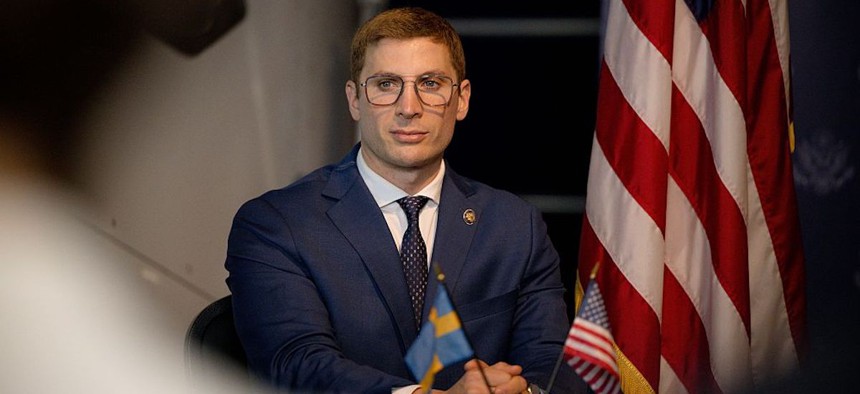
United States Under Secretary for Economic Affairs Jacob Helberg attends the Space Center Houston (official visitor center for NASA's Johnson Space Center) for a signing ceremony marking Sweden’s entry into the Pax Silica initiative on March 17, 2026 in Houston, Texas. Marcus Ingram / Getty Images



“We're not willing to be politely silent, because we are not politely invested,” Under Secretary of State for Economic Affairs Jacob Helberg said about the bloc’s tech regulations.
A top State Department official on Wednesday excoriated the European Union’s regulatory regime for disincentivizing innovative collaboration with the United States and pressed for closer engagement between the allies to counter China’s technological ambitions.
During a conversation in Brussels hosted by The German Marshall Fund, Under Secretary of State for Economic Affairs Jacob Helberg said the bloc has become “a Caligulan bureaucracy that has, regulation-by-regulation, irrigated more and more power away from sovereign European states — not liberating the European economy, but strangulating it.”
Referencing the 2024 Draghi report on the EU’s competitiveness, which laid out recommendations for how the bloc can enhance its economic growth, Helberg said the findings showed that the union has largely missed out on driving major tech advances, such as in artificial intelligence and cloud computing.
“Europe is accruing a lag that will not be reversible in years,” he said. “It will take a generation to undo. That is not a policy disagreement; that is a civilizational emergency. And yet, there is a curious quietude around it.”
Helberg also criticized recent EU laws that have penalized U.S. technology companies, which he said sends the message that the bloc is hostile to foreign investment. This included directing particular scorn at the Digital Markets Act, which first went into effect in 2022 with the goal of promoting fair competition in the online marketplace.
Helberg said the fines imposed on U.S. firms under the law — which have resulted in millions of dollars in penalties for tech giants like Apple and Meta — are ultimately more costly to the EU, since they encourage companies to turn elsewhere for investment and development. He called the Digital Markets Act "the biggest point of friction" in the relationship between the bloc and the U.S.
“We're not willing to be politely silent, because we are not politely invested,” he said of the Trump administration’s approach to engaging with the EU.
Helberg, who was in Brussels as part of a tour of European allies, is also one of the chief architects of State’s Pax Silica initiative. The effort looks to enhance U.S. and allied nations’ access to artificial intelligence and semiconductor technologies by partnering to promote more secure supply chains.
In a March 30 X post, Helberg wrote: “Pax Silica is knitting together the trusted network the Al race requires. Europe belongs in that network. The question is whether Brussels will let it show up.”
His speech on Thursday served as another call for the EU to join the initiative. Greece and Sweden, both members of the bloc, have separately joined Pax Silica.
Given China’s export controls on rare earth minerals, Helberg said, “I do think that there's a lot of appetite to work together [with the EU] on economic security issues.” He added that Pax Silica is a way for the U.S. and its allies to counter China’s tech ambitions, while also promoting a more streamlined regulatory regime.
More effective competition with Beijing, he said, includes a greater focus on logistics, infrastructure and mineral processing when developing emerging technologies. Helberg said the policy-focused components of the initiative include “developing baseline definitions for sensitive technology and critical infrastructure, as well as defining a pro-innovation agenda on AI.”
While the U.S. and EU are discussing the Digital Markets Act as part of continuing trade negotiations between the two powers, Helberg said he’s hopeful that similar ongoing conversations about economic security will also “ultimately culminate in more European countries joining the Pax Silica initiative.”
If you have a tip you'd like to share, Edward can be securely contacted at Grahed.40 on Signal.
NEXT STORY: Citizen Science Month 2026 is about more than just stargazing