
DOGE took credit for savings that never happened, watchdog finds
Thomas Fuller/SOPA Images/LightRocket via Getty Images




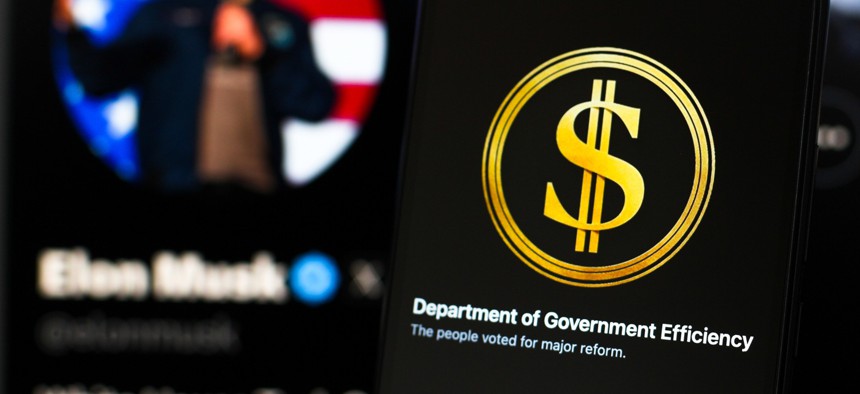
The Department of Government Efficiency claimed tens of billions of dollars in savings on its infamous “Wall of Receipts,” but the Government Accountability Office found it touted savings that never happened and could not be substantiated.
The Trump administration should prominently display data quality issues and limitations on the Department of Government Efficiency’s website listing estimated savings, the Government Accountability Office recommended in a new report, finding the public tally heralding billions of dollars in estimated savings was rife with errors.
The watchdog found that the website’s estimated savings tracker — or “Wall of Receipts” — listed contracts that were not actually cancelled, took credit for leases that were in the process of termination before DOGE’s existence and did not adequately explain how savings were calculated. The findings cast doubt on DOGE’s claim that it saved taxpayers $215 billion by slashing contracts, grants, leases and other wasteful expenditures.
The report, requested by Sens. Gary Peters, D-Mich., and Richard Blumenthal, D-Conn., analyzed the wall of receipts’ estimated savings of roughly $110.34 billion from supposedly terminated contracts, grants and leases.
GAO found that roughly $34.6 billion of the estimated $61 billion saved from cancelled contracts came from either contracts that were never actually terminated or could not be corroborated as terminated.
DOGE specifically reported it cancelled 13,476 contracts but “almost 2,000 contracts were not terminated,” according to GAO’s analysis of the Federal Procurement Data System. In one case, DOGE continued to estimate saving taxpayers more than $1.7 billion by cancelling a Defense Health Agency IT support contract after Defense Department officials got DOGE officials to agree the contract should not be terminated, GAO wrote. No action was ultimately taken on the contract.
Additionally, about 27.8% of contracts listed as terminated — including all contracts at the DOGE-dismantled United States Agency for International Development — did not include identifying information, GAO found. Because of this lack of information, the office could not find 1,856 supposedly terminated contracts on the Federal Procurement Data System even after taking additional steps to do so.
The watchdog added that DOGE did not consistently use its stated methodology for calculating estimated savings from terminated contracts. And even in cases where DOGE did use its stated methodology, it did not “account for many complexities and nuances of federal contracting or sufficiently identify limitations.” DOGE — whose operation formally ended as of July 4 — did not return GAO’s requests for interviews or clarifications.
DOGE did not provide sufficient information to verify about 96.2% — or $47.32 billion — of estimated grant savings, GAO found. But even for the small portion of grant savings GAO could replicate, “the amount of reported savings may not be realized,” according to the report.
DOGE reported that it terminated 264 leases, saving taxpayers about $113 million. But the General Services Administration told GAO that 108 out of those 264 leases were identified for termination before DOGE was established. Because of that discrepancy and other inaccuracies, GAO estimated DOGE overstated how much it saved on terminated leases by $81.1 million.
DOGE also further overstated lease savings by not considering other factors, such as relocation costs and potential early termination fees, according to the report.
The White House did not return a request for comment by the time of publication.
“This GAO report underscores the need for increased transparency and accountability from the Trump Administration so the American public can better understand DOGE’s activities as the organization guts vital government programs,” Blumenthal said in a press release.
The GAO released a separate report Wednesday where it said it could not verify if DOGE employees completed required ethics training designed to avoid conflicts of interest.