
Trump’s anti-fraud task force poised to scrutinize benefits programs
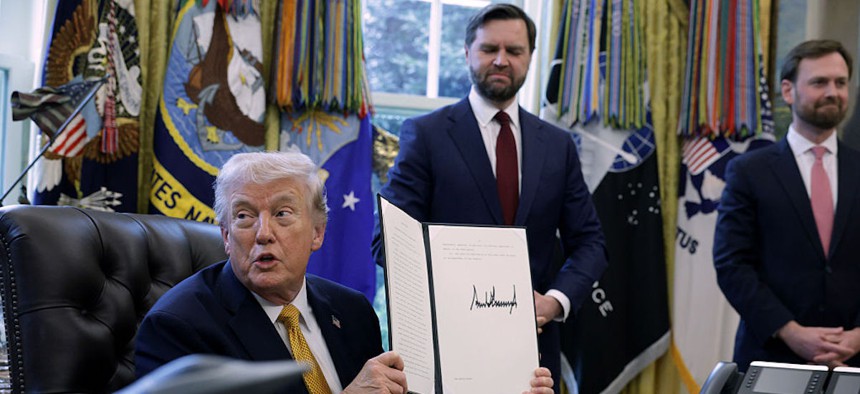
U.S. President Donald Trump holds up a document that he signed as Vice President JD Vance (C) and Federal Trade Commission Chairman Andrew Ferguson look on during a White House signing ceremony in the Oval Office of the White House on March 16, 2026 in Washington, DC. Trump signed an executive order to create a task force on fraud which will be lead by Vice President J.D. Vance. Alex Wong/Getty Images


 By
Natalie Alms
By
Natalie Alms
The new White House task force will withhold government funding for state and local benefits programs if their anti-fraud controls are viewed as lacking.
The White House is kicking off President Donald Trump’s “war on fraud” with a focus on federally-funded benefits like housing, food and cash assistance programs.
Among the tactics that a new anti-fraud task force will be pursuing is withholding government funding to state and local jurisdictions whose anti-fraud controls for benefits are deemed inadequate and increasing data-sharing between states and the federal government, according to the Monday executive order establishing the task force.
Both moves, already deployed by the White House in the name of fighting fraud, have at times been blocked by courts.
Anti-fraud experts have long wanted the federal government to take a more coordinated approach against fraud in government programs. But some worry that the Trump administration is using fraud as a pretext for political goals, including immigration enforcement.
The new task force, which will be drafting an anti-fraud strategy, will be chaired by Vice President J.D. Vance and vice-chaired by the head of the Federal Trade Commission, Andrew Ferguson. White House Deputy Chief of Staff Stephen Miller will also serve on the task force as a senior advisor.
It’s unclear why Ferguson is taking this position on the task force. The FTC doesn’t currently play a role in combating fraud in government benefit programs, although it does run a government portal for people to report identity theft.
The task force will also have an executive director, who has yet to be named, to direct the day-to-day operations of the task force, as well as representatives from various government agencies.
Those agencies will have to identify what parts of their benefit programs are most susceptible to fraud and adopt anti-fraud requirements like identity verification, increased documentation and better back-end data checks within 60 days.
Government agencies will also be maximizing enforcement of eligibility requirements for government benefits and looking across agencies and programs for fraud risk indicators.
“The ‘war on fraud’ is long overdue, but the real question is whether this is a true shift in strategy or, worse, another moment of over-politicization without changing the underlying system,” said Jordan Burris, the head of public sector at identity verification platform Socure. He previously worked on cybersecurity in the White House.
Pre-payment controls, stronger data sharing and centralized coordination are all “encouraging signals,” he said, although “this has to become more than a finger-pointing exercise between federal, state, and local actors.”
Since taking office, Trump has fired nearly 20 inspectors general, whose very jobs are to combat waste, fraud and abuse in the government. He and his top officials have also cited fraud for a variety of their most controversial actions, such as shutting down the U.S. Agency for International Development last year. Many of those claims of fraud at USAID were false or misleading.
As many government benefit programs are delivered by states, the executive order notes that the task force may recommend “any ways that Federal funds may be withheld from jurisdictions that do not have adequate anti-fraud requirements.”
The text of the order name-checks four blue states, “reinforcing the suspicion that the war on fraud is effectively a war on blue state safety nets,” wrote Donald Moynihan, a professor of public policy at the University of Michigan, in a recent blog. “The Trump administration seems to think if it succeeds in pushing its fraud narrative, it can justify what are, in reality, just cuts to the existing program that individual beneficiaries rely on.”
Editor's note: This article has been updated to note that Stephen Miller is also serving on the anti-fraud task force.
If you have a tip you'd like to share, Natalie Alms can be securely contacted at nalms.41 on Signal.
NEXT STORY: Inside DOGE’s early days of pressure campaigns, rule breaking and ‘chaos’