
Super Bowl gears up for massive security operation
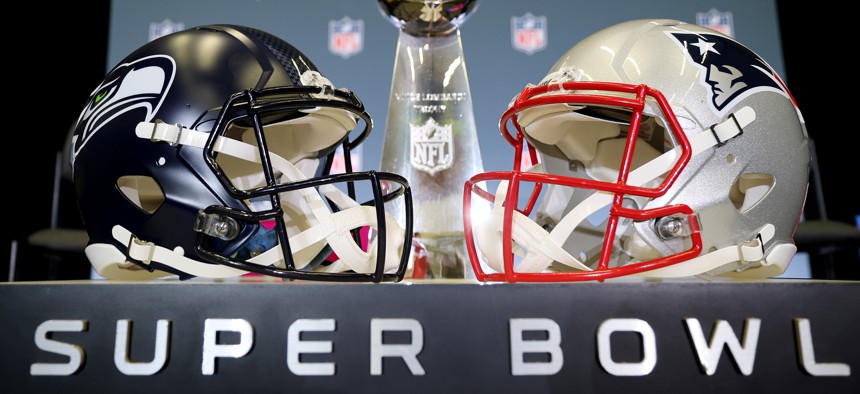
Chris Graythen via Getty Images



 By
Chris Teale
By
Chris Teale
While immigration officials will reportedly not be present at the San Francisco game this weekend, a raft of federal, state and local agencies will be on site to keep the event safe from various threats.
The build-up to this Sunday’s Super Bowl in the San Francisco Bay Area has been dominated by talk of whether Immigration and Customs Enforcement agents will be on the ground.
The Bay Area Host Committee reportedly told local officials that ICE will not be conducting immigration enforcement around Levi’s Stadium. But the NFL expects more than 35 state, local and federal agencies to be active for the event, not just on gameday but also for the events building up to it.
It comes at the start of a busy few years for the United States, which will also host games in the FIFA World Cup this summer, then the Summer Olympic and Paralympic Games in Los Angeles and various satellite venues in 2028. Cathy Lanier, the NFL’s chief security officer, said planning for the Super Bowl has been underway for 18 months and has a tier one Special Event Assessment Rating from the Department of Homeland Security, meaning it requires extensive federal support.
“All these agencies are here to ensure that the Super Bowl and the surrounding community are safe while we carry out all the fun activities around the Super Bowl,” Lanier said during a press conference. “The federal presence here is consistent with past Super Bowls and other sporting events like what you will see around the World Cup and the Olympics as well.”
Jeff Branigan, DHS’ designated federal coordinator for Super Bowl LX and the acting special agent in charge for Homeland Security investigations in Northern California, said during the press conference that a whole swath of agencies are involved, including law enforcement, fire and emergency management from nine Bay Area counties, as well as federal agencies including the Bureau of Alcohol, Tobacco and Firearms, the U.S. Secret Service, Customs and Border Protection, the Cybersecurity and Infrastructure Security Agency and the Transportation Security Administration.
“The security of the Super Bowl is necessarily a combined effort between federal, state, and local public safety agencies, the NFL and regional government leaders,” Branigan said during the press conference. “But security and safety also require the support of the public, the fans, business owners and community members across the Bay Area.”
Tim Miller, field chief technology officer and public sector cyber lead at Dataminr, an artificial intelligence-backed platform that helps leaders track events, threats and risks in real time, said making sure those disparate agencies can communicate and share information is crucial, especially when managing large crowds at high-profile events.
“It's information sharing early and often,” he said. “It's one thing to say, ‘Hey, we share information when we like,’ or ‘We have this confirmed thing and here's a report on it… As you can start to share that level of insight in that real time format, it starts to build that ability to be more trustworthy to each other, where you don't feel like you're hiding things and you feel like you have a mission partner.”
CISA warned recently about the vulnerabilities of stadiums and arenas, which face not just physical threats but also cyber threats that could undermine public safety. In December, the agency warned in a new guide for stadium and arena operators that “nation-state cyber actors, domestic violence extremists, and foreign terrorist organizations” are “major threats to U.S. critical infrastructure and public gathering venues in the coming years.”
“Our collective security planning and preparation has been deliberate and layered focused on countering a wide array of threats,” Branigan said. “We've shared intelligence, ensured the introduction of key countermeasures and shored up our emergency response capabilities while remaining flexible and adaptable.”
The skies above Levi’s Stadium are also being protected from various threats. The Federal Aviation Administration and the Federal Bureau of Investigation designated the Super Bowl and the surrounding area as a strict “No Drone Zone.” It means the agencies can track, detect and assess unauthorized drones, with unauthorized operators facing steep fines, criminal charges and drone seizure. The area also will be under various temporary flight restrictions for general aviation.
Keeping every public safety agency in touch is a massive undertaking, and FirstNet, the dedicated communications network for those agencies, said it’s ready to go. Scott Agnew, president of FirstNet at AT&T, said in a blog post there will be a team on the ground “mitigating ‘what-ifs,’ calling audibles, and executing key plays with public safety command.” FirstNet will also have portable cell sites and other infrastructure on the ground to keep the network operational.