
Trump’s CISA nominee denies Capitol was attacked on Jan. 6
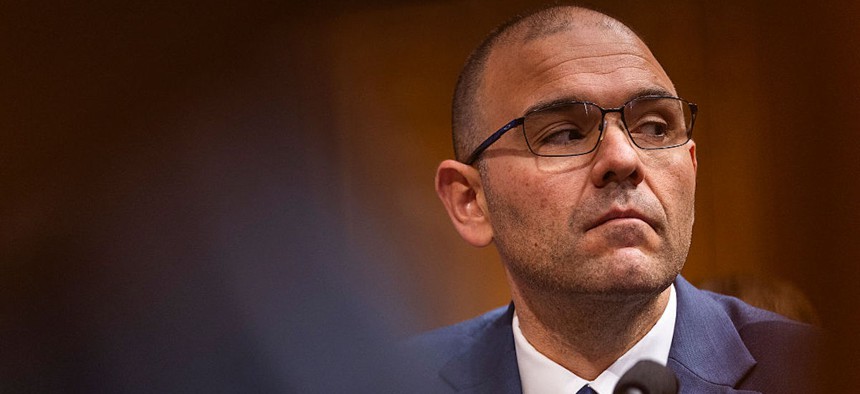
: Michael LoSapio testifies during a nomination hearing before the Senate Committee on Homeland Security and Governmental Affairs at the Dirksen Senate Office Building on November 19, 2026 in Washington, DC. LoSapio has been nominated for Director of the Cybersecurity and Infrastructure Security Agency. He currently works for Palantir, an American software, AI and data company that works extensively with the U.S. military. Finn Gomez/Getty Images






Michael LoSapio also refused to acknowledge Joe Biden’s 2020 election win as senators questioned his independence and plans for the depleted cyber agency.
President Donald Trump’s nominee to lead the Cybersecurity and Infrastructure Security Agency denied Thursday that the U.S. Capitol building was attacked on Jan. 6, 2021, and refused to say who won the 2020 presidential election.
Michael LoSapio, who is currently Palantir’s chief information security officer, made the remarks during his confirmation hearing before the Senate Homeland Security Committee, where Democrats also pressed him on whether he would seek to reverse staffing and budget cuts at the government’s main civilian cyberdefense agency.
“No, I don’t believe it was an attack,” LoSapio told Sen. Richard Blumenthal, D-Conn., after initially saying he did not know. When Blumenthal asked again whether the Capitol had been attacked, LoSapio answered no.
“I wasn’t involved in politics,” he said. “I know what I saw on the news.”
Trump supporters stormed the Capitol that day, assaulting police officers and interrupting Congress’ certification of then-President Joe Biden’s victory. Biden won both the popular vote and the Electoral College in 2020.
Earlier in the exchange, Blumenthal asked LoSapio to identify the popular-vote winner.
“I’m not going to answer the question about an election six years ago,” LoSapio said. Pressed further, he said his only involvement in that election was voting for Trump.
Congressional reports and law enforcement findings widely characterize the events of January 6 as a violent riot aimed at disrupting the certification of the 2020 election results. Explicitly denying that the Capitol was attacked is a major departure from the documented record of the day’s events, particularly for a nominee seeking to lead an agency tasked in part with protecting U.S. elections.
CISA became a target of Trump’s ire in 2020, when the agency rejected false claims that the election was stolen. Trump fired its first director, Chris Krebs, after he publicly said the election was secure.
A Palantir spokesperson did not immediately return a request for comment.
The responses have echoed patterns of other presidential nominees. On Wednesday, Trump’s pick for a federal appeals court position declined to answer who won the 2020 election and told senators that answering such questions could be an ethical violation.
If confirmed, LoSapio would inherit an agency that has lost roughly a third of its workforce since Trump returned to office, gone without a Senate-confirmed director and scaled back assistance to state and local offices. Some election officials said the cuts have left them without trusted federal contacts and disrupted preparations for the midterms.
Acting Director Nick Andersen has since worked to rebuild some of the staffing.
Sen. Elissa Slotkin, D-Mich., asked whether LoSapio supported the administration’s cuts, citing the loss of about 1,000 positions and a proposed budget roughly $385 million below the agency’s 2025 funding.
LoSapio said he could not assess CISA’s current condition from outside government and would examine its needs before deciding whether to seek more money.
“I don’t necessarily believe more money means more security,” he said. “I believe spending money on the right solutions in the right ways actually decreases risk.”
When asked whether he would replace departed staff, LoSapio again said he needed to assess the agency first.
“I’m going to investigate and dig in and understand where our gaps are,” he said, adding that he would request more resources if needed.
In his written opening statement, LoSapio outlined four priorities: defending civilian federal agencies, supporting infrastructure operators and state and local governments, reducing weaknesses in technology products, and recruiting and retaining staff.
His nomination follows nearly two years without a permanent Senate-confirmed CISA director. Jen Easterly left in January 2025, and Andersen has led the agency in an acting capacity since February. Trump’s previous nominee, Sean Plankey, withdrew in April.
Some industry officials told Nextgov/FCW ahead of the hearing that they were uncertain about LoSapio’s plans and had hoped Andersen would receive the nomination. Others welcomed the prospect of permanent leadership.
The White House has defended LoSapio’s selection, citing his technical experience and work protecting Palantir against nation-state threats.
If confirmed, LoSapio would face Democratic majorities in both chambers next year. Lawmakers have already pledged to investigate CISA’s workforce cuts and changes to its election security work, among other things.