
Voting machine researchers say federal work abruptly ended after Trump ally pushed back on their findings
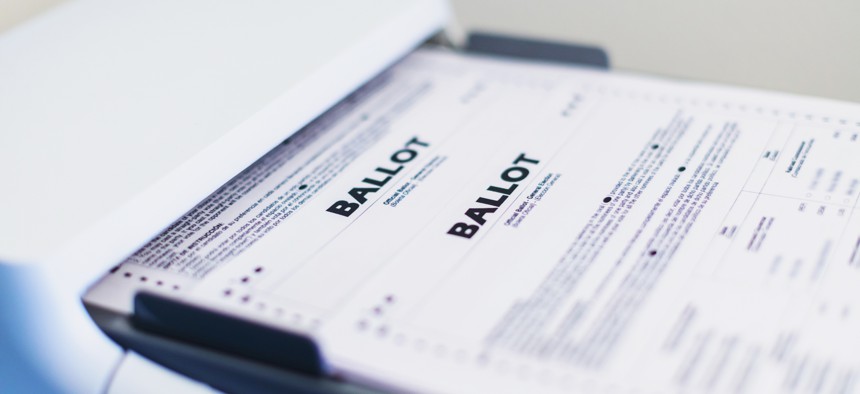
eyecrave productions / Getty Images




Mojave Research executives said at DEF CON that the government had been preparing to expand the company’s election security work, and linked Trump adviser Kurt Olsen to pressure they faced after finding election system vulnerabilities but no evidence votes were altered.
LAS VEGAS — After spending roughly six weeks analyzing Dominion voting systems used in Puerto Rico’s 2024 elections, Mojave Research came back to the Trump administration with findings that startled its researchers.
The systems contained at least a dozen high- or critical-severity software vulnerabilities. Passwords were reused, firewalls were disabled and basic cryptographic protections were poorly implemented. And in Puerto Rico, active cellular hardware modems opened additional pathways into underlying software that was thought to be isolated.
But the small cybersecurity firm found no evidence that any of those weaknesses had actually been exploited, or that votes had been changed. The company still wanted more time to be certain.
Federal officials initially seemed willing to give them considerably more of it. The company was asked to grow the team working on the effort from roughly 10 people to about 60, according to CEO Jason Wareham.
Chief Technology Officer Manbir Gulati also said Mojave received an authorization to proceed with a follow-on effort, hired personnel and was given funding to acquire equipment for examining additional voting systems ahead of the November midterms. A contracting officer had even been brought in to finalize the new agreement, Gulati said.
Then, as Mojave prepared to move ahead, the work was abruptly shut down.
Wareham and Gulati recounted the episode on Friday at DEF CON hacker convention’s Voting Village, where they publicly unpacked their technical findings before sitting down with a small group of reporters and onlookers afterward.
Their account fills in new details about a federal effort that grew out of the Trump administration’s broader focus on voting machines and election interference, and the political pressures that emerged when Mojave’s findings did not support claims of election manipulation.
The ODNI request
Mojave never set out to become an election security provider. Its involvement began last year through the Office of the Director of National Intelligence under then-director Tulsi Gabbard, where it was already performing unrelated technical work for the agency when officials approached the company about examining voting machines and data obtained from Puerto Rico.
Reuters reported in February that the May 2025 operation was tied to an effort involving ODNI and the FBI to investigate allegations that Venezuela had hacked Puerto Rico’s voting systems, though Gabbard’s office denied that Venezuela drove its work and said the examination was focused on technical vulnerabilities. The probe produced no clear evidence of Venezuelan interference.
Wareham said at DEF CON that ODNI asked whether his team of reverse engineers and forensic specialists could travel to Puerto Rico and capture an image of a voting system that had actually been used in an election, without the vendor overseeing the process. He agreed, thinking it would be a relatively small addition to Mojave’s existing contract.
The assignment instead dropped Mojave into a much larger skirmish over American elections. “Ultimately, I made the worst decision of my life in a business context,” Wareham said.
President Donald Trump has spent years falsely maintaining that his 2020 loss was stolen and the product of widespread fraud and foreign interference, claims that have been rejected by courts and officials in his own administration. A 2021 intelligence community assessment found no indication that a foreign actor attempted to alter ballots, vote tabulations or any other technical aspect of the election.
Since returning to office, Trump and allies have revived investigations into the 2020 contest and pushed election security back to the center of his administration’s agenda. Gabbard’s ODNI was one part of that effort, hauling off and analyzing voting systems from Puerto Rico and later becoming involved in a federal investigation of 2020 election records in Georgia.
Wareham said the ODNI officials directly overseeing the company’s technical work wanted the research to continue. Both he and Gulati described the ODNI staff they worked with as professionals who wanted to protect the security of election systems.
The resistance, Wareham said, came from a separate White House collective that was repeatedly dissatisfied Mojave had not produced evidence supporting claims that the 2020 election had been manipulated.
“There was a separate group — let’s call them White House-adjacent — who was dissatisfied,” he said. “They were dissatisfied overall that I was not willing to name and shame at that moment” and declare that Trump had actually won the 2020 election.
Asked whether he believed Mojave’s government work was axed because it failed to find the “smoking gun” some officials wanted, Wareham said: “I believe that was part of the termination, yes.”
Reuters reported in April that Kurt Olsen, a prominent 2020 election-denier and Trump adviser involved in efforts to investigate the election, pressed Mojave to broaden its work in search of evidence that could support those claims.
Olsen, who now works at the Justice Department, turned against the company when its research failed to uncover evidence that the Puerto Rico machines had been hacked. He advocated terminating its work and accused Mojave of secretly receiving money from billionaire George Soros, a frequent target of right-wing conspiracy theories, the news agency reported. ODNI has said Mojave’s contract ended because the company completed its voting-machine analysis.
Wareham said an ODNI official informed him while Mojave was preparing to expand its work that the company had been accused of receiving Soros funding. The allegation prompted him to compile a detailed accounting of the young company’s funding sources within three days and send it up the government chain. Asked who he was told had made the accusation, he said an ODNI official reported to him that it was Olsen.
“One, I’m not funded by George Soros,” Wareham said. “Two, it would be great to be funded by George Soros because I would probably not be here, I’d be on a yacht.”
The company kept moving forward. Wareham said Mojave briefed the White House on some of its findings around September. The firm believed it was heading toward a broader effort to remediate vulnerabilities before the midterms and conduct a deeper analysis for signs that the weaknesses it discovered had ever been actually abused.
Then came the record-long government shutdown. Wareham said that on the day he expected an expanded contract to move ahead, Mojave instead received a stop-work order and no additional funding.
“I think the government shutdown was all that was required, really, to have some folks that I didn’t know were still in the game, again, White-House adjacent, to take their shot,” he said. Wareham stopped short of saying he had direct proof that White House officials ordered Mojave removed because of its findings, but said “it was reported to me it was Kurt Olsen” who led the efforts.
The White House, ODNI and Olsen did not return requests for comment.
Identified vulnerabilities
Mojave had found many issues with the machines it examined. Gulati described the Puerto Rico system during the Voting Village presentation as “deeply insecure,” saying it did not meet the security bar he would expect from “an average low-risk application, let alone critical infrastructure.”
Researchers identified at least 12 major vulnerabilities in commercial software installed on the system, Gulati said. Mojave successfully executed five of them. None were newly discovered flaws, and fixes were already available — in some cases well before the system was used in the election.
Other weaknesses were rooted more deeply in how the system was built and deployed. Some passwords could be easily cracked and others were embedded directly into software. Firewalls were turned off on critical systems and ports were left open. Gulati was particularly critical of the system’s cryptography, which he described as being “in shambles.”
The company does not believe every problem it found necessarily stopped at Puerto Rico, as its formal review covered only one system from one manufacturer in one jurisdiction. Gulati suspects the issues could extend beyond a single voting machine company, though Mojave has not examined enough systems from other manufacturers to establish that.
“I don’t expect that the problems are unique to them,” he said. “I think many manufacturers probably exhibit the same problems.”
Mojave produced an approximately 100-page document of the Puerto Rico findings. Gulati said Mojave has been in discussions with Liberty Vote — which acquired Dominion’s election business last year — and that Liberty told the researchers it does not plan to make changes before November.
Liberty said it has not received Mojave’s report.
“Liberty Vote is not in receipt of any such report so, therefore, we cannot provide any comment,” a spokesperson said. “As always, Liberty Vote is committed to advancing the future of secure American elections.”
No evidence of vote tampering
Looking at the systems headed into the midterms, Gulati said, “I do know that as of now, the state that we have described is going to be pretty similar to what will be deployed in November.”
Despite the extensive findings, Gulati repeatedly returned to what the researchers did not establish: “We found extensive and largely unacceptable weaknesses,” he said in the presentation. “But we did not find evidence that those weaknesses were actively exploited or that votes were altered.”
That distinction has drawn renewed attention as Trump and his allies again focus on election matters.
Last month, the president used a prime-time White House address to release newly declassified intelligence he said showed China interfered in the 2020 election. Among several disclosures, Trump pointed to intelligence showing Beijing had acquired personal information on roughly 220 million American voters. But the documents did not show China altered votes or gained the ability to manipulate voting systems.
Gulati made much the same distinction Friday when asked about the declassification.
“The China thing isn’t really much of anything,” he said, arguing that a large amount of the voter information at issue could be obtained commercially and should not be confused with access to election systems in ways that can manipulate votes.
“There is no evidence that I know of that says China successfully or any other country has successfully infiltrated our systems and manipulated votes in any way,” he added.
Wareham called the 100-page document a preliminary report and said the firm had wanted another six months to a year to dig deeper into the underlying data.
Gulati said the company’s interactions with the ODNI employees overseeing that work were markedly different from the political pressure the researchers later encountered. “We were never pressured to put anything in our reports that was untrue or politically leaning in a certain way,” he said of those officials.
Wareham said Friday that Mojave itself has pushed for its report to be made public for roughly a year and has recently been told it could soon emerge through a Freedom of Information Act request. Nextgov/FCW could not immediately determine the origin of the FOIA requester. As of publishing time, ODNI’s FOIA logs are available up until January 2025.
“I’m a little annoyed that we are very close to midterms and we had a whole year to freaking figure this out,” Wareham said.
With their government work scrapped, he announced at the Voting Village that he had filed paperwork to create the Machine Assurance Institute, seeking to bring together cybersecurity researchers and election technology companies to examine and independently verify voting infrastructure.
“We wanted to be the national security answer, and put to bed, finally, discussions about prior elections and/or accusations of voter fraud,” said Wareham. “Because, believe it or not, I find it fairly national security-destabilizing to constantly accuse each other of cheating.”