
NSA taps three officials for top cybersecurity positions
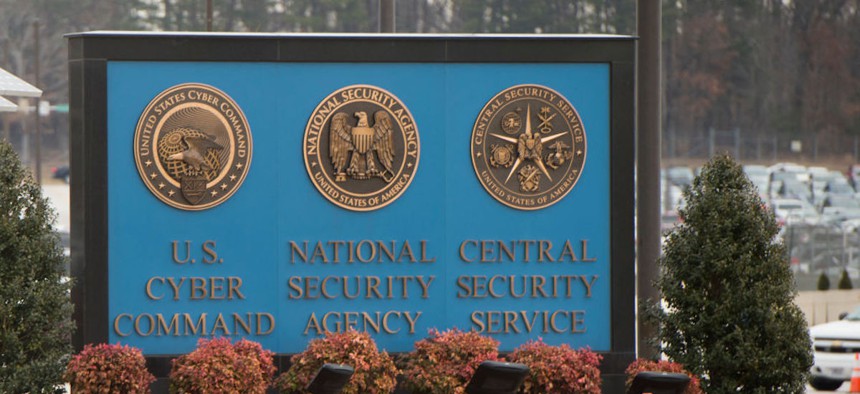
A sign for the National Security Agency (NSA), US Cyber Command and Central Security Service, is seen near the visitor's entrance to the headquarters of the National Security Agency (NSA) in Fort Meade, Maryland, February 14, 2018. SAUL LOEB/AFP via Getty Images





David Imbordino and Holly Baroody will take leadership roles in the agency’s Cybersecurity Directorate, while Bruce Jones will head its Cybersecurity Collaboration Center.
The National Security Agency has internally named a trio of appointments focused on the spy agency’s cyber operations.
David Imbordino, who has overseen the NSA’s Cybersecurity Directorate in an acting capacity in recent months, has been tapped to lead the office permanently, according to two former senior national security officials familiar with the selections.
Holly Baroody — a senior United Kingdom-based NSA official and a former civilian lead in U.S. Cyber Command — will serve as Imbordino’s deputy, the second former official said. Imbordino and Baroody have served as acting officials in their respective roles since around January.
Created in 2019, the cyber directorate combines the agency’s intelligence-gathering and digital defense expertise to help protect U.S. government networks, military systems and contractors from hacking threats.
The second former official also said that Bruce Jones, a longtime agency leader with experience in both technical and operational roles, will head the NSA’s Cybersecurity Collaboration Center, a hub used to share cyber threat intelligence between the government and the private sector.
Both former officials requested anonymity to communicate their knowledge of the positions.
Nextgov/FCW has asked the NSA for comment. The Record first reported the selections.
For the last year, the signals intelligence and foreign eavesdropping giant has grappled with leadership vacuums and significant morale decline as the Trump administration has sought to taper its workforce.
Gen. Josh Rudd was confirmed in March to lead Cyber Command and the NSA in a dual-hatted manner, with Tim Kosiba joining the spy agency soon after to serve as its deputy director.
The NSA has sought to take a role in artificial intelligence policy developments, amid the recent emergence of advanced cyber-focused AI models that, in the wrong hands, could help foreign adversaries and criminal hackers more easily penetrate U.S. computer networks.
The New York Times reported last month that the White House approved some $9 billion for spy agencies like NSA to accelerate AI adoption, though shortages of advanced computing chips have constrained the use of state-of-the-art AI models on their classified systems.