
UL Solutions withdraws as lead admin for FCC cyber label program amid probe into China ties
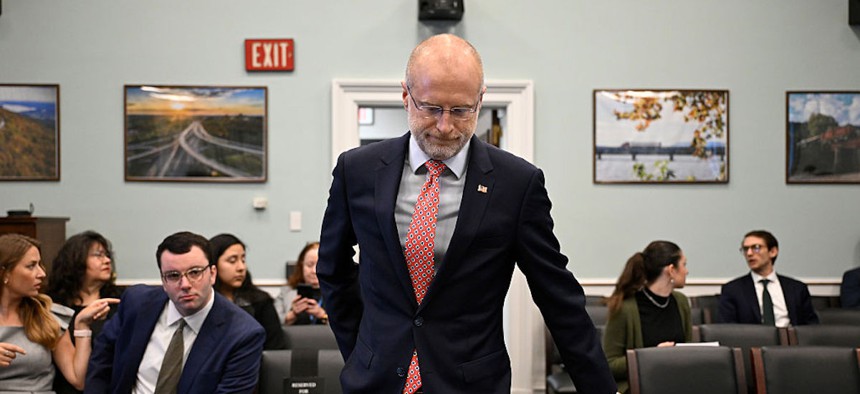
FCC Chairman Brendan Carr arrives to testify before the House Appropriations Subcommittee on Financial Services and General Government on May 21, 2025. Last June, Carr directed an internal FCC national security group to investigate discoveries about UL and other program administrators because of their potential ties to China. John McDonnell / Getty Images



It’s not immediately clear who would administer the program, which was launched under Biden to help designate cyber-secure consumer electronic devices.
UL Solutions, selected to lead a Biden-era Federal Communications Commission program for labeling consumer devices with a cybersecurity certification, has withdrawn as the program’s lead administrator amid a national security review launched last summer that examined the company’s alleged ties to China.
“We appreciate our ongoing discussions with the FCC about the future direction of the Lead Administrator role and the Program,” UL executive Chanté Maurio said in a statement filed to the FCC on Dec. 19. “Having now delivered many of the foundational elements of the Lead Administrator role and given other considerations, we respectfully submit our notice of withdrawal as Lead Administrator effective as of the date of this letter.”
The probe, launched under the Trump 2.0 FCC under Chairman Brendan Carr, came to light this past June. Carr directed an internal FCC national security group to investigate discoveries about UL and other program administrators because of their potential ties to China, including the presence of technology testing locations in the nation’s borders.
The cyber labeling program, known as the Cyber Trust Mark, was designed to certify consumer smart devices with a label that deems them cybersecure. The voluntary program officially launched a year ago after months of development during the Biden administration.
It’s not clear if the program will continue in its current state. It’s also unclear if the probe is ongoing and whether discoveries during the investigation influenced UL’s decision to withdraw from the labeling effort.
National security officials have long argued that technologies linked to China could pose surveillance and sabotage risks. Policy analysts often cite a 2017 Chinese law requiring domestic companies to assist state intelligence efforts, fueling concerns that firms operating with overseas units could be compelled to hand over their data to Beijing.
Nextgov/FCW has asked the FCC if it has picked a new firm to serve as lead administrator of the program.
Anne Neuberger, who was the deputy national security advisor for cybersecurity and emerging technology under Biden, disputed the investigation shortly after it was made public, arguing that UL has testing labs around the world and can be required to test equipment only outside of China.
“Using UL is the fastest and most effective way to change today’s insecure status quo, given it has consumers’ trust and a network of experienced labs who can start testing immediately to get secure [internet of things] devices into Americans’ hands,” she told Nextgov/FCW in June.