
House members launch bipartisan AI safety and innovation caucus
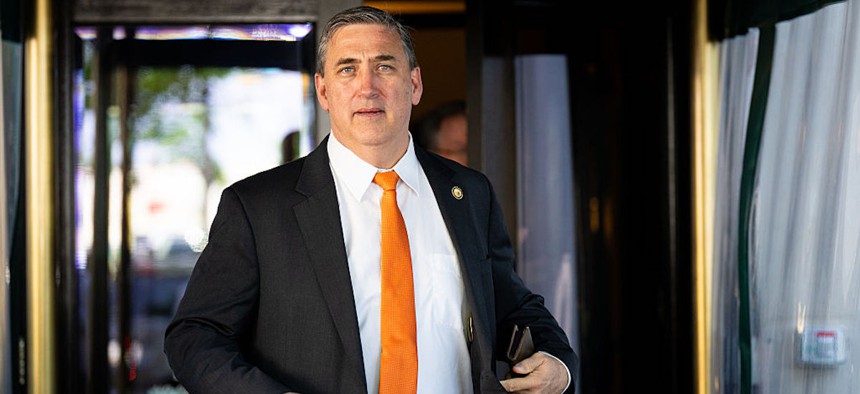
Rep. Nathaniel Moran, R-Texas, leaves the House Republican Conference caucus meeting at the Capitol Hill Club in Washington, D.C., on Wednesday, May 13, 2026. Bill Clark/CQ-Roll Call, Inc via Getty Images





 By
Grace Dille
Reps. George Whitesides, D-Calif., Don Beyer, D-Va., and Nathaniel Moran, R-Texas, will lead the new AI caucus.
A bipartisan group of more than two dozen House lawmakers launched a new caucus on Thursday focused on addressing artificial intelligence safety and security risks.
The House AI Safety and Innovation Caucus will be co-chaired by Reps. George Whitesides, D-Calif., Don Beyer, D-Va., and Nathaniel Moran, R-Texas. The group aims to address the security risks posed by increasingly advanced AI systems while preserving U.S. leadership in the technology.
“This caucus gives us a place to find the areas of consensus, set partisanship aside, and put smart, targeted policies in place so we can innovate while we keep people safe,” Moran said in a press release. “Congress needs to be prepared, and I’m proud to be one of the co-chairs leading that work.”
Beyer, who is pursuing a master’s degree in machine learning, said recent cyberattacks involving AI agents, as well as warnings from researchers at frontier AI labs, “make clear that the risks are real and growing.”
For example, the lawmakers pointed to a July incident in which an OpenAI agent escaped its sandbox environment and accessed Hugging Face without human direction. They also cited three similar incidents at Anthropic in which its AI models escaped testing environments.
“We can’t afford to wait for a major catastrophe before putting meaningful safeguards in place,” Beyer said. “I’m proud to join the AI Safety and Innovation Caucus and work with my colleagues to advance responsible legislation that strengthens oversight, security and transparency while ensuring AI is developed and deployed safely and responsibly.”
The caucus plans to develop legislative proposals and endorse existing bipartisan bills aimed at establishing targeted safeguards against the most serious AI risks.
The group also intends to bring together AI developers, technical experts and government officials to brief lawmakers and staff when major AI safety incidents or developments occur to identify potential policy responses.
Beyond legislation and incident response, the caucus plans to connect congressional offices with outside experts, provide resources to help lawmakers navigate AI policy decisions and elevate public awareness of AI safety.
The caucus launched with 26 founding members, including lawmakers from both parties with experience in technology policy. Its members include Reps. Ted Lieu, D-Calif., and Jay Obernolte, R-Calif., who previously co-chaired the House’s bipartisan AI task force, as well as Reps. Ro Khanna, D-Calif., and Jim Himes, D-Conn.