
Transportation looks to AI to accelerate its modernization initiatives
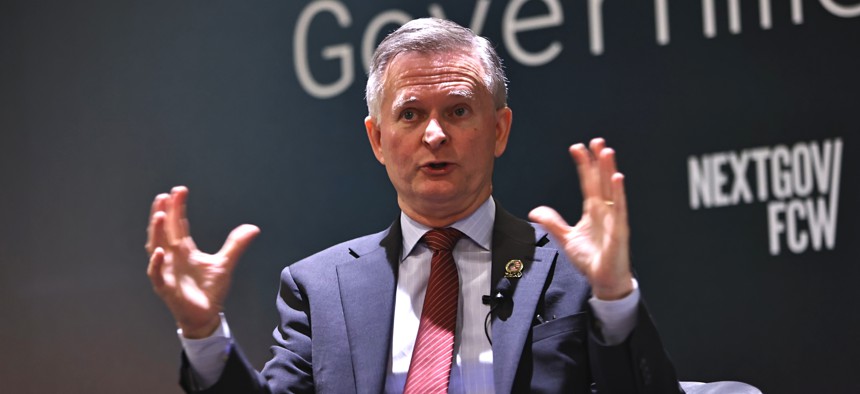
Transportation Deputy Secretary Steven Bradbury speaks at GovExec’s Government Efficiency Summit on July 16, 2026. Zaid Hamid/Nextgov/FCW




Steven Bradbury, the agency’s deputy secretary, said AI has helped Transportation slash its software production timeline from 18 months down to 18 weeks.
The Department of Transportation is ramping up its use of artificial intelligence, according to a top agency official, with the emerging capabilities playing an increasingly important role in the agency’s ongoing modernization efforts.
Speaking at GovExec’s Government Efficiency Summit on July 16, Transportation Deputy Secretary Steven Bradbury said internal adoption of the technologies has already helped to accelerate needed software upgrades, with growing workforce use of AI poised to further expand its impact on agency operations.
Transportation released its 1DOT IT strategy last September to help guide its digital infrastructure transformation, which includes a focus on modernizing and replacing its outdated systems.
Bradbury said uses of the emerging capabilities have already helped Transportation speed up its software production timelines from 18 months down to 18 weeks, noting that “when we have a need for new software applications, we can bring AI to bear to help.”
Agencywide experimentation with AI tools has also highlighted a broader range of potential benefits from the technologies, Bradbury said.
He cited internal figures that found that “80% of DOT people are now looking at the uses of AI,” and said current adoption of the capabilities highlights how the technologies can provide further benefits to the American people.
“We're using it in making our rulemaking faster, more effective,” Bradbury said. “We get tens of thousands of comments on the complicated rules that we issue. We need to be able to digest those quickly, understand them [and] respond to them. AI can obviously help with that. Similarly, reviewing hundreds and hundreds of grant applications to make the right decisions about which projects to support through our grantmaking — AI is going to be instrumental in helping us do that as well.”
Beyond internal uses of AI, the capabilities are also set to play a key role in the Trump administration’s broader push to upgrade the nation’s outdated air traffic control system. Transportation Secretary Sean Duffy announced the modernization effort in May 2025, saying at the time that the multi-billion dollar effort would include a modernized flight management system and updated ground radar systems at all U.S. airports.
Although Congress approved $12.5 billion for the modernization effort as part of the Big, Beautiful Bill, Bradbury said “we do need more” to finish the effort by the end of President Donald Trump’s second term.
He noted that the Federal Aviation Administration, which is overseeing the initiative, is already in the process of setting up a Strategic Management of Airspace, Routes and Trajectories — or SMART — system “to use all of the information available, [including] weather, what's going on at the ground [and] where airplanes are being prepared for takeoff across the whole system to know in advance what the conflict points are.”
The FAA announced last month that it awarded Air Space Intelligence a 12-year, $875 million contract for new software and artificial intelligence capabilities, including for the SMART system.
Bradbury said that “AI is going to be essential to make this happen.”