
sponsor content What's this?
One Citizen Record, Many Federal Missions

Presented by
Melissa Data
Presented by
Melissa Data
Citizen data changes; federal systems need to keep up to avoid costly gaps in identity verification
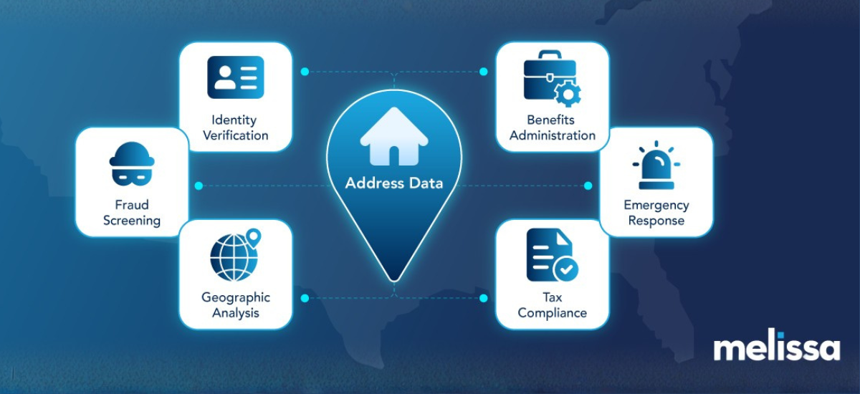
In modern government, a citizen address entered into a federal system may begin simply as contact information. But this data point rarely serves just one purpose and is often applied well beyond the application for which it was initially collected. An address can subsequently affect identity verification, benefits administration, fraud screening, geographic analysis, emergency communications, and all kinds of downstream processes and interactions.
Integrity of federal programs depends on keeping identity, eligibility, location, and life status data current and correct as circumstances change for each citizen. Federal agencies must recognize the continuous and connected life of citizen data and manage it accordingly.
Small errors acquire a “downstream cost”
A mistyped apartment number seems trivial at intake. Once propagated, however, the problem is no longer just a typo. It may produce returned correspondence, duplicate records, an identity mismatch, wasted staff time, or unreliable analytics. Fraud is another potential consequence, as stale eligibility information can generate improper payments, and identity gaps can be deliberately exploited by fraudsters.
Identity problems are a documented source of federal payment errors and intentional fraud; overall, both types of improper payments are estimated at ~$3 trillion since fiscal year 2003, including $186 billion for fiscal year 2025. GAO reported that federal programs acknowledged about $1.8 billion in FY2022 improper payments for which “identity” was included as one of several root causes. Moreover, GAO estimates direct federal fraud losses at roughly $233 billion to $521 billion annually, based on FY2018–2022 data.
A June 2026 GAO report similarly notes that SSA identity, citizenship, incarceration, disability, and death data are used by other agencies to verify eligibility for federal programs. The takeaway is that a citizen record isn't useful simply because it exists – its value depends on whether agencies can validate it against current, trusted information.
Data accuracy is a process
The cheapest place to validate and fix bad data is before it begins traveling. Regular data hygiene fulfills data maintenance needs by identifying moved or deceased individuals, duplicates, and outdated records. Point-of-entry validation, deduplication/matching, change-of-address updating, authoritative reference sources, and secure real-time services can all be integrated as part of your data quality framework. Melissa’s public sector data tools are accessible via its GovCloud™ Address Suite, a FedRAMP® Authorized set of cloud-based solutions. These tools validate and verify global addresses, geocode locations, and enable USPS® NCOALink® processing. That processing identifies and updates addresses of constituents who have moved within the last 48 months.
Melissa’s systems are SOC2 and HIPAA compliant and use 256-bit TLS encryption to protect personally identifiable information.
When agencies commit to ongoing data quality, they solve identity challenges for their intended application and help create a virtuous cycle of data quality. The result is a positive ripple effect of data excellence in federal operations.
Treat quality controls as part of federal IT architecture
Even perfectly entered information has a shelf life. People move, enter care facilities, live with family members, change households, become incarcerated, change eligibility status, and eventually die. Each is a life event that can make previously accurate government data obsolete. As circumstances change, records become duplicated and separate systems multiply the potential for error. More than 40 million Americans move annually, so verification cannot be treated as a one-time event. Data must be both captured and maintained, using tools that are seamless to federal processes.
Good federal data practice has two jobs: prevent bad information from entering systems and keep good information from becoming bad. Federal services are evolving and depend not only on better applications, but on trustworthy information moving through them. Every subsequent process inherits the quality of the data it receives, demonstrating the interconnected nature of citizen records. An error introduced anywhere in that lifecycle can create negative impact somewhere else entirely.
Avoid the Ripple Effect of Bad Data
Data collected for one purpose quickly becomes infrastructure for others, giving it a surprising life throughout federal operations.
An address may look like just one component of a database. In practice, it can serve as part of an identity check or determine where a benefits notice goes. It can also support geographic analysis, help detect suspicious activity, or determine whether an agency can reach someone at all. Understanding that something as mundane as address information can empower fraud and impact functions like national security, emergency response, and tax compliance can help prevent small inaccuracies from becoming much larger problems.
Melissa partners with Carahsoft, The Trusted Government IT Solutions Provider®, to help government agencies make informed decisions based on verified, enriched, and secure citizen data. Through Carahsoft’s reseller network and major public-sector contract vehicles, agencies can now more easily access Melissa’s FedRAMP®-authorized address management, data quality, and identity solutions. Whether the application is national security or tax compliance, Melissa and Carahsoft equip public servants to use data in new ways to better serve constituents.
This content is made possible by our sponsor Melissa Data; it is not written by and does not necessarily reflect the views of Nextgov/FCW's editorial staff.
NEXT STORY: Critical Minerals, Industrial Capacity, and National Security